

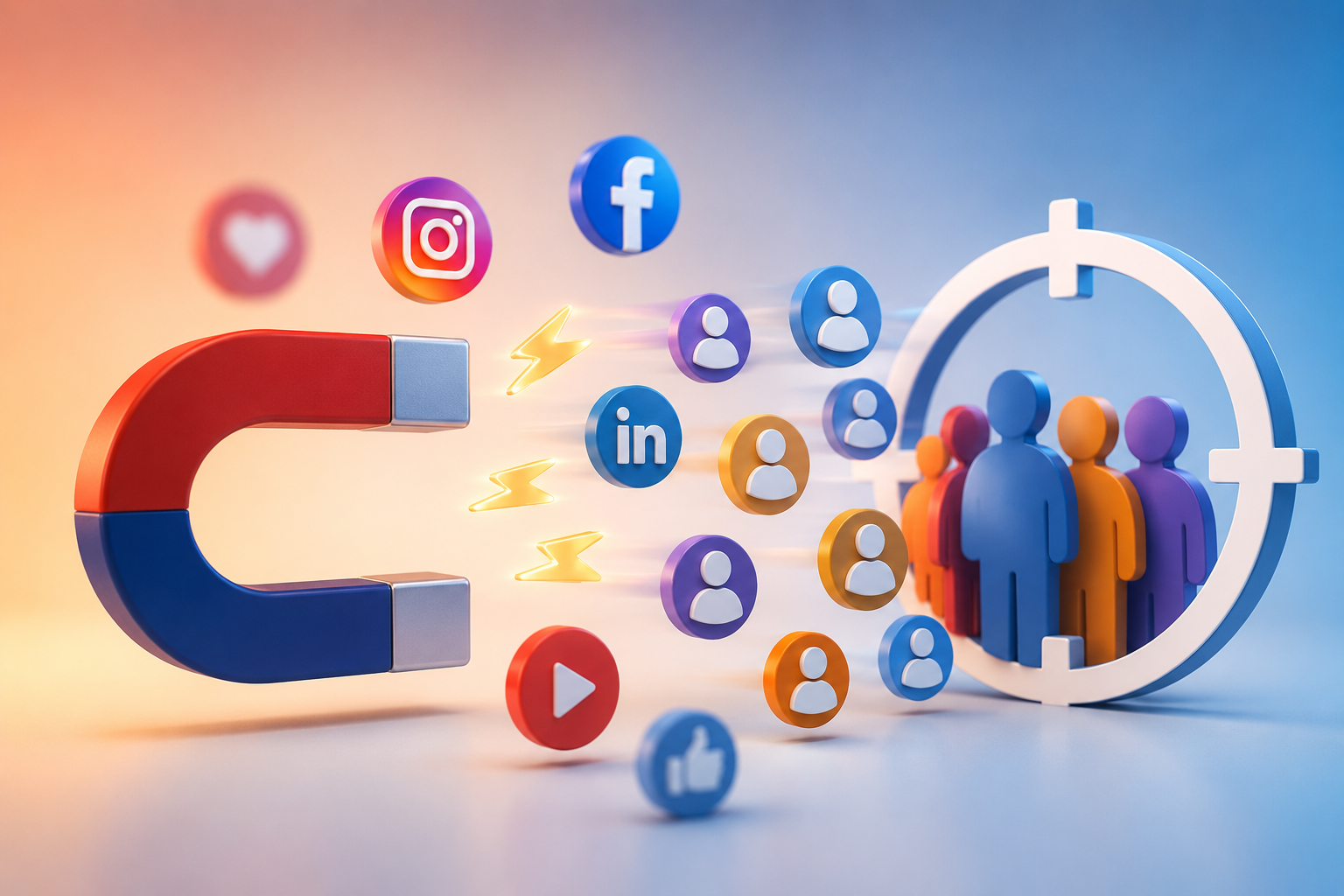
The Role of Social Media in Customer Acquisition

Social Media in Customer Acquisition

Social media has emerged as one of the most effective strategies for attracting new customers in today’s digital-first world. Platforms like Instagram, Facebook, LinkedIn, and YouTube provide direct access to your target audience, regardless of whether you’re a local company, startup, or well-known brand. Social media marketing is now necessary for long-term company growth, as billions of active users spend hours online each day.

How Social Media Helps Acquire New Customers

The process of attracting prospective consumers and turning them into paying customers is known as customer acquisition. This process is made easier by social media, which enables companies to engage with customers where they already spend their time.

1. Increases Brand Visibility

Getting noticed is the first step in acquiring new customers. Through influencer partnerships, reels, stories, targeted advertising, and captivating content, social media platforms assist brands in reaching a wider audience. Regular posting keeps your brand prominent and at the forefront of prospective buyers’ minds. Companies that keep up an active social media presence frequently increase trust and brand recognition.

2. Builds Trust and Credibility

Before making a purchase, modern customers investigate brands online. Credibility is established by a polished social media presence with insightful content, customer testimonials, reviews, and consistent interaction. When prospects see an active community interacting with your brand, they are more likely to trust your products or services.

3. Targets the Right Audience

Businesses can target particular demographics, interests, regions, and behaviors via social media marketing, in contrast to traditional advertising. This accuracy guarantees that your marketing budget is allocated to individuals who are actually interested in what you have to offer, which improves lead quality and boosts conversion rates.

4. Encourages Direct Engagement

Social media facilitates a two-way connection between consumers and brands. Businesses may respond to inquiries, resolve issues, and establish deep connections through comments, messages, surveys, and live sessions. This interaction frequently increases conversion rates and shortens the consumer journey.

5. Drives Website Traffic and Leads

You can direct them to your website, landing sites, or contact forms with every social media post. Calls to action that are strategically placed encourage consumers to find out more, get quotations, schedule consultations, or make purchases. Social media can become a reliable source of quality leads with the correct content strategy.

Why Social Media Marketing Matters for Local Businesses

Social media presents a special benefit for companies operating in the UAE and other regional marketplaces. With GEO-targeted ads, marketers can connect with local consumers who are looking for products and services. Businesses may interact with audiences who are most likely to convert by using location-based content, local hashtags, and tailored ads. Within particular locations, this localized strategy boosts visibility and consumer acquisition.

Why Choose Upswing Digital for Social Media Promotion?

At Upswing Digital, we think social media should produce more than just likes—it should produce consumers. To assist businesses in expanding online, our team creates platform-specific strategies that include creativity, audience data, and performance-driven advertising. In order to maximize return on investment, we manage advertising campaigns, develop brand profiles, produce interesting content, and regularly monitor performance. We prioritize quantifiable growth over vanity metrics and have expertise in social media marketing in UAE.

Conclusion

Social media has transformed the way businesses acquire customers. It offers a highly targeted, scalable, and reasonably priced way to raise brand awareness, generate leads, and boost sales. Businesses that invest in a strategic social media presence today are positioning themselves for long-term success tomorrow.

Upswing Digital can help in developing a personalized social media strategy that produces tangible business outcomes if you’re prepared to convert followers into devoted clients.

Frequently Asked Questions 

1. Which social media platform is most effective for gaining new clients?

The ideal platform will depend on your target market and type of business. LinkedIn is a great tool for acquiring B2B clients, but Instagram and Facebook are great for B2C companies. Finding the ideal platform combination for your objectives might be aided by an experienced social media marketing company.

2. How does social media help generate leads?

By boosting brand awareness, increasing website traffic, advertising deals, and promoting direct connections through messages, forms, and call-to-action buttons, social media helps produce leads.

3. Is social media marketing cost-effective for small businesses?

Yes, one of the most economical ways to do digital marketing is social media marketing. While engagement and visibility can improve within a few weeks, consistent lead generation and customer acquisition typically require a long-term approach of three to six months. 

4. How does Upswing Digital help businesses acquire customers through social media?

Upswing Digital creates customized social media strategies, engaging content, targeted advertising campaigns, and performance-driven marketing solutions designed to attract qualified leads and convert them into loyal customers.

How Small Brands Can Compete OnlinE in 2026

How small brands can compete online is one of the most common questions we hear from entrepreneurs, startup founders, and growing businesses. The challenge feels real  big companies have massive budgets, large teams, and years of brand recognition. How is a small brand supposed to stand a chance?

The honest answer is: better than you think.

The digital landscape has fundamentally changed the rules. With the right strategies, a small brand can out-market, out-connect, and out-engage a large corporation. In fact, there are areas where being small is a genuine advantage.

How Small Brands Can Compete Online: 9 Powerful Strategies to Beat Bigger Companies in 2026

In this blog, we break down 9 proven strategies that show exactly how small brands can compete online  and win.

1. Own a Specific Niche Instead of Competing Broadly

The biggest mistake small brands make is trying to appeal to everyone. Big companies can afford to cast a wide net small brands cannot, and should not try.

One of the most effective answers to how small brands can compete online is this: go narrower, not broader. Pick a specific niche, serve it exceptionally well, and become the go-to brand in that space.

A small bakery does not need to compete with every bakery in the country. It needs to be the best gluten-free bakery in its city. A digital marketing agency does not need to serve every industry  it can become the expert agency for real estate businesses or healthcare clinics.

How to find and own your niche:

•        Identify what you do better than anyone else in your market

•        Research underserved audience segments with specific problems

•        Position all your content, messaging, and services around that niche

•        Use niche-specific keywords in your SEO and content strategy

•        Build case studies and testimonials from within your niche

2. Use Local SEO to Dominate Your Area

If your business serves a specific geographic area, local SEO is one of the most powerful and cost-effective tools available to small brands. Big companies often neglect hyper-local optimisation because their focus is national or global. This is your opportunity.

How small brands can compete online through local SEO involves showing up in Google’s local search results, Google Maps, and local directories when nearby customers are searching for what you offer.

Local SEO essentials for small brands:

•        Complete and verify your Google Business Profile

•        Get listed in local directories like Justdial, Sulekha, and IndiaMart

•        Collect and respond to Google reviews consistently

•        Create location-specific pages or blog content targeting local keywords

•        Use schema markup to help search engines understand your business location

3. Build Authentic Brand Storytelling

Large corporations often struggle with one thing that small brands can do effortlessly: tell a real, human story. People connect with people, not with logos or corporate taglines.

Your journey as a founder, the problem that inspired your business, the challenges you have overcome, the values that drive your decisions these are stories that big brands simply cannot replicate. And they are stories that consumers increasingly want to hear.

This is a crucial part of how small brands can compete online. Authentic storytelling builds emotional connection, and emotional connection drives loyalty.

Where to tell your brand story:

•        Your About Us page  make it personal, not corporate

•        Instagram and LinkedIn posts sharing behind-the-scenes moments

•        Short-form video content showing the human side of your business

•        Email newsletters that feel like letters, not broadcasts

•        Customer testimonials that tell transformation stories

4. Leverage Social Media With Consistency Over Budget

Small brands often assume they cannot compete on social media because they do not have the budget for large-scale paid campaigns. But social media success is built on consistency and creativity, not just spending.

A brand that posts valuable, engaging content consistently five times a week will outperform a brand with a bigger budget that posts sporadically. The algorithm rewards regular engagement, and audiences reward brands that show up reliably.

Understanding how small brands can compete online through social media means choosing one or two platforms where your audience actually spends time, and mastering them before expanding.

Strategy Tip: Do not try to be everywhere at once. One platform done brilliantly is worth more than five platforms done poorly. Pick the platform where your ideal customer is most active and go deep.

Social media priorities for small brands:

•        Post consistently  aim for at least 4–5 times per week on your chosen platform

•        Use short-form video to reach new audiences organically

•        Engage genuinely in comments, DMs, and community conversations

•        Repurpose one piece of content across multiple formats to save time

•        Track what performs well and do more of it

5. Partner With Micro Influencers for Targeted Reach

Celebrity influencer deals are out of reach for most small brands. But micro influencers creators with between 10,000 and 100,000 highly engaged followers are not only affordable, they are often more effective.

Micro influencers have niche, loyal audiences who trust their recommendations. A single post from the right micro influencer can drive more genuine interest than a mass-market campaign from a mega influencer.

This is one of the smartest answers to how small brands can compete online: invest in relationships with 5 to 10 micro influencers in your niche instead of one expensive celebrity deal.

How to work with micro influencers effectively:

•        Identify influencers who already create content in your niche

•        Check engagement quality — comments and saves matter more than follower count

•        Offer free products, commissions, or modest fees in exchange for genuine reviews

•        Give them creative freedom — their audience trusts their authentic voice

•        Track results using custom discount codes or UTM links

6. Create Content That Actually Helps Your Audience

Content marketing is one of the greatest equalisers in digital marketing. A well-researched, genuinely helpful blog post, YouTube video, or Instagram carousel from a small brand can outrank and outperform content from a much larger competitor.

The key word is helpful. Content that educates, solves problems, and answers real questions builds trust and drives organic traffic over time. This is not about posting for the sake of posting it is about becoming a genuine resource for your target audience.

For small brands wondering how to compete online, content marketing offers long-term ROI that compounds a blog post written today can bring in leads two years from now.

Content ideas that work for small brands:

•        How-to guides and tutorials related to your product or service

•        FAQs that address the most common questions your customers ask

•        Behind-the-scenes content showing your process and people

•        Case studies and success stories from your customers

•        Industry insights and opinion pieces that position you as an expert

7. Use Paid Ads Smarter With Tight Targeting

Small brands often shy away from paid advertising because they assume they cannot compete with bigger budgets. But digital advertising  particularly on Meta (Facebook and Instagram) and Google  rewards smart targeting over sheer spend.

A small brand with a well-defined audience, a strong offer, and a compelling creative can achieve a better return on ad spend than a large company running broad, generic campaigns. Tight targeting means your budget goes further and reaches exactly the right people.

This is a critical part of how small brands can compete online: use the precision tools available in digital advertising to punch well above your budget weight.

Paid advertising tips for small brands:

•        Start with a small, well-targeted audience rather than casting a wide net

•        Retarget website visitors and social media engagers first  they already know you

•        Test 2–3 different ad creatives and let the data tell you what works

•        Focus on one clear offer per campaign avoid trying to say too much

•        Set a clear cost-per-result target and optimise toward it consistently

8. Build Community and Loyalty From Day One

Large companies spend millions trying to build brand loyalty. Small brands can do it organically  by creating genuine community around their brand from the very beginning.

When customers feel like they belong to something  a movement, a community, a shared identity  they become advocates. They refer friends, leave reviews, defend the brand online, and come back again and again without needing to be retargeted with ads.

Building community is one of the most powerful long-term strategies in how small brands can compete online. And it costs far more in effort than in money.

Ways to build brand community:

•        Create a WhatsApp group or Facebook Group for your most loyal customers

•        Reward referrals with exclusive discounts or early access to new products

•        Acknowledge and celebrate your customers publicly on social media

•        Ask for feedback genuinely and act on it visibly

•        Host events, webinars, or live sessions to deepen relationships

9. Deliver Customer Experience That Big Brands Cannot Match

Here is where small brands have an advantage that no amount of corporate budget can buy: the ability to deliver genuinely personal, responsive, and memorable customer experiences.

Big companies are slow, bureaucratic, and often impersonal. Small brands can respond to a customer query in minutes, personalise every interaction, remember returning customers by name, and go above and beyond in ways that leave a lasting impression.

When thinking about how small brands can compete online, never underestimate the power of exceptional service. Happy customers talk. And in the age of reviews and social media, word of mouth has never been more powerful.

Customer experience strategies for small brands:

•        Respond to every message, comment, and review within 24 hours

•        Personalise packaging, thank-you notes, or follow-up messages

•        Create a seamless, frustration-free purchase experience on your website

•        Follow up after purchase to check satisfaction and encourage reviews

•        Turn complaints into loyalty moments by resolving issues generously and quickly

Final Thoughts

Knowing how small brands can compete online comes down to one core truth: you do not need a bigger budget, you need a smarter strategy.

Big companies have resources, but they also have rigidity. They move slowly, communicate generically, and often lose sight of the individual customer. Small brands have the ability to be agile, authentic, personal, and laser-focused  and in the digital world, those qualities are priceless.

The 9 strategies outlined in this blog are not theoretical  they are the same approaches that are helping small and growing businesses across industries build real, sustainable competitive advantages online.

At Upswing Digital, we specialise in helping small and medium-sized brands build digital marketing strategies that compete and win against much larger players. If you are ready to stop playing small, we are ready to help.

The Growing Importance of Brand Transparency

Brand transparency has moved from being a nice-to-have quality to an absolute business necessity. In a world where information travels instantly, reviews are permanent, and audiences can fact-check any claim in seconds, the brands that hide behind polished messaging and corporate spin are losing ground fast.

Modern consumers — especially millennials and Gen Z — do not just want to buy from brands they like. They want to buy from brands they trust. And trust, in 2026, is built on one thing above all else: transparency.

In this guide, we explore what brand transparency really means, why it matters more than ever, and 7 powerful reasons why the most transparent brands are consistently winning more customers, more loyalty, and more growth.

What Is Brand Transparency?

Brand transparency is the practice of being open, honest, and clear with your audience about who you are, how you operate, what you stand for, and even where you fall short.

It means communicating authentically — not just sharing the successes but acknowledging the challenges. Not just promoting the product but explaining what goes into it. Not just stating company values but demonstrating them through real actions and decisions.

Brand transparency is not about sharing everything indiscriminately. It is about giving your audience the honest information they need to make informed decisions and build genuine trust in your brand.

7 Powerful Reasons Brand Transparency Is More Important Than Ever

What Brand Transparency Looks Like in Practice:

•        Being honest about product ingredients, sourcing, and manufacturing processes

•        Communicating pricing clearly without hidden fees or misleading comparisons

•        Acknowledging mistakes publicly and explaining what is being done to fix them

•        Sharing real customer reviews — including the critical ones — without selective filtering

•        Being open about company values and the actions taken to uphold them

•        Communicating changes to products, policies, or pricing honestly and in advance

Why Brand Transparency Matters More Than Ever in 2026

Several powerful forces have converged in recent years to make brand transparency not just desirable but essential for any business that wants to build a sustainable relationship with its audience.

Forces Making Brand Transparency Critical in 2026

•        Social media gives consumers the power to expose dishonesty instantly and publicly

•        Review platforms make brand reputation permanently visible and searchable

•        Younger consumers actively research brands before buying and reject those that feel inauthentic

•        AI tools make it easier than ever to fact-check brand claims in seconds

•        High-profile corporate scandals have made audiences deeply sceptical of polished brand messaging

•        The proliferation of AI-generated content has increased the value of genuine, human brand voices

In this environment, the cost of being caught being dishonest or evasive has never been higher. And the reward for genuine brand transparency has never been greater.

1. Brand Transparency Builds Deeper Customer Trust
Why Honesty Is the Foundation of Brand Trust

Trust is the most valuable asset any brand can possess — and brand transparency is the most direct route to building it. When a brand communicates honestly, acknowledges its limitations, and delivers on its promises consistently, the audience’s trust deepens with every interaction.

Conversely, brands that over-promise, obscure negative information, or communicate evasively are eroding trust with every deceptive message — even when those messages appear to succeed in the short term.

How Brand Transparency Builds Trust Specifically

•        Honest product descriptions set accurate expectations — reducing disappointment and returns

•        Transparent pricing eliminates the suspicion that the brand is hiding costs

•        Open communication about challenges shows the brand values the relationship over its image

•        Consistent honesty over time creates a track record that makes the brand reliably trustworthy

The Trust Compound Effect:

Trust built through brand transparency compounds over time. Each honest interaction reinforces the previous ones — creating a reservoir of goodwill that sustains the brand through difficult periods and makes customers far more forgiving when mistakes occur.

2. Transparent Brands Create Stronger Customer Loyalty
How Brand Transparency Turns Customers Into Advocates

Customer loyalty in 2026 is not built by reward points and discounts alone. It is built by the feeling that a brand genuinely respects its customers — treats them as intelligent adults, communicates with them honestly, and consistently delivers on what it promises.

Brand transparency creates this feeling. When customers feel that a brand is being straight with them — not just telling them what they want to hear — they develop a level of loyalty that goes far beyond transactional repeat purchases.

Why Transparency Creates Loyal Brand Advocates

•        Customers who trust a brand are significantly more likely to buy again without needing persuasion

•        Loyal customers are more forgiving of mistakes when a brand has a track record of honesty

•        Transparent brands attract customers who share their values — creating stronger emotional bonds

•        Customers who feel respected by a brand become its most vocal and authentic advocates

The Advocacy Multiplier:

A customer who is loyal because of genuine brand transparency does not just stay — they recruit. They recommend the brand to friends and family with a level of conviction that no advertising can manufacture, because their recommendation is rooted in real trust rather than promotional incentive. 

3. Brand Transparency Improves Crisis Management
Why Transparent Brands Survive Crises Better

Every brand, at some point, will face a crisis — a product failure, a customer service breakdown, a public mistake, or an external event that damages its reputation. How a brand responds in those moments determines whether it emerges stronger or weaker.

The brands that handle crises most effectively are almost always the most transparent ones. They have already built a reservoir of trust through consistent honesty — which means their audience is predisposed to extend them the benefit of the doubt when things go wrong.

The Transparent Brand’s Crisis Playbook

•        Acknowledge the problem quickly — silence in a crisis is interpreted as guilt

•        Take genuine responsibility without deflecting or making excuses

•        Explain clearly what happened and why — audiences appreciate honesty over spin

•        Communicate specifically what is being done to fix the problem

•        Follow up with real evidence that the issue has been addressed

The Contrast With Opaque Brands:

Brands that have not built a foundation of transparency face a far more difficult crisis response. Their audience has no trust reservoir to draw on — so any defensive or evasive response is immediately interpreted as dishonesty. Brand transparency is not just a good practice in good times. It is essential insurance for the difficult ones.

4. Transparency Attracts Better Employees and Partners
How Brand Transparency Strengthens Your Entire Business Ecosystem

Brand transparency does not just affect customer relationships. It shapes the quality of every relationship the brand has — including with its employees, suppliers, investors, and business partners.

People want to work for and with organisations they can trust. A brand that is transparent about its values, its challenges, its culture, and its goals attracts talent and partners who are aligned with that vision — and who are far more likely to contribute meaningfully to long-term success.

How Brand Transparency Attracts the Right People

•        Honest employer branding attracts candidates who genuinely fit the culture

•        Transparent communication of company goals aligns teams around shared purpose

•        Open acknowledgment of challenges creates an environment where problems are solved rather than hidden

•        Transparent partnerships built on clear expectations reduce conflict and misalignment

•        A reputation for integrity attracts suppliers and investors who value long-term relationships

The Culture Connection:

Internal brand transparency — honest communication within the organisation — creates a culture of accountability and trust that directly improves performance. The most transparent brands tend to have the most engaged, motivated, and productive teams.

5. Transparent Brands Generate More Authentic Word-of-Mouth
Why Brand Transparency Is the Most Powerful Marketing Tool

Word-of-mouth remains the most trusted and effective form of marketing available. And authentic word-of-mouth — the kind that comes from genuine customer satisfaction rather than incentivised referrals — is almost always rooted in brand transparency.

When customers feel that a brand has been honest with them, delivered on its promises, and treated them with respect, they talk about it. Not because they have been asked to, but because genuine positive experiences naturally generate genuine positive conversation.

How Brand Transparency Drives Word-of-Mouth

•        Honest brands set accurate expectations — which means customers are delighted rather than disappointed

•        Transparent brands give customers a real story to tell — not just a polished tagline to repeat

•        Brands that admit mistakes publicly often generate more positive sentiment than those that never make mistakes

•        Customers who feel aligned with a brand’s transparent values become passionate ambassadors

The Authenticity Premium:

In an era saturated with paid content, sponsored posts, and AI-generated reviews, genuinely authentic word-of-mouth from a real customer is extraordinarily valuable. Brand transparency is what generates this kind of authentic advocacy — and no marketing budget can replicate it.

6. Brand Transparency Strengthens Your Content Marketing
How Transparency Makes Content More Powerful

Content marketing built on brand transparency consistently outperforms content that feels promotional, evasive, or manufactured. Audiences are highly attuned to authenticity — and content that feels genuinely honest, even when it shares challenges or limitations, builds far deeper engagement than content that only presents a perfect brand image.

Transparent content gives audiences real information, real perspectives, and real stories — which is exactly what cuts through the noise of a saturated content environment.

Transparent Content Formats That Build Brand Authority

•        Behind-the-scenes content that shows the real process behind the brand’s products or services

•        Honest case studies that share both the successes and the challenges of client work

•        Founder stories that include the real struggles and failures alongside the achievements

•        Transparent pricing content that explains clearly what customers are paying for and why

•        Open responses to customer questions and criticisms — addressed publicly and honestly

Why Transparent Content Ranks Better:

Search engines and AI tools in 2026 prioritise content that demonstrates genuine expertise and authentic perspective. Transparent, experience-based content — content that shares real insights from real situations — is exactly what both algorithms and human readers are looking for.

7. Brand Transparency Drives Long-Term Business Growth
The Business Case for Brand Transparency

Beyond the ethical and reputational benefits, brand transparency has a measurable positive impact on long-term business growth. Transparent brands consistently outperform opaque competitors on the metrics that matter most — customer retention, lifetime value, referral rates, and brand equity.

This is because brand transparency creates compounding advantages. Every honest interaction builds trust. Every trust-building interaction deepens loyalty. Every loyal customer generates referrals. And every referral brings in a new customer who is already predisposed to trust the brand because of the recommendation they received.

Measurable Growth Benefits of Brand Transparency

•        Higher customer retention rates — transparent brands lose fewer customers to competitors

•        Greater customer lifetime value — loyal customers spend more over a longer relationship

•        Lower customer acquisition costs — word-of-mouth from loyal advocates reduces reliance on paid advertising

•        Stronger brand equity — a reputation for integrity commands premium pricing and market positioning

•        Greater resilience — transparent brands recover faster from setbacks because of their trust reserves

The Long Game:

Brands built on transparency may not always win the short-term conversion battle against more aggressively promotional competitors. But over months and years, they build a compounding advantage in trust, loyalty, and advocacy that eventually becomes very difficult for less transparent competitors to overcome.

How to Build Brand Transparency Into Your Marketing

Brand transparency is not a single campaign or a one-time statement. It is a consistent practice built into every aspect of how the brand communicates. Here is how to embed it effectively:

Step 1 — Audit Your Current Brand Communication

Review your existing marketing materials, website, and social media content. Where are you over-promising? Where are you being evasive? Where could you be more honest about what you offer, what you charge, and who you are? Identify the gaps between your brand communication and the reality your customers experience.

Step 2 — Share the Real Story

Start telling the genuine story of your brand — including the challenges, the learning experiences, and the imperfections. Audiences connect with real stories far more powerfully than polished corporate narratives. Your real story is a competitive advantage, not a vulnerability.

Step 3 — Communicate Proactively About Problems

When something goes wrong — a delivery delay, a product issue, a service failure — communicate proactively. Do not wait for customers to complain. A transparent, proactive communication about a problem consistently generates more goodwill than a reactive response to customer complaints.

Step 4 — Make Pricing and Process Clear

Hidden fees, confusing pricing structures, and opaque processes are among the most common sources of customer frustration and distrust. Make everything about how you charge and how you work as clear and simple as possible. Customers who understand exactly what they are getting and what they are paying are far more satisfied and far more loyal.

Step 5 — Respond to Criticism Publicly and Honestly

How a brand responds to negative reviews and public criticism reveals its true character. Responding honestly, taking responsibility where appropriate, and demonstrating a genuine commitment to improvement is one of the most powerful brand transparency signals available — and it is visible to every potential customer who reads the exchange.

Final Thoughts

Final Thoughts

The growing importance of brand transparency reflects a broader shift in consumer expectations. People no longer want to engage with brands that simply promote products and services — they want to understand the values, processes, and people behind them.

Transparency builds credibility, reduces uncertainty, and creates stronger emotional connections. In a marketplace where trust is often the deciding factor, brands that communicate openly and consistently gain a significant competitive advantage.

Whether it is being honest about pricing, sharing customer feedback, acknowledging mistakes, or providing clear information, transparency has become a key driver of long-term loyalty and business growth.

At Upswing Digital, we help brands create authentic digital experiences that strengthen trust and build meaningful relationships with their audiences. Through strategic content, brand positioning, and customer-focused communication, Upswing Digital helps businesses demonstrate transparency in ways that resonate with modern consumers.

Because in 2026, transparency is no longer a differentiator — it is an expectation. The brands that embrace openness today will be the ones that earn trust, foster loyalty, and achieve sustainable growth tomorrow.

How to Recover Website Traffic After a Google Core Update

Google Core Update

A sudden drop in website traffic after a Google core update can be frustrating for any business. One day your pages are ranking well, and the next, your organic traffic starts declining without warning. The good news is that a core update doesn’t mean your website has been penalized—it usually means Google has re-evaluated your content and rankings.

Recovering from a core update takes strategy, patience, and the right improvements. At Upswing Digital, we help businesses identify traffic drops, fix weaknesses, and build stronger SEO foundations for long-term growth.

What Is a Google Core Update?

Google core updates are broad algorithm changes designed to improve search result quality. Instead of targeting one issue, they reassess how websites perform based on content quality, relevance, trustworthiness, and user experience.

Recent core updates have placed stronger emphasis on:

  • Content depth and originality
  • Search intent satisfaction
  • E-E-A-T (Experience, Expertise, Authoritativeness, Trustworthiness)
  • Site performance and user experience
  • Topical authority
    This means websites with thin, outdated, or generic content often see ranking drops.

Step 1: Identify What Traffic You Lost

Before making changes, analyze the problem.

Check:

  • Which pages lost the most traffic
  • Which keywords dropped
  • Whether impressions dropped or just clicks
  • If competitors replaced your rankings

Use tools like Google Search Console and Analytics to compare performance before and after the update.

A common mistake is assuming the whole site is affected when only a few pages may have lost visibility. SEO experts recommend diagnosing page-level losses first.

Step 2: Audit Your Content Quality

Content quality is one of the biggest ranking factors after a core update.

Ask yourself:

  • Is the content original?
  • Does it provide real value?
  • Is it more useful than competitors’ content?
  • Does it answer the user’s intent clearly?

Google now favors content that demonstrates real-world experience and practical insights rather than generic information.

Improve by:

  • Updating outdated facts
  • Adding examples, statistics, and case studies
  • Expanding shallow sections
  • Improving readability

Sites that improved content depth and trust signals saw stronger recovery patterns after recent updates.

Step 3: Strengthen Topical Authority

One of the biggest recovery strategies is building topic clusters.

Instead of focusing only on the affected page:

  • Create supporting content around related topics
  • Link related articles internally
  • Build complete topic coverage

A recent Reddit SEO audit of 31 recovered websites found that improving surrounding content clusters and internal linking helped pages recover faster.

This tells us that Google values comprehensive topical expertise.

Step 4: Improve E-E-A-T Signals

E-E-A-T has become more important after every core update.

To strengthen it:

  • Add author bios
  • Showcase expertise and credentials
  • Include case studies and testimonials
  • Add trust signals like reviews and contact details
  • Cite reliable sources

Google wants users to trust the information they find.

If your website lacks authority signals, rankings may suffer.

Step 5: Fix Technical SEO Issues

Technical SEO may not directly cause a core update hit, but it affects user experience.

Check:

Technical FactorWhy It Matters
Page speedFaster sites improve engagement
Mobile usabilityGoogle uses mobile-first indexing
Broken linksImpacts crawlability
Core Web VitalsImportant for user experience
Crawl errorsPrevent pages from indexing properly

Recent SEO recovery guides highlight that Core Web Vitals and site performance continue to influence rankings.

Step 6: Re-Evaluate Search Intent

Sometimes traffic drops because search intent has changed.

For example:

  • Informational content may now need deeper guides
  • Commercial content may need stronger comparisons
  • Local searches may prioritize location-based results

Study the new top-ranking pages and compare:

  • Content format
  • Depth
  • User intent
  • Keyword targeting

Match what users now expect.

Step 7: Monitor and Be Patient

Core update recovery doesn’t happen overnight.

Most recoveries take 3 to 6 months, and in some cases until the next core update.
Track:

  • Rankings
  • Organic traffic
  • Click-through rates
  • Conversion performance

Avoid making too many random changes at once.

Conclusion

A Google core update traffic drop is not the end of your SEO growth. It’s an opportunity to improve your website and build stronger authority.

Focus on:

  • Better content
  • Stronger E-E-A-T
  • Improved technical SEO
  • Better internal linking
  • User-first optimization

At Upswing Digital, we specialize in helping businesses recover from algorithm updates and create long-term SEO strategies that drive sustainable growth. If your website has lost traffic, now is the time to audit, improve, and rebuild smarter.

7 Powerful Ways FOMO Influences Online Purchases (And How Brands Use It)

FOMO — the Fear of Missing Out — is one of the most powerful psychological forces shaping consumer behaviour online today.

It drives impulse purchases, accelerates decision-making, and turns hesitant browsers into committed buyers. And the brands that understand how FOMO influences online purchases are using it deliberately, strategically, and with remarkable results.

In this guide, we explore the psychology behind FOMO, how it shapes buying behaviour, and 7 powerful ways brands are using it to drive more sales — along with how to apply these tactics ethically in your own marketing. 

What Is FOMO and Why Does It Influence Online Purchases?

FOMO — Fear of Missing Out — is the anxious feeling that others are experiencing something rewarding or valuable that you are not part of. In a consumer context, it is the feeling that a great deal, a popular product, or an exclusive experience will be gone before you can take advantage of it.

FOMO influences online purchases because the internet has made social comparison instantaneous and constant. Consumers can see — in real time — what others are buying, what they are enjoying, and what they might be missing.

This constant visibility creates a psychological pressure that traditional offline shopping never generated. And brands that understand this pressure can design experiences that harness it to drive action.

FOMO by the Numbers:

•        Over 60% of millennials report making reactive purchases because of FOMO

•        Nearly 70% of social media users experience FOMO regularly

•        FOMO-driven purchases are made faster and with less deliberation than standard purchases

•        Scarcity and urgency messaging consistently increases conversion rates across industries

7 Powerful Ways FOMO Influences Online Purchases (And How Brands Use It)

The Psychology of FOMO in Consumer Behaviour

Why FOMO Is Such a Powerful Purchase Driver

FOMO taps into two of the most deeply wired human psychological drives: loss aversion and social belonging.

Loss aversion — the tendency to feel the pain of losing something more acutely than the pleasure of gaining something equivalent — means that the prospect of missing a deal feels worse than the prospect of getting it feels good. This asymmetry makes FOMO an exceptionally powerful motivator.

Social belonging — the need to feel included, accepted, and part of a group — means that seeing others enjoy something you do not have creates genuine psychological discomfort. Online, this discomfort is constantly amplified by social media.

How FOMO Overrides Rational Decision-Making

•        It compresses the decision timeline — reducing deliberation and increasing impulse

•        It shifts focus from price to availability — making scarcity more important than cost

•        It activates emotional rather than logical thinking — bypassing careful evaluation

•        It creates a sense of urgency that feels externally imposed rather than brand-generated

1. Limited-Time Offers and Countdown Timers

How Time Scarcity Drives FOMO in Online Purchases

Limited-time offers are one of the most direct and effective ways that FOMO influences online purchases. By attaching a deadline to a deal, brands transform a casual browsing decision into an urgent, time-sensitive choice.

Countdown timers make this urgency visual and undeniable. Every second that ticks away is a reminder that the opportunity is disappearing — and the brain responds with heightened attention and accelerated decision-making.

How to Use Limited-Time Offers Effectively

•        Display a visible countdown timer on product pages, landing pages, and in emails

•        Make the deadline specific and real — vague urgency is less effective than a precise end time

•        Use language that reinforces the time constraint — ‘Ends tonight’, ‘Only 3 hours left’

•        Send reminder emails and notifications as the deadline approaches

•        Honour the deadline — extending offers repeatedly destroys credibility and trust

Platform Application:

Instagram Stories and WhatsApp Status updates are ideal for time-limited offers because they disappear after 24 hours — creating a natural, built-in urgency that the platform itself reinforces.

2. Low Stock and Scarcity Signals

How Product Scarcity Triggers FOMO and Accelerates Purchases

Scarcity is one of the oldest and most reliable psychological triggers in marketing. When something is rare or running out, we want it more — regardless of whether we actually needed it moments before.

Online retailers use scarcity signals to communicate that a product’s availability is limited — triggering the fear that if the consumer does not act now, they will lose the opportunity entirely.

Effective Scarcity Signals for Online Purchases

•        Low stock indicators — ‘Only 4 left in stock’ displayed on product pages

•        Sold out labels on similar products — showing that demand exceeds supply

•        Limited edition product launches with a fixed, finite quantity

•        Waitlists and pre-order queues that signal high demand and limited access

•        Real-time inventory counters that update as stock decreases

The Credibility Rule:

Scarcity signals only work when they are genuine. False scarcity — claiming limited stock when inventory is actually abundant — damages trust severely when discovered. Use scarcity messaging only when it accurately reflects reality.

3. Social Proof and Real-Time Activity Notifications

How Seeing Others Buy Triggers FOMO in Online Shopping

Social proof is the psychological phenomenon where people look to the behaviour of others to guide their own decisions. Online, this manifests as reviews, ratings, testimonials — and increasingly, real-time notifications showing what other shoppers are doing right now.

Notifications like “23 people are viewing this product” or “Priya from Mumbai just purchased this” are powerful FOMO triggers. They signal that others have already made the decision — creating social pressure to follow.

Social Proof Formats That Amplify FOMO

•        Live visitor counts on product pages showing real-time demand

•        Recent purchase notifications displayed on e-commerce sites

•        Review counts and star ratings that signal widespread adoption

•        User-generated content showing real customers enjoying the product

•        Social media share counts demonstrating the content’s popularity

Why This Works:

When we see that others have already made a decision, the perceived risk of making the same decision decreases dramatically. Combined with FOMO, social proof creates a powerful double trigger — the fear of missing out amplified by the evidence that others are already benefiting.

 4. Exclusive Access and Members-Only Offers

How Exclusivity Creates the Most Powerful Form of FOMO

Exclusivity takes FOMO to its most potent level. While time-based and scarcity-based FOMO says the opportunity is running out, exclusivity-based FOMO says the opportunity was never available to everyone in the first place.

Being part of an exclusive group — early access members, VIP customers, loyalty programme subscribers — creates a sense of privilege and belonging that most people find deeply motivating.

Exclusivity Tactics That Drive Online Purchases

•        Early access launches for email subscribers before public sale

•        VIP or loyalty tiers with access to products and deals unavailable to the general public

•        Invite-only communities or membership programmes

•        Pre-launch waitlists that create anticipation and a sense of earned access

•        Members-only pricing that makes non-members feel they are missing a significant benefit

Building the Exclusivity Ladder:

The most effective exclusivity strategies create a progression — free subscribers get early access, paid members get exclusive products, premium members get personalised experiences. Each tier creates FOMO for the tier above it, continuously driving upgrades and deeper engagement.

5. Flash Sales and Unannounced Drops

How Surprise Urgency Supercharges FOMO

Flash sales and product drops combine time scarcity, product scarcity, and surprise into a single, high-intensity FOMO event. Unlike planned sales, flash sales and drops are often unannounced or announced with minimal notice — creating an immediate, urgent response.

The unpredictability is a feature, not a bug. Consumers who have missed previous drops become hyper-attentive to brand communications, never wanting to miss the next one. This trains audiences to stay engaged and act quickly.

How to Run a High-Impact Flash Sale or Product Drop

•        Announce with minimal notice — 2 to 6 hours creates maximum urgency

•        Use all available channels simultaneously — email, WhatsApp, Instagram Stories, push notifications

•        Keep the sale window genuinely short — no extensions

•        Make the offer meaningfully compelling — deep discounts or genuinely exclusive products

•        Follow up with those who missed out — building anticipation for the next drop

The Anticipation Build:

Some brands combine surprise drops with subtle teaser campaigns — cryptic social media posts, mysterious countdowns — that build anticipation without revealing specifics. This amplifies FOMO before the event even begins.

 6. Influencer and Peer-Driven FOMO

How Social Influence Amplifies FOMO in Online Purchases

When someone we admire, follow, or identify with is seen using or enjoying a product, the desire to have that same experience is immediate and powerful. Influencer marketing is, at its core, a FOMO machine — it creates a continuous stream of aspirational content that makes audiences want what the influencer has.

Peer-driven FOMO is even more powerful. While we may dismiss celebrity endorsements, seeing a friend, colleague, or community member enjoying something creates a much more personal and urgent desire to participate.

How Brands Leverage Influencer and Peer FOMO

•        Partner with influencers whose audience closely matches your target customer

•        Encourage user-generated content that shows real customers enjoying your product

•        Create referral programmes that incentivise customers to share with their network

•        Feature customer stories and testimonials prominently across all touchpoints

•        Build community spaces where customers naturally share their experiences with others

Micro-Influencer Advantage:

Micro-influencers with smaller but highly engaged audiences often generate stronger FOMO than major celebrities. Their recommendations feel more personal and believable — making the resulting FOMO feel more genuine and urgent.

7. How to Use FOMO Ethically in Your Marketing

The Difference Between Ethical FOMO and Manipulative Tactics

FOMO is an extraordinarily powerful marketing tool — and with that power comes responsibility. There is a clear line between ethical FOMO marketing, which communicates genuine scarcity and real urgency, and manipulative tactics, which manufacture false pressure to deceive consumers into buying.

Crossing that line does not just risk regulatory consequences — it destroys the trust that is the foundation of any long-term brand relationship.

Principles of Ethical FOMO Marketing

•        Only use scarcity messaging when stock or availability is genuinely limited

•        Only use countdown timers for offers with real, fixed end dates

•        Never fabricate social proof — real-time notifications should reflect actual activity

•        Be transparent about why an offer is limited or exclusive

•        Honour every deadline and constraint you communicate to your audience

Why Ethical FOMO Builds Long-Term Brand Strength

Brands that use FOMO ethically build a reputation for exclusive, high-value experiences. Their audience trusts that when they say an offer is limited, it genuinely is — which makes every future FOMO trigger more powerful and more effective.

Brands that manufacture false FOMO may see short-term conversion spikes, but they erode the trust that sustains long-term customer relationships. The short-term gain is never worth the long-term cost.

The Ethical FOMO Framework:

•        Is the scarcity or urgency real? If yes, communicate it clearly.

•        Does the offer provide genuine value? If yes, the FOMO serves the customer.

•        Would you be comfortable if the customer knew exactly how this tactic works? If yes, proceed.

Final Thoughts

FOMO influences online purchases in ways that are deep, consistent, and remarkably predictable. It bypasses deliberate thinking, compresses decision timelines, and transforms hesitant browsers into committed buyers.

The brands that understand this psychology — and apply it honestly and creatively — have a genuine competitive advantage. They create marketing experiences that do not just inform or entertain, but genuinely move people to act.

Whether through limited-time offers, scarcity signals, exclusive access, or influencer partnerships, ethical FOMO marketing is one of the most reliable tools available to any brand looking to increase conversions and drive meaningful growth.

At Upswing Digital, we help brands leverage consumer psychology strategically and responsibly, creating campaigns that drive action while building long-term trust.

Use it well. Use it honestly. And watch what happens when your audience genuinely does not want to miss what you have to offer.

Because the most effective marketing is not about creating pressure — it is about creating value that people genuinely want to be part of. Through data-driven strategy, engaging content, and audience-first campaigns, Upswing Digital helps brands turn attention into action and interest into lasting growth.

Use it well. Use it honestly. And watch what happens when your audience genuinely does not want to miss what you have to offer.

The Science Behind Digital First Impressions

Digital first impressions and online consumer behaviour

First impressions happen faster than most businesses realize. Before a customer reads your content, understands your services, or explores your products, they have already started forming opinions about your brand. In today’s digital environment, these judgments happen within seconds.

A website design, loading speed, social media presence, typography, colors, messaging, and even small interface details can instantly influence how people perceive a business online.
And once those first impressions are formed, changing them becomes difficult.

In 2026, digital first impressions are no longer only about aesthetics. They directly influence:

  • Trust
  • Engagement
  • Credibility
  • Customer decisions
  • Conversion rates

This is why brands are investing heavily in user experience, branding psychology, and digital behavior research to better understand how audiences react online.

Because in many cases, your digital presence speaks before your business ever does.

Why First Impressions Matter So Much Online

Human brains are designed to process information quickly.

When people visit a website or interact with a brand online, the brain immediately begins making rapid judgments based on visual and emotional cues.

Within moments, users subconsciously decide:

  • Does this brand look trustworthy?
  • Does this feel professional?
  • Is this relevant to me?
  • Should I continue exploring?

These decisions happen almost automatically.

The digital world moves extremely fast, and consumers are constantly comparing brands, experiences, and content. This means businesses often have only a very short window to capture attention and build confidence.

A poor first impression can quietly push potential customers away before meaningful engagement even begins.

The Psychology Behind Digital Perception

Digital first impressions are strongly connected to psychology.

People naturally associate visual quality and smooth experiences with professionalism and reliability. A clean, modern, and organized digital experience creates confidence, while cluttered or outdated designs often create hesitation.

Several psychological factors influence online perception, including:

  • Visual hierarchy
  • Simplicity
  • Color psychology
  • Familiarity
  • Emotional response
  • Cognitive ease

When digital experiences feel intuitive and effortless, users are more likely to trust and engage with the brand.

Complex or confusing experiences create mental friction, which often leads to higher bounce rates and lower conversions.

1. Website Design Shapes Instant Brand Perception

Website design is often the first major interaction consumers have with a brand.

Modern audiences quickly judge businesses based on:

  • Layout quality
  • Visual consistency
  • Typography
  • Spacing
  • Image quality
  • Mobile responsiveness

A professional design creates the feeling that the business itself is credible and trustworthy.

On the other hand, outdated or cluttered websites can create doubts even if the actual product or service is excellent.

This is why design is not just about aesthetics — it directly impacts business perception.

2. Speed Strongly Influences User Trust

Consumers expect digital experiences to feel fast and effortless.

Even small delays in loading time can negatively impact perception. Slow websites often create frustration and reduce confidence in the brand.

Fast-loading experiences communicate:

  • Professionalism
  • Efficiency
  • Reliability
  • Modern technology standards

In 2026, website performance has become part of branding itself.

People may not consciously analyze loading speed, but they emotionally respond to the experience almost immediately.

3. Visual Consistency Builds Familiarity

Consistency is one of the strongest drivers of recognition and trust.

When branding feels consistent across:

  • Websites
  • Social media
  • Emails
  • Advertisements
  • Landing pages

audiences experience a smoother and more reliable brand interaction.

Repeated exposure to the same visual identity helps businesses become more memorable over time.

Inconsistent branding, however, can create confusion and weaken trust subconsciously.

4. Emotional Reactions Influence Decision-Making

Most online decisions are not purely logical.

Emotions play a major role in how people respond to digital experiences. Colors, imagery, messaging tone, storytelling, and visuals all influence emotional perception.

A calming, confident, or inspiring experience can increase engagement significantly.

This is why strong digital experiences often feel emotionally intentional rather than purely functional.

Brands that understand emotional design create stronger customer connection and loyalty.

5. Simplicity Improves Cognitive Ease

Consumers process simple experiences faster.

When websites and digital platforms feel easy to navigate, users experience less mental effort. This creates what psychologists call cognitive ease — the feeling that something is clear, understandable, and trustworthy.

Complicated interfaces often create confusion and increase abandonment rates.

Modern users prefer:

  • Clear navigation
  • Simple layouts
  • Easy-to-read content
  • Smooth interactions
  • Predictable user flows

Simplicity is not about removing creativity. It is about reducing unnecessary friction.

6. Mobile Experience Shapes Modern First Impressions

In many industries, the first interaction with a brand now happens on mobile devices.

This means mobile design quality directly impacts digital first impressions.

Consumers expect:

  • Fast mobile loading
  • Responsive layouts
  • Easy navigation
  • Thumb-friendly interfaces
  • Clear readability

A poor mobile experience can immediately reduce trust and engagement.

As mobile usage continues growing, businesses that neglect mobile optimization risk damaging customer perception from the very beginning.

7. Authenticity Is Becoming Part of Digital Design

Modern consumers are increasingly drawn toward authentic and human-centered digital experiences.

Overly corporate or artificial experiences can sometimes feel disconnected.

Brands are now focusing more on:

  • Real photography
  • Human storytelling
  • Transparent communication
  • Authentic messaging
  • Relatable experiences

This creates stronger emotional connection and trust.

In 2026, authenticity itself has become a major part of digital first impressions.

Mistakes That Hurt Digital First Impressions

Many businesses unintentionally create poor first impressions online without realizing it.

Some common issues include:

• Slow-loading websites
• Cluttered layouts
• Outdated design styles
• Weak mobile optimization
• Generic stock imagery
• Confusing navigation
• Inconsistent branding
• Overwhelming pop-ups and distractions

Even small usability problems can impact trust significantly because users make judgments so quickly online.

The Future of Digital First Impressions

As digital experiences become more advanced, customer expectations will continue increasing.

AI personalization, immersive interfaces, voice interactions, and interactive experiences are already changing how people interact with brands online.

But despite these technological shifts, one thing remains constant:
People still make emotional judgments extremely quickly.

The businesses that succeed in the future will be the ones creating digital experiences that feel:

  • Trustworthy
  • Human
  • Seamless
  • Relevant
  • Emotionally engaging

Because digital first impressions are no longer only visual — they are experiential.

Final Thoughts & Conclusion

Digital first impressions have become one of the most powerful factors influencing modern consumer behavior.

In just a few seconds, people form opinions about a brand’s credibility, professionalism, trustworthiness, and relevance. These perceptions shape whether users continue exploring or leave entirely.

Today, businesses are not only competing on products or pricing — they are competing on experience. A fast, clear, emotionally engaging, and user-friendly digital presence can quietly build trust before a customer even speaks to your business.

At Upswing Digital, we believe a strong digital presence is more than good design — it is about creating an experience that immediately communicates confidence and credibility.

And in 2026, that first impression often determines everything that follows. Because online, perception happens instantly, and trust begins long before conversion.

The brands that succeed are the ones that understand this shift and intentionally build digital experiences that feel seamless, authentic, and memorable. Through strategic branding, web design, and user-focused digital experiences, Upswing Digital helps businesses create first impressions that turn visitors into loyal customers.

The Future of Influencer Marketing for Small and Medium Businesses

Future of Influencer Marketing

Influencer marketing has evolved from a trend into one of the most powerful digital marketing strategies for businesses of all sizes. What was once dominated by celebrities and big-budget campaigns is now becoming more accessible, measurable, and effective for small and medium businesses (SMBs).

In 2026, influencer marketing is no longer just about brand awareness. It has shifted toward trust, niche targeting, and performance-driven results. Industry reports show that micro and nano influencers are now outperforming larger creators in engagement and ROI, making them ideal partners for growing businesses.
For small and medium businesses, this shift opens up exciting opportunities to compete with larger brands in a more affordable and authentic way.

Why Influencer Marketing is Becoming More Important

Consumers today trust people more than advertisements. Traditional ads often feel intrusive, while influencer content feels natural and relatable.

This is why influencer marketing works:

  • Builds trust faster
  • Reaches niche audiences directly
  • Creates authentic product awareness
  • Generates user-driven content
  • Improves conversion rates

Recent consumer studies indicate that 64% of people are more likely to buy when brands collaborate with creators they follow regularly.

For SMBs, this means influencer partnerships can directly impact sales—not just visibility.

The Rise of Micro and Nano Influencers

One of the biggest changes in influencer marketing is the shift away from celebrity influencers.

Today, micro-influencers (10K–100K followers) and nano-influencers (under 10K followers) are leading the market because:

  • They have stronger audience trust
  • Their engagement rates are higher
  • They cost much less
  • Their followers are more niche-focused

In many cases, businesses get better results by partnering with five smaller creators instead of one large influencer. Community discussions and industry benchmarks consistently point to this trend.
For local brands and startups, this makes influencer marketing more budget-friendly than ever.

Long-Term Partnerships Will Replace One-Time Promotions

The future of influencer marketing is not about single sponsored posts. It’s about long-term creator relationships.

Businesses are now focusing on:

  • Monthly content collaborations
  • Product ambassador programs
  • Long-term storytelling campaigns
  • Repeated audience exposure

This builds stronger trust because audiences see creators genuinely using products over time. Research and brand case studies show long-term creator relationships are outperforming one-off campaigns in retention and conversion.
For SMBs, this approach helps build consistency and stronger brand recall.

Performance-Based Influencer Marketing is Growing

One major trend shaping the future is performance-based influencer partnerships.

Instead of paying just for a post, brands now pay based on:

  • Website clicks
  • Leads generated
  • Sales conversions
  • Affiliate commissions
  • Coupon code usage

This makes influencer marketing more measurable and less risky for small businesses.

With better tracking tools available, businesses can now clearly see which influencers are delivering actual results. Experts across marketing communities are highlighting ROI-based creator campaigns as the new standard.

Short-Form Video Will Continue to Dominate

Short-form videos like Instagram Reels, YouTube Shorts, and TikTok videos are shaping the future of influencer campaigns.

Why?

Because they:

  • Capture attention quickly
  • Feel more organic
  • Have higher engagement
  • Are easier to share

LinkedIn’s recent push into creator-led video advertising shows that even B2B platforms are embracing video-first influencer content.

For SMBs, short-form content offers a cost-effective way to increase reach and engagement.

AI Will Change How Brands Find Influencers

Artificial intelligence is becoming a major part of influencer marketing.

AI tools now help businesses:

  • Find relevant influencers
  • Analyze audience quality
  • Detect fake followers
  • Measure campaign ROI
  • Predict engagement performance

This makes it easier for small businesses to find the right creators without wasting budget.

According to recent industry reports, AI-driven creator matching and performance tracking are becoming essential parts of influencer campaigns in 2026.

Social Commerce Will Make Influencers More Powerful

Social media is no longer just for engagement—it’s becoming a direct sales channel.

Platforms like Instagram, TikTok, and YouTube now support:

  • Product tagging
  • In-app shopping
  • Affiliate links
  • Live shopping events

This allows influencers to drive purchases directly without sending users outside the platform.

This trend is expected to make influencer marketing even more effective for e-commerce brands and local sellers.

How Small Businesses Can Prepare for the Future

To stay ahead, small and medium businesses should:

  • Focus on niche influencers
  • Prioritize authenticity over follower count
  • Invest in video-based campaigns
  • Build long-term creator relationships
  • Track campaign performance carefully
  • Use AI tools for better influencer selection

Businesses that adapt early will have a major advantage in the coming years.

Conclusion

The future of influencer marketing is becoming smarter, more affordable, and more results-driven. For small and medium businesses, this is good news. You no longer need huge budgets to compete with bigger brands.

By choosing the right creators, focusing on authentic storytelling, and measuring performance, influencer marketing can become one of the most valuable growth strategies for your business.

At Upswing Digital, we help businesses build powerful influencer marketing strategies that connect brands with the right audience, increase engagement, and drive real business growth.

The future of marketing is personal—and influencer marketing is leading the way.

How Consumer Behaviour Is Changing in 2026

Consumer behaviour 2026 looks nothing like it did just a few years ago. Rapid advances in AI, a post-pandemic mindset, economic pressure, and an explosion of digital touchpoints have fundamentally changed the way people discover, evaluate, and purchase products and services.

For digital marketing agencies and brands, understanding these shifts is not optional; it is the difference between campaigns that connect and campaigns that miss entirely.

In this blog, we explore 8 critical changes in consumer behaviour in 2026 and what they mean for your marketing strategy.

Consumer Behaviour 2026: 8 Powerful Shifts Every Smart Marketer Must Know
1. The Rise of AI-Assisted Buying Decisions

One of the most defining shifts in consumer behaviour 2026 is how artificial intelligence has entered the purchase journey. Consumers now routinely use AI tools to research products, compare options, read reviews, and even get personalized recommendations before they ever visit a brand’s website.

Search itself has changed. A growing number of consumers now use conversational AI tools as their primary research method rather than traditional search engines. This means brands must optimize for AI-generated answers and conversational queries, not just traditional keywords.

What this means for marketers:

•        Create content that directly answers specific questions your audience is asking

•        Focus on authority, accuracy, and depth – AI tools surface the most credible sources

•        Structure content clearly so it can be easily extracted and cited by AI assistants

•        Optimise for long-tail, conversational search queries

2. Trust Has Become the New Currency

In 2026, consumer trust is harder to earn and faster to lose than ever before. Years of data breaches, misleading advertising, and influencer scandals have made audiences deeply sceptical of brand claims.

Consumers now demand proof. Reviews, testimonials, case studies, user-generated content, and third-party endorsements carry far more weight than polished brand messaging. In fact, according to recent research, over 85% of consumers trust peer reviews as much as personal recommendations.

This shift in consumer behaviour 2026 is reshaping how brands must communicate. Authenticity is no longer a nice-to-have – it is a conversion requirement.

Key trust signals consumers look for:

•        Real customer reviews on Google, Trustpilot, or industry platforms

•        Transparent pricing and clear refund or return policies

•        Behind-the-scenes content showing the human side of your brand

•        Consistent brand voice across all touchpoints

•        Data privacy compliance and clear cookie/data usage policies

3. Short-Form Video Is Now the First Point of Discovery

Short-form video has moved from entertainment to the primary discovery channel for a vast segment of consumers. Platforms like Instagram Reels, YouTube Shorts, and TikTok are now where people first encounter brands, products, and services.

The consumer behaviour 2026 pattern looks like this: a user sees a product in a 30-second video, visits the brand profile, reads comments, checks the website, and makes a purchase  often all within the same session. The funnel has compressed dramatically.

Key Insight: Brands that do not have a short-form video presence in 2026 are effectively invisible to a significant portion of their potential customers.

How to leverage short-form video:

•        Post consistently on at least one short-form video platform

•        Lead with value in the first 2–3 seconds or you lose the viewer

•        Showcase products in real-use scenarios, not studio shoots

•        Use trending audio and formats to reach new audiences organically

•        Include a clear but natural call to action in every video

4. Value-Conscious Spending Is the New Normal

Economic pressures across global markets have made consumers more deliberate and value-driven in their purchasing decisions. This does not necessarily mean they are spending less  it means they are spending more thoughtfully.

Consumers in 2026 are asking harder questions before buying: Is this worth it? What makes this brand better than the alternative? Will this purchase improve my life in a tangible way?

For brands, this shift in consumer behaviour 2026 demands clearer value propositions, stronger proof of quality, and messaging that speaks to outcomes rather than features.

Practical strategies for value-conscious audiences:

•        Lead with outcomes and benefits, not just product features

•        Offer comparison content that honestly positions your product

•        Use social proof to validate pricing  reviews, before-and-after results

•        Consider bundling or loyalty rewards to increase perceived value

•        Be transparent about what sets you apart from competitors

5. Hyper-Personalisation Is Now Expected

Generic marketing messages no longer cut through. Consumers in 2026 have been conditioned by platforms like Netflix, Spotify, and Amazon to expect experiences that feel tailored specifically to them.

Hyper-personalisation in consumer behaviour 2026 means delivering the right message, to the right person, on the right platform, at the right moment. Brands that fail to personalise risk being ignored entirely.

The good news is that advances in marketing automation and AI make personalisation more accessible than ever, even for small and mid-sized businesses.

Pro Tip: Segment your email list and social audiences based on behaviour, not just demographics. A customer who browsed a product three times needs a different message than a first-time visitor.

Ways to implement personalisation:

•        Dynamic email content based on past purchase or browsing behaviour

•        Retargeting ads that show products a user has already expressed interest in

•        Personalised landing pages for different audience segments

•        Behaviour-triggered SMS or WhatsApp messages

•        AI-powered product recommendations on your website

6. Social Commerce Is Replacing Traditional E-Commerce

The line between social media and online shopping has all but disappeared in 2026. Consumers now expect to discover, evaluate, and purchase products without ever leaving their social media app.

Instagram Shopping, Facebook Shops, TikTok Shop, and Pinterest Product Pins have created seamless purchase journeys that reduce friction and increase impulse buying. This shift in consumer behaviour 2026 has massive implications for how brands structure their digital presence.

Brands that are not set up for social commerce are missing an increasingly significant portion of online sales.

Getting started with social commerce:

•        Set up Instagram and Facebook Shops with your full product catalogue

•        Tag products directly in Reels, Stories, and feed posts

•        Partner with creators to showcase products via TikTok Shop

•        Make the checkout process as seamless as possible  every extra step loses customers

•        Use user-generated content featuring your products as shoppable posts

7. Sustainability Is a Purchase Criterion, Not a Buzzword

Environmental and social values have moved from nice-to-have positioning into actual purchase criteria for a growing segment of consumers. In 2026, especially among younger demographics, sustainability is no longer just appreciated, it is expected.

However, consumer behaviour 2026 also shows a sharp rise in ‘greenwashing’ scepticism. Vague sustainability claims without evidence actively damage brand credibility. Consumers want specifics, not slogans.

How to communicate sustainability authentically:

•        Share specific, measurable sustainability commitments and progress

•        Highlight ethical sourcing, production processes, or packaging choices

•        Partner with recognised environmental or social certifications

•        Feature employee and supplier stories that humanise your supply chain

•        Avoid vague terms like ‘eco-friendly’ without backing them up with data

8. Community Belonging Drives Long-Term Loyalty

One of the most underestimated shifts in consumer behaviour 2026 is the growing importance of community. Consumers no longer just want to buy from a brand — they want to belong to something.

Brands that have built active communities through Facebook Groups, Discord servers, WhatsApp communities, or exclusive memberships are seeing dramatically higher retention rates and customer lifetime value.

When a consumer feels like they are part of a group with shared values and identity, switching to a competitor becomes emotionally costly, not just financially costly.

Building a brand community in 2026:

•        Create a dedicated space for customers to connect with each other and your brand

•        Share exclusive content, early access, or insider information with community members

•        Feature community members in your content to build belonging

•        Listen actively , community feedback is the most valuable market research you can get

•        Host live events, Q&As, or virtual meetups to deepen relationships

What This Means for Your Marketing Strategy

Understanding consumer behaviour 2026 is only useful if it drives action. Here is how to translate these 8 shifts into a practical marketing roadmap:

11. Audit your content – does it answer real questions your audience is typing into AI tools and search engines?

12. Build trust assets – invest in review generation, case studies, and transparent communication

13. Go all-in on short-form video – even one platform done well will outperform zero

14. Sharpen your value proposition – can a new visitor understand why you are the right choice in 10 seconds?

15. Segment and personalise – use your existing data to speak more specifically to different audience groups

16. Set up social commerce -reduce friction between discovery and purchase

17. Back up your sustainability claims with evidence

18. Start building community –  even a small, engaged community is an enormous competitive advantage

Final Thoughts

Consumer behaviour 2026 is defined by one overarching truth: people have more choices, more information, and higher expectations than at any point in history. The brands that thrive will be the ones that genuinely understand their audience and meet them where they are.

This is not about chasing every trend. It is about identifying which of these shifts are most relevant to your audience and doubling down on those with consistency and authenticity.

At Upswing Digital, we help brands navigate exactly these kinds of changes, turning consumer insights into campaigns that drive real, measurable growth. By combining strategy, creativity, and data-driven decision-making, Upswing Digital empowers businesses to adapt to evolving consumer expectations and build stronger connections with their audiences.

The future belongs to brands that listen, learn, and evolve. Those that understand changing consumer behaviour today will be the ones leading their industries tomorrow.

Why Simplicity Wins in Modern Branding

Simplicity in modern branding is one of the most misunderstood concepts in marketing. Many businesses associate simplicity with being plain, unambitious, or creatively limited.

In reality, simplicity is one of the hardest things to achieve and one of the most powerful brand advantages available. The world’s most recognised, trusted, and valuable brands are almost universally built on simple foundations — a clear identity, a focused message, and an effortless experience.

In this guide, we explore what simplicity in modern branding really means, why complexity is costing brands more than they realise, and 7 powerful reasons why the simplest brands consistently outperform the complicated ones. 

7 Proven Ways Simplicity in Branding Builds Stronger, More Trusted Businesses

What Is Simplicity in Modern Branding?

Simplicity in modern branding is not about being minimal for the sake of aesthetics. It is about clarity — the ability to communicate who you are, what you do, and why it matters in a way that is instantly understood by the right audience.

A simple brand has a focused identity. It knows exactly who it serves, what problem it solves, and what makes it different. It communicates that identity consistently across every touchpoint — without confusion, without contradiction, and without clutter.

Simplicity is not the absence of depth. It is the disciplined expression of depth in the clearest possible way.

What Simplicity in Modern Branding Looks Like:

•        A brand name and tagline that immediately communicates value

•        A visual identity that is distinctive, clean, and instantly recognisable

•        A core message that can be understood in a single sentence

•        A product or service offering that is focused rather than sprawling

•        A consistent brand experience across every customer touchpoint

Why Complexity Is Hurting Your Brand

Most brands do not set out to be complicated. Complexity accumulates gradually — a new product line added here, a new target audience pursued there, a new brand message crafted for a specific campaign that never quite gets retired.

Over time, this accumulation creates a brand that tries to be everything to everyone — and ends up being nothing in particular to anyone. Audiences cannot understand what the brand stands for. Customers cannot decide whether it is right for them. And the team cannot communicate consistently because there is no clear north star to follow.

Signs Your Brand Has a Complexity Problem

•        Your team struggles to explain what your brand does in one clear sentence

•        Your visual identity has evolved inconsistently across different platforms and materials

•        Your messaging changes significantly depending on who is writing it

•        Customers frequently misunderstand what your business offers

•        Your website tries to appeal to too many different audiences simultaneously

•        New team members take a long time to understand how to represent the brand

1. Simple Brands Are Easier to Remember
How Simplicity in Modern Branding Drives Brand Recall

The human brain is not designed to retain complexity. It remembers things that are clear, distinctive, and easily categorised. A brand that is simple — visually, verbally, and conceptually — is a brand the brain can file away efficiently and retrieve quickly when the need arises.

Think of the most recognised brands in the world. Their logos are simple. Their taglines are short. Their core proposition can be stated in a single sentence. This is not coincidence — it is the result of deliberate simplicity applied as a brand strategy.

Why Simple Brands Win the Memory Game

•        Simple visual identities are processed faster and stored more effectively in memory

•        Short, clear brand names are easier to recall than long or complex ones

•        Focused brand messages create stronger mental associations than broad, generic ones

•        Consistent simplicity across every touchpoint reinforces memory through repetition

The Recall Advantage:

When a customer is ready to make a purchase decision, the brand they think of first has a massive advantage. Simplicity in modern branding is the most reliable route to becoming the brand that comes to mind first — because simple things are remembered and complex things are forgotten.

2. Simplicity Builds Trust Faster

Why Simple Brands Feel More Trustworthy

Complexity signals uncertainty. When a brand’s messaging is convoluted, its visual identity is inconsistent, or its offering is difficult to understand, the audience’s subconscious response is scepticism. If the brand cannot explain itself clearly, how can it be trusted to deliver clearly?

Simplicity in modern branding communicates confidence. A brand that presents itself cleanly and clearly is signalling that it knows exactly what it does, who it serves, and why it is the right choice — without needing to bury that message in unnecessary complexity.

How Simplicity Accelerates Trust Building

•        Clear messaging removes ambiguity — the audience immediately understands the value proposition

•        Consistent visual identity signals reliability and attention to detail

•        A focused offering suggests genuine expertise rather than scattered generalism

•        Straightforward communication respects the audience’s time and intelligence

Trust as a Business Asset:

In markets where audiences have many choices, trust is often the deciding factor. Simplicity in modern branding builds trust faster than complexity ever can — because clear, honest communication is the foundation that all trust is built on. 

3. Simple Messaging Converts Better
The Conversion Power of Simplicity in Modern Branding

Every extra word in a marketing message is a reason for the audience to stop reading. Every additional element on a landing page is a reason for the visitor to feel overwhelmed. Every unnecessary step in a customer journey is an opportunity for the prospect to abandon the process entirely.

Simple messaging removes these friction points. When a customer can immediately understand what is being offered, what it costs, and what they need to do next — they convert at significantly higher rates than when they have to work to extract that information.

Simplicity Principles That Improve Conversion Rates

•        Lead with a single, clear headline that communicates the core benefit immediately

•        Use one primary call to action per page — not multiple competing options

•        Remove every element that does not directly contribute to the conversion goal

•        Write in plain, direct language that your audience uses naturally

•        Reduce the number of steps required to complete a purchase or enquiry

The Cognitive Load Principle:

Every element a user must process on a page adds to their cognitive load. When cognitive load becomes too high, the brain defaults to inaction. Simplicity in modern branding reduces cognitive load — making the decision to act feel easy rather than effortful.

4. Simplicity Creates a Stronger Visual Identity
Why Simple Visual Brands Are More Distinctive

In a world of visual noise, the brands that stand out are almost never the ones with the most complex visual identities. They are the ones with the most distinctive, immediately recognisable design systems — built on a small number of carefully chosen elements used with extraordinary consistency.

A simple visual identity — a strong logo, a defined colour palette, consistent typography — is infinitely more scalable and recognisable than a complex one. It works at every size, on every medium, and in every context without losing its integrity.

Elements of a Simple and Powerful Visual Brand Identity

•        A logo that works in black and white as well as in full colour

•        A colour palette of 2 to 3 primary brand colours used consistently across all touchpoints

•        A typography system of 1 to 2 typefaces that express the brand’s personality clearly

•        A consistent visual style for photography and illustrations that reinforces brand character

•        White space used deliberately to give the brand room to breathe and communicate clearly

The Scalability Test:

A great simple brand identity works on a business card and on a billboard. It works in a social media profile picture and on a shop front. If your visual identity loses its clarity at small sizes or in simple formats, it is probably too complex.

5. Simple Brands Scale More Effectively
How Simplicity in Modern Branding Enables Growth

One of the most practical advantages of simplicity in modern branding is the ease with which simple brands can scale. A clear brand identity, a focused message, and a consistent visual system can be applied by any team member, across any medium, in any market — without losing its integrity.

Complex brands, by contrast, are fragile. They break down when applied by different team members, across different platforms, or in different cultural contexts. Maintaining consistency requires constant supervision and correction — which consumes time and resources that should be directed toward growth.

How Simple Brands Scale Without Losing Identity

•        Brand guidelines that are simple enough for any team member to understand and apply

•        Messaging frameworks that can be adapted for different audiences without changing the core

•        Visual systems that work across digital, print, packaging, and environmental applications

•        A core brand story that translates naturally across different markets and cultures

•        Content templates built on the brand’s simple identity that can be produced efficiently at scale

The Franchise Test:

A useful question for any brand considering its complexity is: could a new team member in a different city represent this brand accurately after reading a single page of guidelines? If the honest answer is no — the brand is too complex to scale effectively.

6. Simplicity Reduces Decision Fatigue for Customers
The Psychology of Choice and Simplicity in Modern Branding

One of the most well-documented phenomena in consumer psychology is decision fatigue — the deterioration of decision quality that occurs when people are faced with too many choices. The more options a brand presents, the harder the customer has to work to make a decision — and the more likely they are to walk away without making one at all.

Simplicity in modern branding addresses this directly. By offering a focused, clearly defined product or service — rather than an overwhelming array of options — simple brands make it easier for customers to choose, commit, and feel confident in their decision.

How Simplicity Reduces Decision Fatigue

•        A focused product range eliminates the paralysis of too many options

•        Clear pricing with minimal tiers removes confusion and speeds up decision-making

•        Streamlined purchase journeys reduce the number of decisions required to complete a transaction

•        Consistent messaging eliminates contradictions that force customers to reconcile conflicting information

•        Simple onboarding processes make it easy for new customers to get started quickly

The Paradox of Choice in Practice:

Research consistently shows that offering fewer, better-curated options leads to higher conversion rates and greater customer satisfaction than offering more choices. Simplicity is not limiting for the customer — it is liberating. It removes the burden of over-analysis and makes the right choice feel obvious.

How to Apply Simplicity in Modern Branding

Simplicity in modern branding is not achieved by removing things arbitrarily. It is achieved by making deliberate, disciplined decisions about what to keep, what to remove, and what to focus on. Here is a practical framework:

Step 1 — Clarify Your Core Brand Purpose

What does your brand exist to do? Who does it serve? What problem does it solve? Reduce these answers to their clearest, most essential form. Everything in your brand should express this purpose — and anything that does not should be questioned.

Step 2 — Simplify Your Core Message

Can you explain what your brand does in a single sentence that a ten-year-old could understand? If not, keep refining. The simplest brands have the clearest core messages — and those messages are the foundation of every piece of communication they produce.

Step 3 — Audit and Streamline Your Visual Identity

Review every element of your visual identity. Does each element serve a clear purpose? Is your colour palette focused? Is your typography consistent? Is your logo versatile? Remove or simplify anything that adds visual complexity without adding meaning.

Step 4 — Focus Your Offering

Consider whether your product or service range is focused enough. The most powerful brands are often associated with one thing they do extraordinarily well — not ten things they do adequately. Reducing complexity in your offering is often the most impactful simplicity decision a brand can make.

Step 5 — Create Clear Brand Guidelines

Document your simplified brand identity in clear, concise guidelines that any team member can understand and apply. Simple brands need simple guidelines — not 100-page documents that nobody reads. The goal is clarity, not comprehensiveness.

Final Thoughts

Final Thoughts & Conclusion

Simplicity in modern branding is a choice — and it is one of the most courageous and impactful choices a brand can make. In a world that rewards noise, complexity, and constant stimulus, choosing clarity takes genuine discipline.

But the brands that make that choice consistently — that resist the temptation to add more, say more, and complicate more — are the ones that build the strongest identities, the deepest trust, and the most loyal audiences. At Upswing Digital, we believe the most effective brands are not those that communicate the most, but those that communicate the clearest.

Simple is not small. Simple is not plain. Simple is powerful — because it is the only way to be genuinely clear. And in a world where clarity is rare, a brand that communicates with purpose and simplicity stands out effortlessly from every competitor around it.

Strip back the complexity. Find the essential truth of your brand. And build everything from there. Through strategic branding, clear messaging, and audience-focused communication, Upswing Digital helps businesses create memorable brand experiences that are simple, impactful, and built for long-term growth.

Why Brands That Educate Their Audience Grow Faster

Most consumers today do not want to be sold to constantly. They want brands that help them learn, solve problems, and make better decisions.

That’s why educational marketing has become one of the biggest growth strategies in modern business.

Instead of focusing only on promotions and advertisements, successful brands are creating content that teaches audiences something useful. Whether it’s through blogs, videos, guides, podcasts, webinars, or social media content, educational marketing helps brands build trust before asking for a sale.

And in 2026, trust has become one of the most valuable assets a brand can have.

The Shift From Selling to Educating

Years ago, marketing was mostly about visibility. Brands focused on getting attention through advertisements and promotions.

Today, consumers behave differently.

Before making decisions, people research extensively. They compare products, watch reviews, read blogs, and look for expert opinions online. Customers want to feel informed before they buy anything.

This change in consumer behavior is why educational content performs so strongly. When brands consistently provide valuable insights, audiences begin seeing them as trusted experts instead of companies simply trying to sell products.

Over time, that trust turns into stronger engagement, customer loyalty, and higher conversions.

Why Educational Content Builds Stronger Trust

Educational marketing works because it creates value before asking for anything in return.

When a brand helps people understand a problem, learn a new skill, or make smarter decisions, it naturally creates credibility. Consumers begin associating that brand with expertise and reliability.

Unlike aggressive sales messaging, educational content feels helpful instead of intrusive.

Modern audiences appreciate brands that:

  • Answer real questions
  • Simplify complex topics
  • Share useful insights
  • Provide practical solutions
  • Help customers make informed choices

The more value brands provide consistently, the stronger the relationship becomes.

1. Educational Brands Become Industry Authorities

One of the biggest advantages of educational marketing is authority building.

When businesses consistently publish high-quality educational content, they position themselves as experts within their industry.

This could include:

  • Detailed blogs
  • How-to videos
  • Industry reports
  • Case studies
  • Podcasts
  • Tutorials
  • Webinars

Over time, audiences begin trusting these brands as reliable sources of information.

And in competitive markets, trust often becomes the deciding factor between brands offering similar products or services.

Brands using educational marketing to grow faster


2. Educational Content Improves Long-Term SEO Growth

Educational marketing also plays a major role in organic visibility.

When people search online, they are usually looking for answers, solutions, or information. Brands that create educational content aligned with those searches naturally attract more organic traffic over time.

Instead of relying only on paid ads, educational brands continuously generate visibility through:

  • Blogs
  • FAQs
  • Tutorials
  • Guides
  • Video explainers

This creates sustainable traffic growth while improving brand awareness at the same time.

Educational content also tends to remain relevant longer compared to short promotional campaigns.

3. Customers Feel More Confident Before Purchasing

Consumers are more likely to buy when they fully understand a product or service.

Educational marketing reduces uncertainty by helping people:

  • Understand benefits clearly
  • Compare options
  • Learn how products work
  • See practical applications
  • Solve real problems

When audiences feel informed, they make decisions with greater confidence.

This is especially important in industries where customers need time before making purchasing decisions.


4. Educational Marketing Creates Better Audience Engagement

People naturally engage more with content that teaches them something useful.

Instead of scrolling past advertisements, audiences spend more time interacting with:

  • Helpful videos
  • Step-by-step guides
  • Industry insights
  • Educational social posts
  • Problem-solving content

This increased engagement helps brands build stronger relationships with their audience over time.

In many cases, educational content also generates more shares because people enjoy sharing useful information with others.

5. It Makes Brands Feel More Human

Modern consumers connect more with brands that feel authentic and approachable.

Educational content allows companies to communicate in a more human way instead of sounding overly promotional or corporate.

Through educational marketing, brands can:

  • Share experiences
  • Explain ideas simply
  • Showcase expertise naturally
  • Build conversations with audiences

This creates stronger emotional connection and relatability.

In 2026, human-centered communication is becoming more important than polished advertising.

6. Educational Brands Build Stronger Customer Loyalty

Educational marketing does not stop after a customer makes a purchase.

Many successful brands continue educating customers through onboarding content, tutorials, newsletters, and ongoing insights.

This helps customers:

  • Get better results
  • Use products more effectively
  • Stay engaged with the brand
  • Feel supported after purchasing

As a result, educational brands often create stronger customer retention and long-term loyalty.

7. Educational Content Supports Every Marketing Channel

One of the biggest strengths of educational marketing is versatility.

A single educational idea can be repurposed into:

  • Blog articles
  • Instagram posts
  • LinkedIn carousels
  • YouTube videos
  • Podcasts
  • Email newsletters
  • Webinars
  • Short-form video clips

This allows brands to maintain consistency across multiple platforms while continuously providing value to audiences.

Educational content becomes the foundation of a stronger long-term marketing strategy.

Common Mistakes Brands Make With Educational Marketing

While educational marketing can be highly effective, many brands still approach it incorrectly.

Some common mistakes include:

• Making educational content too sales-focused
• Using overly technical language
• Creating generic content without real value
• Publishing inconsistently
• Prioritizing quantity over quality

The goal of educational marketing is not simply to produce content — it is to genuinely help the audience.

Consumers can quickly recognize when content is created only to drive sales instead of providing meaningful value.

The Future of Marketing Is Value-Driven

The digital world is becoming increasingly crowded. Consumers are exposed to thousands of advertisements every day.

Because of this, attention is shifting toward brands that provide real value instead of constant promotion.

Educational marketing works because it aligns with what modern audiences actually want:

  • Clarity
  • Insight
  • Guidance
  • Solutions
  • Expertise

Brands that consistently educate their audience are not just gaining visibility — they are building trust, authority, and long-term relationships.

And those relationships ultimately drive sustainable growth.

Final Thoughts & Conclusion

The fastest-growing brands today are not always the loudest ones.

They are the brands that help people learn, understand, and make better decisions.

Educational marketing is powerful because it changes the relationship between brands and consumers. Instead of interrupting audiences with advertisements, educational brands become trusted sources of value and insight.

In 2026, consumers expect more than products and promotions. They expect brands to guide them, inform them, and help them solve problems. At Upswing Digital, we believe the most effective marketing starts with delivering genuine value before asking for anything in return.

That is why brands that educate their audience continue to grow faster, build stronger communities, and create deeper customer loyalty. Through strategic content, thought leadership, and audience-focused storytelling, Upswing Digital helps businesses position themselves as trusted industry resources.

Because when people learn from a brand, they begin to trust it.

And trust is what drives long-term growth.