

WhatsApp Marketing Automation for Small Businesses in Kerala
For many small businesses, customer conversations begin on WhatsApp. A potential customer may ask about pricing, enquire about a service, request an appointment or look for product details. However, when several enquiries arrive at once, responding to everyone on time can become challenging.
This is where WhatsApp marketing automation can make a difference. By combining automated replies, customer segmentation, scheduled follow-ups and lead management, businesses can create a more organised customer communication process without relying entirely on manual work.
For businesses in Kerala, adopting a structured WhatsApp strategy can help improve customer experiences, manage enquiries efficiently and support long-term growth.

What Is WhatsApp Marketing Automation?
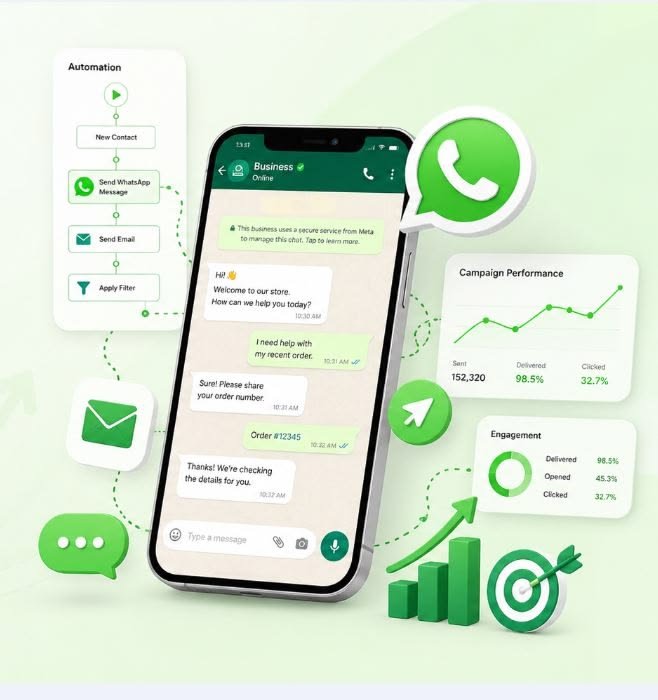
WhatsApp marketing automation uses messaging tools and predefined workflows to manage customer interactions on WhatsApp. Instead of manually handling every repetitive task, businesses can automate selected conversations based on customer actions, enquiry types and communication preferences.
For example, when someone enquires about a service, an automated message can acknowledge the enquiry and ask a few relevant questions. The system can then direct the conversation to the appropriate team member for further assistance.
Depending on the platform and setup, businesses can use automation for:
- Instant replies to incoming enquiries
- Frequently asked questions about products and services
- Lead qualification and customer segmentation
- Appointment confirmations and reminders
- Follow-up messages and customer updates
- Customer support and feedback collection
- CRM integration and lead tracking
The objective of WhatsApp marketing automation is not to replace meaningful conversations. It is to reduce repetitive work so that teams can focus on customers who need personal assistance.
Why Small Businesses in Kerala Should Consider WhatsApp Automation
1. Respond to Enquiries More Consistently
Customers often contact businesses outside regular working hours or when employees are occupied. An automated acknowledgement can confirm that the enquiry has been received and explain what happens next.
For example, a training institute in Kochi could automatically acknowledge course enquiries and ask whether the person is interested in online or classroom training.
A team member can then handle detailed questions and guide the prospect towards enrolment.
2. Improve Lead Follow-Up
Generating enquiries is only one part of the sales process. Businesses also need a consistent way to follow up with interested prospects.
With WhatsApp marketing automation, businesses can create suitable follow-up workflows for people who have requested information but have not completed the next step.
A follow-up sequence might include:
- An initial acknowledgement of the enquiry
- Relevant information about the requested service
- A reminder about an appointment or consultation
- A final check-in offering further assistance
Messages should be useful, appropriately timed and based on customer consent. Avoid sending repeated promotional messages that customers have not agreed to receive.
3. Reduce Repetitive Customer Support Tasks
Many businesses answer the same questions every day, such as opening hours, service availability, delivery options and appointment procedures.
A well-designed chatbot can handle common questions using approved business information. When a question requires judgement or a personalised response, the conversation should be transferred to a human representative.
This approach helps teams spend less time repeating basic information and more time resolving customer needs.
4. Organise Leads More Effectively
When enquiries come from advertisements, websites, social media and referrals, tracking them manually can become difficult.
Integrating WhatsApp with a customer relationship management (CRM) system can help businesses organise contact details, enquiry sources, conversation history and follow-up status.
With WhatsApp marketing automation connected to a CRM, businesses can build a clearer process for assigning leads, monitoring opportunities and identifying enquiries that need attention.
5. Support Customer Retention
Communication should not stop immediately after a purchase or service appointment.
Businesses can use suitable automated workflows to send order updates, appointment reminders, feedback requests and relevant information after a transaction.
For example, a salon could send an appointment confirmation and reminder, while an online store could provide order-status updates. These interactions can make the customer journey more convenient and encourage repeat business when handled thoughtfully.
How to Build an Effective WhatsApp Automation Workflow
A successful automation strategy starts with a clear business process rather than simply installing a chatbot.
Step 1: Identify Your Business Goal
Decide what you want to improve. Your priority might be responding to new enquiries, qualifying leads, booking appointments or reducing repetitive customer support tasks.
Choose one main objective before adding multiple workflows.
Step 2: Map the Customer Journey
Understand what happens after a customer sends a message. Identify the questions they usually ask, the information your team needs and the next action that should follow each conversation.
A simple customer journey could be:
Enquiry received → Automated acknowledgement → Lead qualification → Team follow-up → Conversion tracking.
Step 3: Set Up the Appropriate Business Messaging Platform
Choose a solution that supports your required messaging features, automation workflows and integrations. For larger-scale automation, the official WhatsApp Business Platform provides business messaging capabilities and support for approved message templates.
Review the current WhatsApp Business Platform features before selecting a solution.
Step 4: Create Helpful Message Templates
Automated messages should sound natural, answer the customer’s immediate question and explain the next step.
For example:
“Hi! Thank you for contacting us. We have received your enquiry. Could you let us know which service you are interested in? Our team will assist you with the relevant details.”
Keep messages clear and concise. Use personalisation only when the relevant information is available and accurate.
Step 5: Connect Your CRM and Follow-Up Process
Where appropriate, connect customer conversations to your CRM so that leads can be assigned, categorised and tracked.
Define who will handle complex enquiries, when a human representative should take over and how follow-up tasks will be recorded.
Step 6: Measure and Improve Performance
Monitor meaningful metrics such as response time, qualified enquiries, appointment bookings, follow-up completion and conversion rate.
Review customer feedback and conversation drop-off points to identify where the workflow needs improvement.
WhatsApp Automation Best Practices Businesses Should Follow
While automation can make communication more efficient, the quality of the customer experience remains important.
Obtain customer consent: Send business-initiated messages in accordance with WhatsApp’s current policies and applicable privacy requirements.
Respect customer preferences: Provide an appropriate way to stop receiving promotional messages and honour opt-out requests.
Use relevant messages: Segment audiences so customers receive information related to their enquiries, interests or transactions.
Make human support available: Customers should be able to reach a person when automated responses are insufficient.
Protect customer information: Limit access to personal data and use appropriate security measures when connecting messaging platforms to other business systems.
Review workflows regularly: Update message templates, business information and routing rules when services or processes change.
For official guidance, refer to the WhatsApp Business website.
How Upswing Digital Can Help Businesses Automate Customer Communication
Implementing automation involves more than setting up automatic replies. Businesses need workflows that connect customer enquiries with lead qualification, follow-ups and sales processes.
Upswing Digital provides WhatsApp automation services designed to help businesses manage customer conversations, create chatbot workflows and connect messaging with CRM systems.
Businesses can also explore business automation and CRM solutions to organise leads across different channels.
For companies combining automation with paid advertising, performance marketing services can help connect campaign activity with lead generation and measurable business outcomes.
The right setup depends on your business model, enquiry volume, customer journey and existing tools. Starting with a specific problem and measuring the outcome can help businesses build a more effective automation strategy over time.
Frequently Asked Questions
Is WhatsApp marketing automation suitable for small businesses?
Yes. Small businesses can automate selected tasks such as enquiry acknowledgements, appointment reminders, FAQs and follow-ups. The level of automation should match the business’s needs and resources.
Can WhatsApp automation help generate more sales?
It can support sales by improving response consistency, organising leads and making follow-ups easier to manage. Actual results depend on lead quality, the offer, customer experience and how well the sales process works.
Is WhatsApp marketing automation the same as a chatbot?
No. A chatbot is one component of automation. A broader automation system can also include message templates, follow-up sequences, customer segmentation, CRM integration and reporting.
Can WhatsApp be connected to a CRM?
Yes. Depending on the chosen platform and integration, customer conversations and lead details can be connected to a CRM to support tracking, assignment and follow-up workflows.
How can a business get started with WhatsApp automation?
Begin by identifying repetitive tasks and mapping the customer journey. Then select a suitable business messaging platform, design the workflows, test the messages and monitor results after launch.
Conclusion
Customer communication plays an important role in building trust and moving potential customers towards a purchase. By using WhatsApp marketing automation thoughtfully, small businesses can improve enquiry handling, maintain consistent follow-ups and create more organised customer experiences.
he key is to automate repetitive tasks while preserving the personal attention that customers need. With the right workflows, suitable integrations and regular performance reviews, businesses can build a messaging process that supports sustainable growth.
Explore Upswing Digital’s WhatsApp automation solutions to learn how automation and CRM integration can support your business communication goals.
Why Retention Marketing Is the Future of Growth
For years, marketing strategies have focused heavily on one goal: acquiring new customers. Businesse
Importance of Brand Consistency Across Platforms
Consistency builds trust. When brands present themselves uniformly across platforms, they reinforce

Instagram vs. Google: Which One Should Your Brand Focus On?
Today, every brand wants online attention but choosing the right platform can be confusing. Two of t
Leave a Reply