
How Brands Can Turn Followers into Paying Customers

Turning Followers into Customers

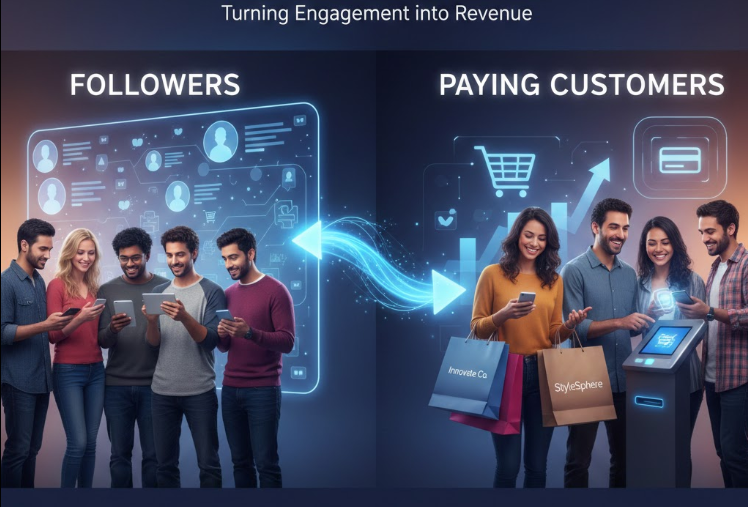
Social media has given brands unprecedented access to audiences worldwide. Yet, having thousands of followers doesn’t automatically translate into revenue. The real challenge lies in converting those followers into loyal customers who trust your brand enough to make a purchase. This blog explores actionable strategies that help brands turn followers into paying customers while building long-term relationships.

Why Followers Don’t Always Equal Customers

Many businesses assume that a large follower count automatically leads to sales, but in reality, followers often engage with content without converting into customers due to several key gaps such as lack of trust in the brand’s credibility, poor alignment between content and product offerings, weak or unclear calls-to-action that fail to guide users toward purchase, and an overemphasis on vanity metrics instead of meaningful engagement; recognizing these issues is essential for building effective strategies that turn passive followers into active, paying customers.

Building Trust Through Authentic Engagement

Trust is the foundation of conversion, as followers are far more likely to make a purchase when they feel a genuine connection with a brand, believe in its credibility, and see consistent, authentic communication that builds confidence over time.

Humanize Your Brand

Humanize your brand by showing the people and stories behind it—share behind-the-scenes moments to build authenticity, highlight real customer testimonials and user-generated content to reinforce credibility, and use storytelling to create an emotional connection that makes your audience feel more engaged and connected.

Consistency Matters

Maintain a consistent posting schedule to stay visible and reliable, ensure your visuals, tone, and messaging align with your brand identity for a cohesive experience, and respond promptly to comments and direct messages to build genuine engagement; by consistently nurturing trust in these ways, brands create an environment where followers feel confident enough to make purchasing decisions, making it a crucial step in turning followers into paying customers.

Crafting Content That Drives Action

Content acts as the bridge between awareness and conversion, guiding followers through each stage of the journey, which is why brands must focus on creating content that not only captures attention but also educates, inspires, and persuades, helping build trust, demonstrate value, and ultimately move audiences closer to making a purchase decision.

Educational Content

Share valuable tips, tutorials, and industry insights that genuinely help your audience, positioning your brand as a trusted thought leader and go-to source for knowledge in your space.

Persuasive Content

Use case studies to clearly demonstrate how your product or service delivers real results, while highlighting limited-time offers or exclusive deals to create urgency and encourage quicker decision-making.

Interactive Content

Polls, quizzes, and challenges encourage active participation, making your audience feel involved rather than passive viewers, while interactive formats boost engagement and help build stronger connections; when content truly resonates in this way, followers are far more likely to take the next step and convert into paying customers.

Leveraging Social Proof

Social proof is one of the most powerful tools in marketing psychology, as people tend to trust the experiences of others far more than direct brand claims; by prominently showcasing reviews and ratings, collaborating with micro-influencers who hold niche credibility, and sharing real customer success stories across platforms, brands can build authenticity and reduce hesitation, making it much easier to turn followers into confident, paying customers.

Optimizing Calls-to-Action (CTAs)

CTAs guide followers toward the desired action, and without clear direction, even highly engaged audiences may hesitate or fail to convert, which is why strong, specific, and well-placed calls-to-action are essential for turning interest into actual results.

Best Practices for CTAs

Use action-oriented language like “Shop Now” or “Get Started” to create urgency, place CTAs strategically across captions, stories, and bios to maximize visibility, and ensure landing pages are mobile-friendly and fast-loading for a smooth user experience, as strong CTAs provide the final push needed to turn interested followers into paying customers.

Personalization and Customer Experience

Generic marketing no longer works, as today’s audiences expect experiences tailored to their preferences and behaviour; by using data analytics to understand follower actions, segmenting audiences based on interests and demographics, and offering personalized recommendations or exclusive discounts, brands can create more relevant interactions, and this level of personalization shows that the brand truly values its audience, making followers far more likely to convert into paying customers.

Building Long-Term Loyalty

Conversion is only the beginning, as the real goal is to build long-term relationships by turning one-time buyers into loyal advocates who not only return but also actively promote your brand through trust, satisfaction, and positive experiences.

Loyalty Programs

Reward repeat purchases with points or exclusive discounts to encourage loyalty, and offer VIP access to new products or events to make customers feel valued and part of a special community.

Continuous Engagement

Keep customers informed with regular newsletters and updates, celebrate important milestones like anniversaries or birthdays to build a personal connection, and focus on nurturing loyalty so that once followers become paying customers, they continue to support and actively promote your brand over time.

Conclusion

Turning followers into customers requires more than flashy content or high follower counts. It demands authenticity, trust, strategic content, social proof, strong CTAs, personalization, and loyalty-building initiatives. Brands that master these elements not only increase conversions but also create lasting relationships with their audience.

At Upswing Digital, we believe that combining these strategies with a clear understanding of your audience can significantly improve conversion outcomes and long-term brand value. By focusing on consistency, engagement, and data-driven decisions, businesses can confidently turn followers into paying customers and build sustainable growth in the digital era. With the right approach and execution, Upswing Digital helps brands bridge the gap between audience engagement and real business results.

The Power of Design: Boost Trust, Clicks, and Conversions

The Power of Design: Boost Trust, Clicks, and Conversions

In today’s fast-paced digital landscape, designs are no longer just about aesthetics—it’s a powerful business tool that directly influences how users perceive, interact with, and respond to your brand. As competition continues to grow, businesses must understand that designs are not optional but essential for success. At Upswing Digital, we believe that strategic, user-focused designs are key to turning visitors into loyal customers and driving measurable business growth.

The Trust Factor: How Designs Influence Credibility

The overall look and feel of a website play a major role in shaping first impressions. A well-structured and visually appealing interface builds confidence, while poor layout and usability can quickly reduce trust. Elements like consistency, navigation, and visual clarity directly impact how credible a brand appears to users. Key visual elements that impact trust include:

Visual Appeal: A clean, modern design with high-quality visuals can convey professionalism and credibility.

Navigation and Usability: Intuitive navigation and clear information architecture can make users feel comfortable and confident.

Consistency: Consistent branding and visual elements can reinforce trust and recognition.

Design Elements That Boost Clicks

Certain visual and structural elements can significantly influence user interaction. Clear call-to-actions, effective use of colours, proper spacing, and readable typography work together to guide users toward taking action and improving engagement across the website.

1. Clear Call-to-Actions (CTAs): Prominent, action-oriented CTAs can encourage users to take action.

2. Colour Scheme: Colours can evoke emotions and influence user behaviour; choose colours that align with your brand and resonate with your audience.

3. Whitespace: Strategic use of whitespace can draw attention to key elements and improve readability.

4. Typography: Clear, readable typography can enhance user experience and engagement.

Visual Strategies for Conversions

Converting visitors into customers requires more than just good visuals—it depends on reducing friction and guiding user behaviour. Simplified forms, strong visual hierarchy, trust signals, and mobile responsiveness help create a seamless journey that encourages users to complete desired actions.

1. Simplify Forms: Minimize form fields and make the process straightforward to reduce friction.

2. Visual Hierarchy: Use size, colour, and positioning to guide users’ attention to key elements.

3. Trust Signals: Incorporate trust badges, reviews, and security certifications to build credibility.

4. Mobile Responsiveness: Ensure a seamless experience across devices to cater to diverse user preferences.

The Impact of Designs on User Experience

User experience is directly shaped by how easily visitors can navigate and interact with a website. Factors like page speed, accessibility, and intuitive navigation determine whether users stay engaged or leave, ultimately affecting overall performance and conversions.

Designs directly influence user experience, affecting engagement, bounce rates, and ultimately, conversions. Key aspects include:

Page Load Speed: Optimize images and streamline code to ensure fast load times.

Intuitive Navigation: Make it easy for users to find what they’re looking for.

Accessibility: Designs with accessibility in mind to cater to a broader audience.

Measuring Design Effectiveness

Understanding how well your website performs requires tracking key metrics and user behaviour. By analysing data such as bounce rates, conversion rates, feedback, and heatmaps, businesses can identify areas for improvement and optimize their approach effectively.

To gauge impact, track metrics like:

Bounce Rate: High bounce rates may indicate usability issues.

Conversion Rate: Monitor how designs affect conversions.

User Feedback: Collect feedback to identify areas for improvement.

Heatmaps: Use heatmaps to understand user behaviour and optimize designs.

Best Practices for Visual Optimization

Continuous improvement is essential for maintaining performance. Conducting user research, testing variations, staying updated with trends, and prioritizing usability ensure that your website remains relevant, efficient, and aligned with user expectations.

1. Conduct User Research: Understand your target audience’s preferences and behaviours.

2. A/B Testing: Test designs to identify what works best.

3. Stay Updated with Trends: Keep your designs modern and relevant.

4. Prioritize Usability: Ensure designs serve functionality and user needs.

Conclusion

Designs play a critical role in shaping how users experience your brand and how they decide to engage with it. From building trust and encouraging clicks to driving conversions, every visual element contribute to the overall effectiveness of your digital presence. Businesses that prioritize clarity, usability, and consistency are more likely to stand out and create lasting impressions in a crowded market. However, designs are not a one-time effort—it requires continuous testing, analysis, and improvement to stay relevant and effective. At Upswing Digital, we help businesses leverage designs as a strategic advantage to create impactful experiences, strengthen customer relationships, and achieve long-term growth.

How to Reduce Ad Costs After Recent Meta Policy Changes

How to Reduce Ad Costs After Meta Policy Changes

Meta advertising is no longer what it used to be. With evolving privacy policies, AI-driven delivery systems, and stricter ad regulations, many brands are noticing one major shift: rising ad costs with unpredictable results.

But here’s the reality: the problem isn’t just the platform. It’s how strategies need to evolve with it.

Reduce ad costs today is not about spending less, it’s about spending smarter. Brands that understand the new system are still achieving strong results without increasing budgets.

1. Creative Strategy Matters More Than Ever

Meta’s algorithm now prioritizes creative performance over manual targeting, meaning the quality of your ad content plays a major role in determining reach and cost; instead of relying only on audience settings, brands need to focus on strong strategies like crafting attention-grabbing hooks within the first few seconds, using relatable and human-centered content, and continuously testing multiple variations of visuals and messaging, as high-performing creatives drive better engagement, which ultimately reduces cost per click and cost per conversion while improving overall campaign efficiency.

2. Avoid Over-Targeting Your Audience

Earlier, detailed targeting was seen as a major advantage, but today over-segmentation can actually drive up ad costs and limit performance; Meta’s AI works more effectively when given flexibility, which is why broader targeting often delivers better results, allowing the system to identify and optimize for the right audience over time, so instead of narrowing down too much, brands should adopt smarter strategies like using wider audience groups, giving campaigns enough time to gather meaningful data before making changes, and trusting automated audience expansion, as this approach reduces internal competition within small audience pools and leads to more efficient, scalable performance.

3. Focus on Conversion, Not Just Traffic

Driving traffic alone is no longer enough, because if your landing page fails to convert, your ad costs will naturally increase; to improve overall efficiency, brands need to focus on optimizing the post-click experience by simplifying landing page design, ensuring fast loading speeds, using clear and compelling calls-to-action, and maintaining strong alignment between the ad message and the landing page content, as higher conversion rates directly reduce ad costs per result, even when ad spend remains the same, making your campaigns far more effective and profitable.

4. Use First-Party Data More Effectively

With privacy updates reducing the reliability of third-party tracking, brands can no longer depend heavily on external data and must shift focus toward building and leveraging their own first-party audience data; this includes insights from website visitors, social media engagers, and existing customers, all of which provide more accurate and actionable signals, allowing businesses to create stronger retargeting strategies, as engaging warm audiences who already have some level of familiarity or interest is significantly more cost-effective and conversion-friendly than targeting completely new, cold audiences in today’s evolving digital landscape.

5. Refresh Creatives to Avoid Ad Fatigue

One of the biggest reasons behind rising ad costs is creative fatigue, where the same ad loses effectiveness over time as audiences become less responsive, leading to lower engagement and higher costs; to avoid this, brands should consistently refresh their creatives by updating visuals and messaging, experimenting with new formats, and closely monitoring performance to quickly replace underperforming ads, as keeping content fresh not only sustains audience interest but also helps maintain efficient campaigns with lower overall costs.

6. Scale Campaigns Gradually

Many brands make the mistake of scaling budgets too quickly when they see positive results, which can disrupt the algorithm’s learning phase and lead to unstable performance and higher costs; instead, a more effective approach is to increase budgets gradually, give campaigns enough time to stabilize, and scale only when performance remains consistent over time, as this controlled strategy helps maintain efficiency, protects performance, and avoids unnecessary overspending.

7. Diversify Your Marketing Channels

Relying only on Meta ads can make your marketing strategy both expensive and risky, especially as competition and costs continue to rise, which is why smart brands focus on building a balanced approach by combining paid ads with other channels like organic social media content, search engine optimization (SEO), and email marketing, as this not only reduces pressure on ad spend but also creates multiple touchpoints for the audience, ultimately improving overall marketing efficiency, strengthening brand presence, and delivering more sustainable long-term results.

8. Track What Actually Matters

Not all metrics carry equal value, and focusing only on surface-level numbers like impressions or clicks can often give a misleading picture of performance; what truly matters is the actual outcome your campaigns deliver, which is why brands should prioritize meaningful metrics such as cost per lead, cost per conversion, and return on ad spend (ROAS), as these directly reflect business impact, and with better tracking and analysis, you can clearly identify what’s working, optimize effectively, and eliminate wasted budget to improve overall efficiency.

Conclusion

Meta’s recent policy changes have made advertising more competitive and data-driven. But they have also made one thing clear, success now depends on strategy, not just spending.

Brands that focus on strong creatives, better conversion systems, and smarter data usage can still reduce ad costs and improve performance.

At Upswing, we help brands adapt to these changes with strategies designed for the current digital landscape. Because in today’s marketing world, it’s not about spending more, it’s about making every rupee work smarter.

What Successful Brands Do Differently With Marketing

What Makes Successful Brands? 7 Key Marketing Strategies

Ever wondered what makes successful brands tick in today’s competitive marketing world? Strategies are what separate average brands from truly successful ones in today’s competitive marketing landscape. It’s not just about big budgets or chasing trends—it’s about using the right strategies to connect with people, deliver value, and stay consistent over time. The most successful brands understand how to combine creativity, data, and customer insight to drive real results. At Upswing Digital, we’ve seen how well-planned strategies can transform marketing efforts into measurable growth. Let’s explore the key strategies that set successful brands apart and how businesses can apply them effectively.

Customer-Centric Approach

Successful brands place their customers at the heart of every decision they make. Instead of focusing only on selling, they invest time in understanding customer needs, expectations, and challenges. This approach helps create meaningful experiences, improves satisfaction, and builds long-term relationships that go beyond one-time transactions.

1. Know Your Audience

Deep dive into customer demographics, preferences, and behavior. Create buyer personas to guide your marketing efforts.

2. Personalization

Tailor messages and experiences to individual needs. Leverage data and analytics to deliver personalized content.

3. Feedback Loop

Encourage feedback and act on it. Use customer insights to refine your marketing strategy.

Storytelling That Resonates

Brands that tell compelling and authentic stories are able to create deeper emotional connections with their audience. Instead of just promoting products or services, they communicate values, purpose, and real experiences. Strong storytelling makes a brand more relatable, memorable, and trustworthy in a crowded digital space.

1. Authentic Narratives

Share brand stories that reflect values and mission. Be genuine and transparent in your messaging.

2. Emotional Connection

Create content that evokes emotions and builds loyalty. Use storytelling to highlight customer experiences.

3. Consistent Messaging

Align messaging across all channels. Ensure consistency in tone, voice, and visuals.

Innovative Marketing Strategies

To stay competitive, successful brands continuously explore new and creative ways to reach their audience. They combine traditional marketing with modern digital approaches, experiment with content formats, and adapt to changing consumer behavior. Innovation allows brands to stand out and remain relevant in a fast-moving market.

1. Omnichannel Presence

Engage customers across multiple platforms seamlessly. Leverage social media, email, and content marketing.

2. Content Marketing

Provide value through informative and entertaining content. Focus on quality over quantity.

3. Influencer Partnerships

Collaborate with influencers who align with brand values. Choose influencers who resonate with your target audience.

Data-Driven Decisions

Rather than relying on assumptions, successful brands use data to guide their marketing strategies. By analysing customer behaviour, campaign performance, and market trends, they make informed decisions that improve efficiency and results. This approach helps optimize efforts and ensures that every action contributes to business growth.

1. Analytics Tools

Use tools to track performance and understand audience behavior. Leverage data to optimize campaigns.

2. A/B Testing

Test and optimize campaigns for better results. Use data to inform creative decisions.

3. ROI Focus

Measure and optimize marketing ROI. Ensure marketing efforts drive business growth.

Adaptability and Innovation

The marketing landscape is constantly evolving, and successful brands know the importance of staying flexible. They quickly respond to changes in trends, technology, and customer expectations. By embracing innovation and being open to experimentation, they maintain a competitive edge and continue to grow.

1. Stay Ahead of Trends

Anticipate and adapt to market changes. Stay agile and responsive to customer needs.

2. Experimentation

Try new strategies and learn from failures. Encourage innovation and creativity in your team.

3. Agility

Respond quickly to market shifts. Be prepared to pivot your marketing strategy.

Building Brand Loyalty

Strong brands focus not only on acquiring customers but also on retaining them. By delivering consistent value, engaging meaningfully, and rewarding loyalty, they turn customers into long-term advocates. Loyal customers not only return but also promote the brand through word-of-mouth.

1. Loyal Customer Programs

Reward loyalty and encourage repeat business. Create programs that recognize and reward customer loyalty.

2. Community Engagement

Build communities around your brand. Engage with customers through social media and events.

3. Consistent Quality

Deliver consistent quality and service. Ensure every customer interaction is positive.

Measuring Success

Successful brands regularly track and evaluate their performance to understand what works and what doesn’t. They rely on key metrics, customer feedback, and ongoing analysis to refine their strategies. This continuous improvement mindset helps them stay efficient, relevant, and aligned with their goals.

1. KPIs

Track relevant metrics like engagement, conversions, and ROI. Use data to inform marketing decisions.

2. Customer Feedback

Regularly collect and act on feedback. Use insights to refine your marketing strategy.

3. Adjust Strategies

Be ready to pivot based on performance. Continuously optimize and improve your marketing efforts.

Conclusion

Successful brands don’t grow by chance—they grow through clear strategy, consistent execution, and a deep understanding of their audience. By focusing on customer needs, telling meaningful stories, embracing innovation, and making data-driven decisions, businesses can build stronger connections and achieve long-term success. In a fast-changing digital landscape, adaptability and authenticity are what truly set brands apart. At Upswing Digital, we work closely with brands to turn these principles into actionable strategies that deliver measurable results. With the right approach and mindset, any business can elevate its marketing and create lasting impact in its industry.

Why Personal Branding Is Becoming a Business Asset

In the past, businesses focused only on company branding. Employees and leaders stayed mostly behind the scenes, while logos and slogans represented the brand.

Today, this has changed. In 2026, people want to connect with real humans, not faceless companies. Customers prefer to buy from people they trust and relate to. This is why personal branding has become a valuable business asset.

5 Reasons Why Personal Branding is a Business Asset
What Is Personal Branding?

Personal branding is how people see you online and professionally. It includes your knowledge, values, experience, and the way you communicate with others.

For businesses, personal branding helps leaders and employees represent the company in a more human and relatable way.

Why Human Connection Matters in Business?

The digital world is crowded with ads, AI-generated content, and polished marketing messages. Because of this, people are more careful about who they trust.

When businesses show real people, real stories, and real experiences, they feel more authentic. This human approach helps brands stand out and build emotional connections.

Trust Is the Key to Growth

Trust plays a major role in buying decisions. People feel more comfortable working with brands that have a clear and honest human presence.

When leaders build strong personal brands, they become trusted voices in their industry. This trust improves lead quality, increases conversions, and strengthens customer loyalty.

5 Simple Reasons Personal Branding Helps Businesses
1. Builds Credibility

Sharing useful insights and experiences helps position leaders as experts. When people trust the leader, they also trust the company.

This makes it easier to win clients, partnerships, and long-term business relationships.

2. Attracts Better Talent

People want to work with inspiring leaders. A strong personal brand allows leaders to show company culture, values, and vision.

This helps attract skilled professionals who align with the company’s mission.

3. Provides Long-Term Security

Markets change quickly. Products and services may evolve, but a trusted personal brand lasts.

Leaders with strong personal brands can carry their audience and credibility into future ventures.

4. Improves Organic Reach

Social media platforms often show posts from individuals more than company pages.

Personal branding helps businesses reach more people without spending heavily on ads.

5. Shortens the Sales Process

When people already know and trust a leader through content and engagement, sales conversations become easier.

Customers enter the process with confidence, reducing decision time.

Personal Branding for Teams, Not Just Leaders

Personal branding should not be limited to CEOs or founders. Employees can also build their own professional presence.

When team members share knowledge and experiences, they strengthen the company’s overall brand and credibility.

Addressing Common Concerns

Some businesses worry that encouraging personal branding may lead employees to leave. In reality, employees feel more valued when supported.

Empowered employees often become loyal brand advocates and help attract more talent.

How to Start Building a Personal Brand

You don’t need a large following to begin. Focus on clarity and consistency.

Choose one area of expertise, share content regularly, and communicate honestly. Engage with others by replying to comments and joining discussions.

Authenticity and consistency are more important than perfection.

Conclusion

Personal branding is no longer optional—it’s a core driver of modern business success. In a world where trust determines every decision, people choose to connect with individuals who are authentic, consistent, and visible. Businesses that encourage their teams to build personal brands create stronger relationships, improve credibility, and accelerate growth in ways traditional marketing alone cannot achieve. At Upswing Digital, we recognize that real impact comes from real people, which is why we believe investing in personal branding is investing in long-term business value. As the digital landscape continues to evolve, companies like Upswing Digital that embrace human connection will not only stand out but lead the way forward.

Are AI Content Detection Tools Affecting Rankings?

Are AI Content Detection Tools Affecting SEO Rankings?

With the rapid rise of AI-generated content, a new concern has emerged among marketers, writers, and businesses: do AI content detection tools impact search engine rankings? As more brands rely on AI to scale content production, the fear of being penalized or flagged by search engines is growing.

The reality, however, is more nuanced. Search engines are not focused on whether content is created by AI or humans. What truly matters is quality, relevance, and user value. Understanding this distinction is key to navigating SEO in an AI-driven world.

1. Search Engines Prioritize Quality Over Creation Method

Search engines like Google do not rank content based on whether it is created by AI or humans; instead, they prioritize delivering helpful, reliable, and relevant information to users. What truly influences rankings is the quality of the content—its originality, how well it matches search intent, its clarity and readability, and the depth of information it provides—while low-quality content, regardless of its source, is unlikely to perform well in search results.

2. AI Content Detection Tools Are Not Used by Search Engines

AI content detection tools are often misunderstood, as they attempt to guess whether content is AI-generated by analysing patterns, predictability, and language structure, but they are not used by search engines like Google for ranking purposes. This means that being flagged by an AI detector does not directly impact SEO, detection scores are not ranking factors, and content is evaluated independently by search algorithms based on quality and usefulness. As a result, relying too heavily on these tools can create unnecessary concern instead of focusing on what truly matters—producing valuable, relevant, and well-crafted content for users.

3. The Real Risk Is Low-Quality AI Content

The real issue is not AI itself but how it is used, as many brands rely on it to produce large volumes of content without proper editing, leading to generic, repetitive, and shallow articles that fail to engage users or rank well. Common problems with unoptimized AI content include a lack of originality, repetitive phrasing, absence of a clear brand voice, and surface-level insights, all of which reduce its value. Search engines like Google are designed to identify and deprioritize low-quality or unhelpful content, regardless of whether it is written by humans or generated by AI.

4. Human Editing Is Essential for SEO Success

AI can accelerate content creation, but human input remains essential for ensuring quality, as the most successful brands use AI content as a starting point and then refine the output to make it more engaging, insightful, and aligned with their audience. Through human editing, content gains unique perspectives, stronger storytelling, improved factual accuracy, and a tone that reflects the brand’s voice, creating a more authentic and valuable experience for readers. This balance of AI content efficiency and human creativity ultimately leads to better performance in search results on platforms like Google.

5. EEAT Matters More Than Ever

Google emphasizes EEAT—Experience, Expertise, Authoritativeness, and Trustworthiness—as key factors in evaluating content quality, and while AI can assist in creation, it often lacks real-world experience unless carefully refined. To strengthen EEAT, content should include practical insights and real examples, clearly demonstrate expertise and credibility, and build trust through transparency and factual accuracy. Ultimately, content that reflects genuine knowledge and delivers meaningful value will consistently outperform generic, surface-level output in search rankings.

6. User Experience and Engagement Drive Rankings

Search engines like Google closely measure how users interact with content, using signals such as time on page, bounce rate, and overall engagement to assess its value, meaning that if AI content fails to capture and hold attention, it is unlikely to rank well. To improve engagement, content should be written clearly and concisely, structured for easy readability with effective headings and logical flow, and focused on solving real user problems rather than just targeting keywords. Ultimately, the most successful content is created with people in mind first, as user satisfaction naturally aligns with better search performance.

7. Over-Optimization Can Hurt More Than AI

In trying to “beat” AI detection tools, some writers end up over-editing content to the point where it feels unnatural or overly complex, which harms readability and creates a poor user experience. Instead of chasing detection scores—which search engines like Google don’t use for rankings—brands should focus on maintaining a natural writing style, communicating ideas clearly, and delivering genuine value to their audience. In the end, SEO success is driven by authenticity and usefulness, not forced optimization or attempts to game detection systems.

Conclusion

AI content detection tools may create concern, but they do not directly influence search rankings—what truly matters is the quality, relevance, and value of the content you produce. AI is a powerful tool, but it needs to be used thoughtfully and strategically to deliver meaningful results.

At Upswing, we help brands combine AI efficiency with human creativity to create content that ranks, engages, and builds trust, and at Upswing, this balanced approach ensures content remains authentic, useful, and aligned with what search engines like Google prioritize. By focusing on value, authenticity, and consistency, your content can perform well regardless of how it is created.

YouTube Shorts vs Reels vs TikTok Where Should Brands Invest?

Short-form video marketing is rapidly becoming the most powerful way for brands to capture attention in 2026. With platforms like TikTok, Instagram Reels, and YouTube Shorts dominating user engagement, businesses must understand where to focus their efforts for maximum impact. What started as a trend has now evolved into a core marketing channel, where visibility, creativity, and consistency directly impact growth. Each platform offers unique advantages — from TikTok’s trend-driven virality to Instagram’s polished storytelling and YouTube’s depth and discoverability. For brands, the challenge is no longer whether to invest in short-form video, but where to focus for maximum impact. Let’s break it down.

Short-Form Video Marketing: TikTok vs Instagram Reels vs YouTube Shorts
Platform Overview
1. TikTok

– Audience: Gen Z and Millennials

– Content: Creative, entertaining, and authentic

– Features: Duets, effects, and music library

2. Instagram Reels

– Audience: Millennials and Gen Z

– Content: Visual storytelling and product showcases

– Features: Music, effects, and shopping integrations

3. YouTube Shorts

– Audience: Broad, existing YouTube users

– Content: Informative, tutorials, and behind-the-scenes

– Features: Music, editing tools, and monetization

Key Differences in Short-Form Video Marketing
1. Audience Reach

– TikTok: 1 billion+ monthly active users

– Instagram Reels: 2 billion+ monthly active users (Instagram’s overall)

– YouTube Shorts: Growing rapidly, leveraging YouTube’s existing user base

2. Content Style

– TikTok: Trendy, entertaining, and quirky

– Reels: Polished, visual storytelling

– Shorts: Informative, educational, and DIY

3. Monetization

– TikTok: Creator Fund and brand partnerships

– Reels: Shopping integrations and brand partnerships

– Shorts: Ad revenue sharing and sponsorships

Where Should Brands Invest?
1. TikTok

– Best for: Brands targeting Gen Z, creative and entertaining content

– Strategy: Leverage trends, collaborate with influencers, and engage with challenges

2. Instagram Reels

– Best for: Brands with strong Instagram presence, visual storytelling

– Strategy: Showcase products, use shopping features, and collaborate with influencers

3. YouTube Shorts

– Best for: Brands with existing YouTube audience, educational content

– Strategy: Repurpose long-form content, tutorials, and behind-the-scenes

Best Practices for Short-Form Video Marketing
1. Know Your Audience

Choose the platform where your target audience is most active.

2. Content Adaptation

Tailor content to each platform’s unique style and features.

3. Engagement

Respond to comments, engage with users, and build a community.

4. Analytics

Track performance and adjust strategies accordingly.

Conclusion

Short-form video marketing has become a defining force in how brands capture attention and drive growth in 2026, with platforms like TikTok, Instagram Reels, and YouTube Shorts each offering unique advantages across discovery, storytelling, and long-term visibility. The most effective approach is not choosing one over the other, but aligning platform strengths with your audience, content style, and business goals while consistently testing, adapting, and refining your strategy. At Upswing, we help brands navigate this complexity with strategies that turn content into measurable results, and with Upswing, businesses can build a sustainable short-form video marketing system that drives both engagement and growth.

5 Powerful Storytelling Marketing Strategies to Emotionally Connect with Your Audience

Storytelling Marketing is the single most powerful way to cut through the noise, earn trust, and build an audience that genuinely cares about your brand. In a world where consumers are exposed to between 4,000 and 10,000 ads every single day, the brands that win are not the ones shouting the loudest — they are the ones telling the most compelling stories.

Think about the last ad that made you stop scrolling. It probably wasn’t a product description or a feature list. It was a story. Maybe a founder talking about the moment they almost gave up. Maybe a customer describing how one product quietly changed their life. That’s the power of Storytelling Marketing — it turns a brand from a logo into something people feel connected to.

In 2026, Storytelling Marketing has moved from a “nice to have” to a core growth strategy. With AI-generated content flooding every platform, the brands that lead will be the ones grounded in authentic human narrative. This guide breaks down 5 proven Storytelling Marketing strategies that build emotional connections, drive loyalty, and convert audiences into advocates.

THE FOUNDATION

What Is Storytelling Marketing and Why Does It Work?

Storytelling Marketing is the strategic use of narrative to communicate a brand’s message, values, and purpose in a way that resonates emotionally with the audience. Instead of listing features or pushing promotions, it weaves brand messaging into stories that people naturally want to engage with.

The science behind it is compelling. Stories trigger the release of oxytocin — the same bonding hormone released during human connection — making audiences more receptive, more trusting, and more likely to act. Research in neural coupling shows that a listener’s brain activity actually mirrors the storyteller’s when the narrative is specific and emotionally authentic. Generic campaigns simply don’t trigger this response.

The framework is simple: in every great Storytelling Marketing campaign, the customer is the protagonist, their problem is the challenge, and your brand is the guide that helps them reach resolution. That’s it. When you build every piece of content around this structure, your marketing stops feeling like advertising and starts feeling like a conversation.

Storytelling Marketing strategies to emotionally connect with audience

THE 5 STRATEGIES

5 Proven Storytelling Marketing Strategies That Drive Emotional Connection

1. Lead with Your Brand Origin Story — The Heart of Storytelling Marketing

Every brand has a founding moment — a problem that needed solving, a gap that demanded filling, a frustration that sparked action. Your origin story is the most underused asset in Storytelling Marketing, and it’s the most human thing you can share.

Your origin story answers the question your audience is quietly asking: “Why should I trust you?” According to Harvard Business Review, narratives that reveal vulnerability and purpose build significantly stronger emotional bonds than polished corporate messaging. Authenticity is not a bonus in Storytelling Marketing — it is the entire point.

Write your origin story and place it prominently: on your About page, in your email welcome sequence, in your social media bios, and woven into your pitch. It should answer three questions clearly: What problem did you set out to solve? What drove you to act? And what does that mean for your customer today?

2. Use Customer Transformation Stories as Your Most Powerful Storytelling Marketing Asset

Nothing accelerates trust faster in Storytelling Marketing than a real customer transformation story. Not a generic five-star review — but a before-and-after narrative that shows a specific person, with a specific problem, achieving a specific outcome with your help.

This is the Storytelling Marketing format that converts best across every channel — case studies, video testimonials, social posts, email sequences, and sales pages. The structure is always the same: establish the customer’s world before, show the friction and challenge they faced, then reveal the transformation and result. According to Nielsen Consumer Research, consumers trust peer stories significantly more than brand-created content — making this your most credible Storytelling Marketing format.

Gather these stories through post-purchase interviews, survey follow-ups, or simply asking your most loyal customers to share their experience in their own words. The messier and more specific the detail, the more believable and powerful the story.

3. Build Emotional Storytelling Marketing Into Your Content Calendar

Most brands treat Storytelling Marketing as a one-off campaign rather than a consistent content system. The brands that build lasting emotional connections do the opposite: they map story beats into every piece of content they produce, across every channel, week after week.

According to Content Marketing Institute, consistency is one of the most critical — and most overlooked — elements of effective Storytelling Marketing. A single powerful campaign builds awareness. A consistent narrative builds identity.

Map your content calendar around a story arc: Monday posts share customer wins (transformation). Wednesday content shares behind-the-scenes brand moments (authenticity). Friday content shares values-driven opinion pieces (purpose). Each format serves a different emotional need, but together they build a coherent, emotionally rich brand narrative that audiences return to.

•        Short-form video — for transformation and quick emotional impact on social

•        Long-form blog content — for deep storytelling, proof, and SEO (like this post)

•        Email sequences — for personal, direct storytelling that builds loyalty over time

•        User-generated content — for peer storytelling that builds trust at scale

4. Make Your Customer the Hero — The Golden Rule of Storytelling Marketing

The most common mistake brands make in Storytelling Marketing is making themselves the hero. They tell the story of their own journey, their own awards, their own capabilities. But the audience doesn’t want to hear about you — they want to see themselves in your story.

Effective Storytelling Marketing positions the brand as the guide and the customer as the hero. Think of how Nike’s campaigns center on the athlete’s struggle, not Nike’s product specs. Or how Airbnb’s storytelling focuses on the traveller’s sense of belonging, not Airbnb’s platform features. The product is the enabler — the customer is always the story.

Audit your current marketing content: how much of it talks about you, and how much of it puts your customer at the centre? Reframe your messaging by leading with the customer’s pain point, their desire, their aspiration — and then show how your brand fits into their journey as a trusted guide.

5. Use Data-Backed Storytelling Marketing to Build Credibility and Emotion Together

The most sophisticated Storytelling Marketing in 2026 combines emotional narrative with hard data. Numbers establish credibility. Stories create connection. When you combine both, you build the trust that turns an interested audience into committed customers.

This approach — sometimes called data storytelling — transforms statistics from cold facts into compelling evidence that reinforces your narrative. Instead of saying “Our clients see results,” you say: “After 90 days of working with us, a Kochi-based retail brand grew their Google Maps traffic by 340% — here’s exactly how we did it.” The data validates the story. The story makes the data memorable.

According to Stanford Social Innovation Review, people are 22 times more likely to remember a fact when it is embedded in a story. That means your Storytelling Marketing becomes the most efficient delivery mechanism for the proof points your audience needs to make a decision.

AVOID THESE

Storytelling Marketing Mistakes That Break Emotional Connection

Even well-intentioned brands make these errors in their Storytelling Marketing — and each one quietly erodes the trust they’re trying to build:

•        Over-polishing the narrative: Perfectly scripted, highly produced stories often feel less authentic than raw, honest ones. Storytelling Marketing that hides imperfection loses credibility.

•        Making the brand the hero: As covered above, this is the single biggest Storytelling Marketing error. Your audience will disengage the moment the story becomes about you.

•        Inconsistent storytelling across channels: If your Instagram tells one story and your website tells another, your audience loses trust. Storytelling Marketing must be cohesive across every touchpoint.

•        Ignoring the emotional arc: A story without tension or transformation is just a description. Great Storytelling Marketing always moves through a problem, a journey, and a resolution.

•        No clear call to action: Emotional connection without direction wastes the moment. Every piece of Storytelling Marketing should guide the audience toward a meaningful next step.

UPSWING PERSPECTIVE

Storytelling Marketing Is the Upswing Approach — Because It’s the Human Approach

At Upswing, we believe Storytelling Marketing is not a campaign tactic — it’s the strategic foundation that everything else is built on. Data tells you what is happening. Story tells your audience why it matters to them. When you combine both, you stop competing on price or features and start competing on meaning — and that is a race very few brands know how to run.

In 2026, with AI generating more content than ever before, the brands that stand out will be the ones that are distinctly, irreducibly human. Storytelling Marketing is how you stay human at scale. It’s how a consultancy in Kerala builds an audience that trusts them before a sales call happens. It’s how a product brand in a crowded market earns loyalty that no ad budget can buy.

We help brands find their story, structure it for every channel, and build the content systems that tell it consistently. From brand origin narratives and customer transformation case studies to data-backed Storytelling Marketing campaigns that drive measurable growth — Upswing builds the full narrative ecosystem your brand needs to connect, convert, and grow.

Your audience is not waiting for another ad. They are waiting for a story worth believing in. Let Upswing help you tell it.

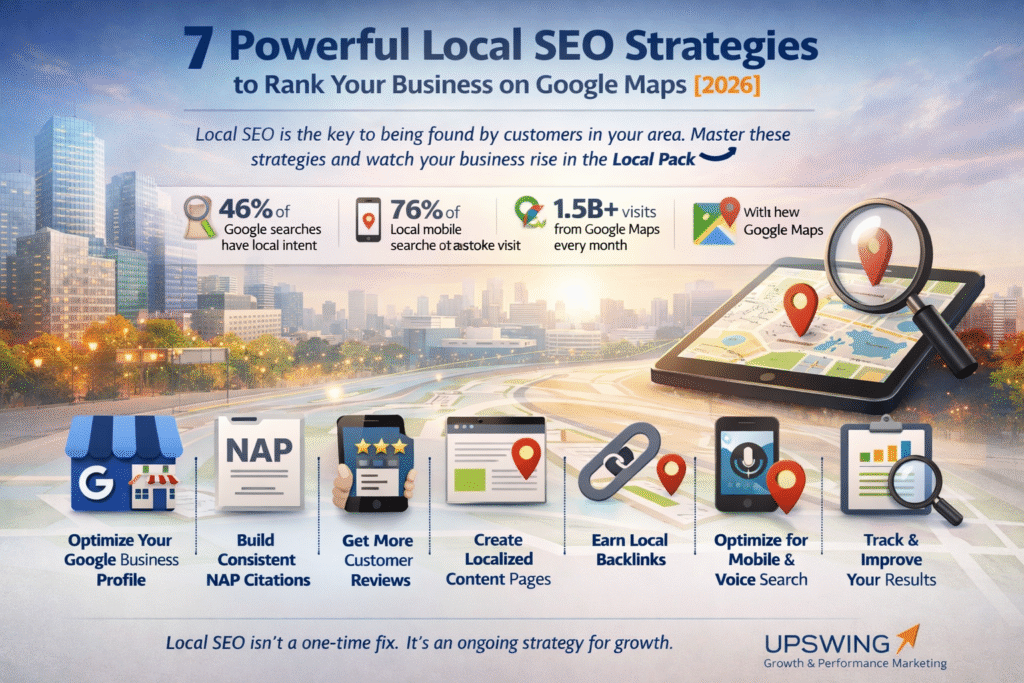
7 Powerful Local SEO Strategies to Rank Your Business on Google Maps

Local SEO is no longer optional for businesses that want to grow in their area — it’s the difference between being found and being invisible. If your business doesn’t appear in the Google Maps Local Pack, you’re missing out on customers who are actively searching for exactly what you offer, right now, in your area, ready to buy.

Think about the last time you searched for a restaurant, a salon, or a plumber. Chances are, you clicked one of the first three results that appeared on the map — and never scrolled further. That coveted strip of three listings is called the Local Pack, and it’s the most competitive real estate in modern digital marketing.

In 2026, Local SEO extends far beyond just Google. Customers now discover local businesses through AI tools, voice search, and Google’s Ask Maps feature. But the foundation of all of it remains the same: a rock-solid Local SEO strategy. Whether you’re managing your own business or running campaigns for clients, this guide covers the 7 strategies that actually move the needle.

•        46% — of all Google searches have local intent

•        76% — of local mobile searches result in a store visit within 24

•        1.5B+ — destination visits are driven by Google Maps every single month

•        28% — of local searches result in a purchase within 24 hours

How Google Decides Your Local SEO Ranking

Before jumping into tactics, it’s essential to understand the three core pillars Google uses to determine Local SEO rankings. Every strategy in this blog feeds directly into one of these signals:

•        Relevance: How well your Business Profile matches what the searcher is looking for. Categories, descriptions, keywords, and services all contribute.

•        Distance: How close your business is to the searcher’s location. Accurate, consistent address data ensures Google trusts your location data.

•        Prominence: How well-known and authoritative your business is online. Reviews, backlinks, citations, and mentions all feed into this signal.

Master all three, and you’ll consistently appear in the top results. Neglect even one, and your competitors will quietly take your spot.

Local SEO strategies to rank on Google Maps
7 Proven Local SEO Strategies That Actually Work in 2026
1. Optimize Your Google Business Profile for Local SEO

Your Google Business Profile (GBP) is the single most critical asset in your Local SEO toolkit. It’s the primary data source Google uses to populate the map. A half-filled profile is a ranking opportunity left on the table.

Start with the basics: accurate business name, address, phone number, categories, hours, and website URL. Then go deeper — write a keyword-rich business description that naturally includes Local SEO terms relevant to your industry, upload geotagged photos weekly, enable messaging and booking, and post regular updates with offers or news.

Pro Tip: Choose your Primary Category with precision. If you’re an orthodontist, don’t just list “dentist.” Specificity is a core Local SEO relevance signal.

2. Build Consistent NAP Citations Across All Platforms

NAP — Name, Address, Phone Number — consistency is one of the most overlooked factors in Local SEO. If your phone number on Yelp differs from your website, or your address format varies between directories, Google’s confidence in your location data drops, and so does your ranking.

Audit your business information across your website, GBP, Yelp, Bing Places, Apple Maps, Facebook, and all industry directories. Every detail must be identical — down to whether you write “Street” or “St.” This is foundational Local SEO hygiene that most businesses skip.

Pro Tip: Fix major data aggregators like Data Axle and Foursquare first — they feed dozens of directories automatically, so corrections cascade downstream.

3. Build a Review System — The Local SEO Multiplier

Reviews are a dual Local SEO signal — impacting both Relevance and Prominence. A business with a 4.7-star rating and 500 reviews will almost always outrank a 5.0-star business with just 10 reviews. Volume signals popularity, and Google rewards it.

When customers naturally include search terms in their reviews — “best gluten-free pizza,” “affordable plumber in [city]” — Google associates your listing with those keywords. This passive Local SEO signal is one most businesses completely ignore.

Build a system: follow up post-purchase, share a direct review link, and respond to every review — positive or negative. Engagement signals are a growing Local SEO factor in 2026.

Pro Tip: Prompt customers with context: “If you found our service fast and helpful, we’d love to hear about it.” This naturally encourages keyword-rich, useful reviews.

4. Create Localized Content and Service Area Landing Pages

Your website and GBP work as a system in Local SEO. Google cross-checks data across platforms — signals must align. Beyond consistent NAP on your contact page, your website content itself needs to reflect local relevance.

If you serve multiple cities or neighborhoods, create dedicated landing pages for each. Each page should target a specific service-city combination — “Digital Marketing Agency in Kochi” or “SEO Services in Thrissur.” Include LocalBusiness schema markup to help search engines understand exactly where you operate. This is one of the highest-impact Local SEO moves available to multi-location businesses.

Pro Tip: Embed a Google Map of your business on your contact page. It’s a simple addition that reinforces Local SEO signals for both Google and your visitors.

5. Earn Local Backlinks to Strengthen Your Local SEO Authority

Backlinks remain a key Prominence signal in Local SEO. But in local search, a link from a neighborhood blog, city chamber of commerce, or local news outlet often outweighs a link from a massive national site — because it validates your location and community relevance to Google.

Sponsor local events, partner with complementary businesses, get listed in community directories, or be featured in local “Best of” guides. These hyper-local backlinks are often easier to earn than national placements — and they’re more powerful for your Local SEO map ranking.

Pro Tip: Join your local business association or chamber of commerce. Membership typically includes a directory listing — a high-quality Local SEO citation and often a backlink.

6. Optimize for Mobile, Voice Search & AI Discovery

In 2026, Local SEO extends beyond the traditional Google Maps 3-pack. Customers are discovering local businesses through AI tools like ChatGPT, Perplexity, and Google’s Ask Maps. These platforms rely on your documented presence across authoritative, crawlable web sources — meaning your GBP optimization, review volume, and local citations now serve a dual purpose: traditional map rankings and AI visibility.

Voice searches on mobile tend to use conversational queries: “Who’s the best marketing agency near me?” Structure your website content in a Q&A format and ensure it loads fast on mobile. According to Moz’s Local Search Ranking Factors, mobile optimization is an increasingly weighted Local SEO signal.

Pro Tip: Building documented brand presence across authoritative sources is no longer just a backlink strategy — it’s a Local SEO and AI visibility strategy combined.

7. Track, Measure & Continuously Improve Your Local SEO

The businesses that consistently dominate Local SEO rankings aren’t just the ones who set up their profiles correctly — they’re the ones who track performance and adapt. What gets measured gets improved.

Use Google Search Console to monitor organic impressions and clicks from local queries. Track your Google Maps ranking position using tools like BrightLocal or Whitespark. Monitor your GBP Insights weekly to understand how customers are finding your listing, what actions they’re taking, and which photos are performing best.

•        Track keyword rankings for your focus Local SEO terms weekly

•        Monitor GBP Insights: searches, views, calls, direction requests

•        Measure review volume and average star rating monthly

•        Audit NAP consistency across directories quarterly

•        Review backlink growth and citation count every 60 days

Pro Tip: Set a recurring monthly audit for your Local SEO performance. Small consistent improvements compound into significant ranking gains over 3–6 months.

Common Local SEO Mistakes That Kill Your Rankings

Knowing what to do is only half the battle. These are the Local SEO errors that quietly suppress your visibility — and are often the hardest to diagnose:

•        Keyword stuffing your business name: Adding your city or service to your GBP name violates Google’s guidelines and risks suspension. Your GBP name must match your legal business name exactly.

•        Inconsistent NAP data: Conflicting information across platforms sends mixed signals to Google and directly hurts your Local SEO ranking confidence.

•        Treating GBP as a one-time setup: Active profiles — with regular posts, new photos, and fresh reviews — consistently outrank static, neglected listings.

•        Ignoring review responses: Failing to respond to reviews signals disengagement. Both Google and potential customers notice this Local SEO red flag.

•        Choosing overly broad business categories: Generic categories reduce your Local SEO relevance score. Be as specific as your business type allows.

Local SEO Is a System, Not a One-Time Fix — Let Upswing Build Yours

At Upswing, we work with businesses and marketing teams who are done with guesswork. Local SEO isn’t a one-time checklist — it’s an ongoing system of signals that compound over time: a fully optimized GBP, airtight NAP consistency, a steady flow of genuine reviews, localized content that speaks to your community, and backlinks that validate your authority in your market.

The businesses that dominate Local SEO in 2026 aren’t necessarily the biggest or the oldest — they’re the ones who treat their local digital presence as a strategic asset and maintain it consistently. A competitor who posts weekly, responds to every review, and earns two local backlinks a month will quietly outrank a bigger brand that set up their profile in 2022 and forgot about it.

That’s where Upswing comes in. As a growth and performance marketing consultancy, we build Local SEO systems designed to deliver real business outcomes — more calls, more foot traffic, more revenue — not just vanity rankings. We audit, implement, optimize, and report with clarity so you always know what’s working and where to invest next.

If you’re ready to own your local market, let’s build the Local SEO system that gets you there.

Performance Marketing vs Brand Marketing: What Should You Prioritize in 2026?

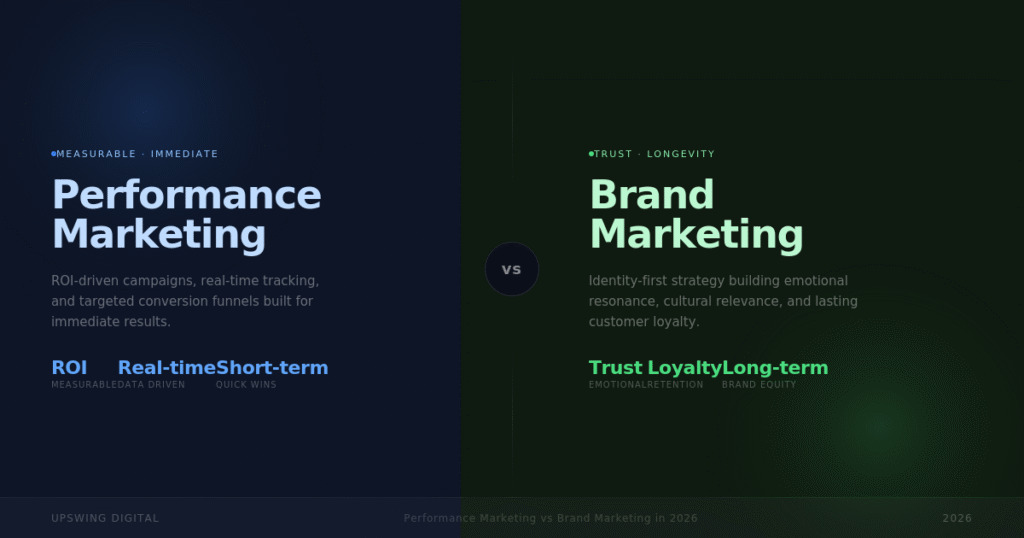
Marketing in 2026 is no longer about choosing one strategy over another it’s about balance, adaptability, and aligning with evolving consumer expectations. Businesses are facing a rapidly changing digital landscape where both performance marketing vs brand marketing play critical roles. The challenge lies in knowing which approach deserves more focus depending on your goals, industry, and audience.

Performance vs Brand Marketing in 2026
Understanding Performance Marketing

Performance marketing is a results-driven approach focused on measurable actions such as clicks, conversions, leads, and sales, where every dollar spent is tied to a specific outcome, making it highly effective for businesses seeking immediate returns. It offers measurable ROI through real-time tracking, ensures budget efficiency by optimizing spend toward high-performing channels, enables scalability based on performance data, and delivers targeted reach to audiences most likely to convert. In 2026, performance marketing continues to evolve with advanced analytics, automation, and personalized targeting, making it essential for start ups and e-commerce brands aiming for short-term growth.

Understanding Brand Marketing

Brand marketing focuses on building identity, trust, and long-term loyalty by shaping perceptions, creating emotional connections, and positioning a company as more than just a product or service. It drives emotional resonance to foster deeper relationships, builds long-term value through recognition and credibility, ensures consistency across channels for unified messaging, and maintains cultural relevance by aligning with consumer values and social trends. In 2026, brand marketing has become increasingly important as consumers prioritize authenticity, sustainability, and purpose-driven messaging, with businesses investing in brand equity benefiting from stronger customer retention and greater resilience to market changes.

Performance Marketing vs Brand Marketing: The Core Differences

Performance marketing is focused on immediate results, measured by clicks, conversions, and ROI. It thrives on short-term campaigns and transactional relationships. Brand marketing, on the other hand, is about long-term loyalty, awareness, and emotional connection. It requires consistent investment and patience but pays off with stronger recognition and customer trust.

While performance marketing is flexible and data-driven, brand marketing is strategic and consistent. One delivers quick wins, the other builds lasting value.

Why 2026 Demands a Balanced Approach?

Relying solely on one marketing approach is increasingly risky in today’s evolving advertising landscape. Data privacy regulations are limiting tracking capabilities, making performance marketing more challenging, while declining consumer trust is driving the need for stronger brand marketing. At the same time, omnichannel journeys mean customers engage with brands across multiple touchpoints, and growing emphasis on sustainability and purpose is shaping purchase decisions. Businesses that integrate both strategies—leveraging performance marketing for measurable growth and brand marketing for long-term trust—are best positioned to succeed.

When to Prioritize Performance Marketing?

Performance marketing should be prioritized when you’re launching a new product and need immediate traction, when your business model depends heavily on conversions such as in e-commerce, when you have limited budgets and require quick ROI, or when you are testing new markets or audiences. In these situations, focusing on performance marketing vs brand marketing helps ensure that resources are directed toward measurable outcomes and immediate results.

When to Prioritize Brand Marketing?

Brand marketing should take precedence when you operate in a highly competitive industry where differentiation is essential, when your audience values authenticity and purpose, when your goal is to build long-term loyalty and recognition, or when you seek resilience against market shifts and ad fatigue. For established businesses, prioritizing performance marketing vs brand marketing often means placing greater emphasis on brand building to sustain consistent growth over time.

The Ideal Strategy: Integration

The most successful companies in 2026 will not rely on a single approach but will integrate both performance and brand marketing to maximize impact. They will use performance marketing to drive immediate conversions while investing in brand marketing to build trust and recognition, ensuring both strategies are aligned under a unified vision. This integrated approach allows short-term gains to support and strengthen long-term success.

Actionable Steps for Businesses in 2026

To balance performance marketing and brand marketing effectively, regularly audit your strategy to ensure you’re not focusing too heavily on short-term gains at the cost of long-term growth. Set clear goals for both immediate sales and long-term brand loyalty, and allocate budgets deliberately across performance campaigns and brand-building efforts. Combine data analytics with strong storytelling to drive conversions while also building emotional connection with your audience. Continuously monitor market trends, consumer behaviour, and regulatory changes to keep your strategy adaptable and aligned with both current demand and future brand equity.

Conclusion

In 2026, the debate over performance marketing versus brand marketing is less about choosing one and more about effectively combining both into a unified strategy. Performance marketing remains essential for driving immediate, measurable results such as conversions, leads, and short-term revenue growth, while brand marketing builds long-term trust, recognition, and customer loyalty. Together, they create a balanced approach where performance campaigns deliver efficiency and scalability, and brand efforts strengthen emotional connection and reduce long-term acquisition costs. Businesses that align these two strategies can use data-driven insights to refine targeting while leveraging strong brand storytelling to improve engagement and conversion rates.