

7 Powerful Local SEO Strategies to Rank Your Business on Google Maps
Local SEO is no longer optional for businesses that want to grow in their area — it’s the difference between being found and being invisible. If your business doesn’t appear in the Google Maps Local Pack, you’re missing out on customers who are actively searching for exactly what you offer, right now, in your area, ready to buy.
Think about the last time you searched for a restaurant, a salon, or a plumber. Chances are, you clicked one of the first three results that appeared on the map — and never scrolled further. That coveted strip of three listings is called the Local Pack, and it’s the most competitive real estate in modern digital marketing.
In 2026, Local SEO extends far beyond just Google. Customers now discover local businesses through AI tools, voice search, and Google’s Ask Maps feature. But the foundation of all of it remains the same: a rock-solid Local SEO strategy. Whether you’re managing your own business or running campaigns for clients, this guide covers the 7 strategies that actually move the needle.
• 46% — of all Google searches have local intent
• 76% — of local mobile searches result in a store visit within 24
• 1.5B+ — destination visits are driven by Google Maps every single month
• 28% — of local searches result in a purchase within 24 hours
How Google Decides Your Local SEO Ranking
Before jumping into tactics, it’s essential to understand the three core pillars Google uses to determine Local SEO rankings. Every strategy in this blog feeds directly into one of these signals:
• Relevance: How well your Business Profile matches what the searcher is looking for. Categories, descriptions, keywords, and services all contribute.
• Distance: How close your business is to the searcher’s location. Accurate, consistent address data ensures Google trusts your location data.
• Prominence: How well-known and authoritative your business is online. Reviews, backlinks, citations, and mentions all feed into this signal.
Master all three, and you’ll consistently appear in the top results. Neglect even one, and your competitors will quietly take your spot.
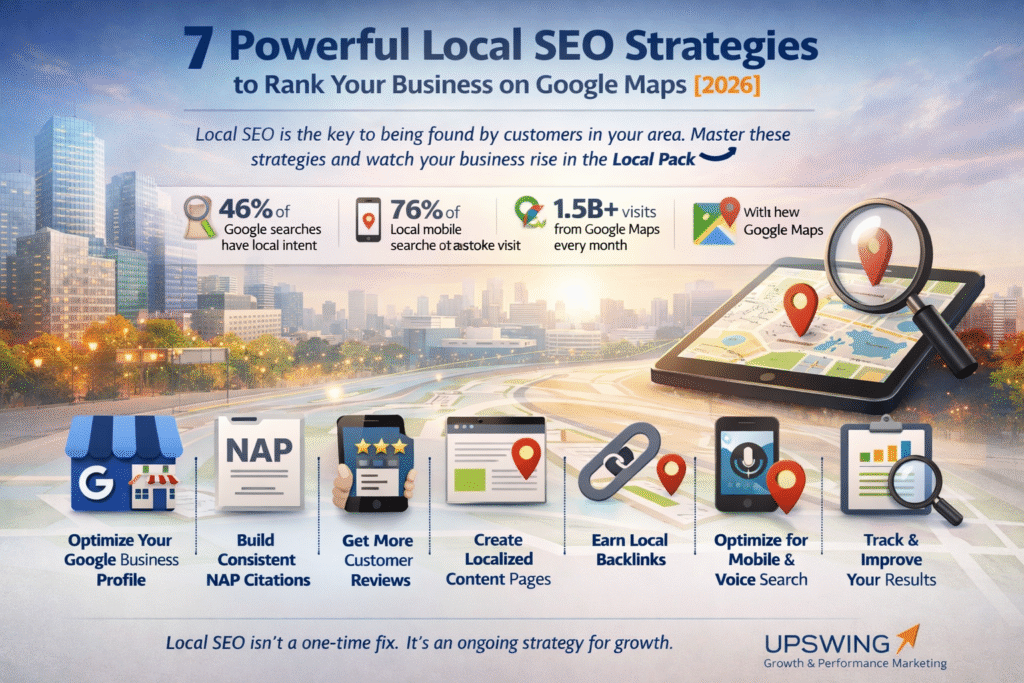
7 Proven Local SEO Strategies That Actually Work in 2026
1. Optimize Your Google Business Profile for Local SEO
Your Google Business Profile (GBP) is the single most critical asset in your Local SEO toolkit. It’s the primary data source Google uses to populate the map. A half-filled profile is a ranking opportunity left on the table.
Start with the basics: accurate business name, address, phone number, categories, hours, and website URL. Then go deeper — write a keyword-rich business description that naturally includes Local SEO terms relevant to your industry, upload geotagged photos weekly, enable messaging and booking, and post regular updates with offers or news.
Pro Tip: Choose your Primary Category with precision. If you’re an orthodontist, don’t just list “dentist.” Specificity is a core Local SEO relevance signal.
2. Build Consistent NAP Citations Across All Platforms
NAP — Name, Address, Phone Number — consistency is one of the most overlooked factors in Local SEO. If your phone number on Yelp differs from your website, or your address format varies between directories, Google’s confidence in your location data drops, and so does your ranking.
Audit your business information across your website, GBP, Yelp, Bing Places, Apple Maps, Facebook, and all industry directories. Every detail must be identical — down to whether you write “Street” or “St.” This is foundational Local SEO hygiene that most businesses skip.
Pro Tip: Fix major data aggregators like Data Axle and Foursquare first — they feed dozens of directories automatically, so corrections cascade downstream.
3. Build a Review System — The Local SEO Multiplier
Reviews are a dual Local SEO signal — impacting both Relevance and Prominence. A business with a 4.7-star rating and 500 reviews will almost always outrank a 5.0-star business with just 10 reviews. Volume signals popularity, and Google rewards it.
When customers naturally include search terms in their reviews — “best gluten-free pizza,” “affordable plumber in [city]” — Google associates your listing with those keywords. This passive Local SEO signal is one most businesses completely ignore.
Build a system: follow up post-purchase, share a direct review link, and respond to every review — positive or negative. Engagement signals are a growing Local SEO factor in 2026.
Pro Tip: Prompt customers with context: “If you found our service fast and helpful, we’d love to hear about it.” This naturally encourages keyword-rich, useful reviews.
4. Create Localized Content and Service Area Landing Pages
Your website and GBP work as a system in Local SEO. Google cross-checks data across platforms — signals must align. Beyond consistent NAP on your contact page, your website content itself needs to reflect local relevance.
If you serve multiple cities or neighborhoods, create dedicated landing pages for each. Each page should target a specific service-city combination — “Digital Marketing Agency in Kochi” or “SEO Services in Thrissur.” Include LocalBusiness schema markup to help search engines understand exactly where you operate. This is one of the highest-impact Local SEO moves available to multi-location businesses.
Pro Tip: Embed a Google Map of your business on your contact page. It’s a simple addition that reinforces Local SEO signals for both Google and your visitors.
5. Earn Local Backlinks to Strengthen Your Local SEO Authority
Backlinks remain a key Prominence signal in Local SEO. But in local search, a link from a neighborhood blog, city chamber of commerce, or local news outlet often outweighs a link from a massive national site — because it validates your location and community relevance to Google.
Sponsor local events, partner with complementary businesses, get listed in community directories, or be featured in local “Best of” guides. These hyper-local backlinks are often easier to earn than national placements — and they’re more powerful for your Local SEO map ranking.
Pro Tip: Join your local business association or chamber of commerce. Membership typically includes a directory listing — a high-quality Local SEO citation and often a backlink.
6. Optimize for Mobile, Voice Search & AI Discovery
In 2026, Local SEO extends beyond the traditional Google Maps 3-pack. Customers are discovering local businesses through AI tools like ChatGPT, Perplexity, and Google’s Ask Maps. These platforms rely on your documented presence across authoritative, crawlable web sources — meaning your GBP optimization, review volume, and local citations now serve a dual purpose: traditional map rankings and AI visibility.
Voice searches on mobile tend to use conversational queries: “Who’s the best marketing agency near me?” Structure your website content in a Q&A format and ensure it loads fast on mobile. According to Moz’s Local Search Ranking Factors, mobile optimization is an increasingly weighted Local SEO signal.
Pro Tip: Building documented brand presence across authoritative sources is no longer just a backlink strategy — it’s a Local SEO and AI visibility strategy combined.
7. Track, Measure & Continuously Improve Your Local SEO
The businesses that consistently dominate Local SEO rankings aren’t just the ones who set up their profiles correctly — they’re the ones who track performance and adapt. What gets measured gets improved.
Use Google Search Console to monitor organic impressions and clicks from local queries. Track your Google Maps ranking position using tools like BrightLocal or Whitespark. Monitor your GBP Insights weekly to understand how customers are finding your listing, what actions they’re taking, and which photos are performing best.
• Track keyword rankings for your focus Local SEO terms weekly
• Monitor GBP Insights: searches, views, calls, direction requests
• Measure review volume and average star rating monthly
• Audit NAP consistency across directories quarterly
• Review backlink growth and citation count every 60 days
Pro Tip: Set a recurring monthly audit for your Local SEO performance. Small consistent improvements compound into significant ranking gains over 3–6 months.
Common Local SEO Mistakes That Kill Your Rankings
Knowing what to do is only half the battle. These are the Local SEO errors that quietly suppress your visibility — and are often the hardest to diagnose:
• Keyword stuffing your business name: Adding your city or service to your GBP name violates Google’s guidelines and risks suspension. Your GBP name must match your legal business name exactly.
• Inconsistent NAP data: Conflicting information across platforms sends mixed signals to Google and directly hurts your Local SEO ranking confidence.
• Treating GBP as a one-time setup: Active profiles — with regular posts, new photos, and fresh reviews — consistently outrank static, neglected listings.
• Ignoring review responses: Failing to respond to reviews signals disengagement. Both Google and potential customers notice this Local SEO red flag.
• Choosing overly broad business categories: Generic categories reduce your Local SEO relevance score. Be as specific as your business type allows.
Local SEO Is a System, Not a One-Time Fix — Let Upswing Build Yours
At Upswing, we work with businesses and marketing teams who are done with guesswork. Local SEO isn’t a one-time checklist — it’s an ongoing system of signals that compound over time: a fully optimized GBP, airtight NAP consistency, a steady flow of genuine reviews, localized content that speaks to your community, and backlinks that validate your authority in your market.
The businesses that dominate Local SEO in 2026 aren’t necessarily the biggest or the oldest — they’re the ones who treat their local digital presence as a strategic asset and maintain it consistently. A competitor who posts weekly, responds to every review, and earns two local backlinks a month will quietly outrank a bigger brand that set up their profile in 2022 and forgot about it.
That’s where Upswing comes in. As a growth and performance marketing consultancy, we build Local SEO systems designed to deliver real business outcomes — more calls, more foot traffic, more revenue — not just vanity rankings. We audit, implement, optimize, and report with clarity so you always know what’s working and where to invest next.
If you’re ready to own your local market, let’s build the Local SEO system that gets you there.
The Best Lead Generation Strategies for Small Businesses
When we start a small business, the venture feels thrilling, yet one issue hits: the struggle starts

Social Listening: Understanding and Engaging the Kochi Audience
In a world dominated by social media, the ability to understand and engage with your audience has ne

Leave a Reply