

Why Digital Communities Are Replacing Traditional Audiences
Digital communities are replacing traditional audiences at a pace that most brands are only beginning to understand. For decades, the marketing playbook was simple: build an audience, broadcast your message, and convert. Audiences were passive. Brands spoke, and people listened.
That model is broken.
Today, consumers do not want to be spoken at they want to belong somewhere. They want conversations, shared identities, and genuine connections with both brands and fellow customers. The shift from audience to community is one of the most significant transformations in modern marketing.
In this blog, we explore what this shift really means, why digital communities are replacing traditional audiences, and most importantly, what your brand needs to do to stay relevant and competitive in 2026.
What Is the Difference Between an Audience and a Community?
Before exploring why digital communities are replacing traditional audiences, it is important to understand what separates the two.
An audience is a group of people who receive information from a single source a brand, a broadcaster, a publisher. The relationship is one-directional. The brand speaks. The audience listens. There is no meaningful interaction between members of the audience themselves.
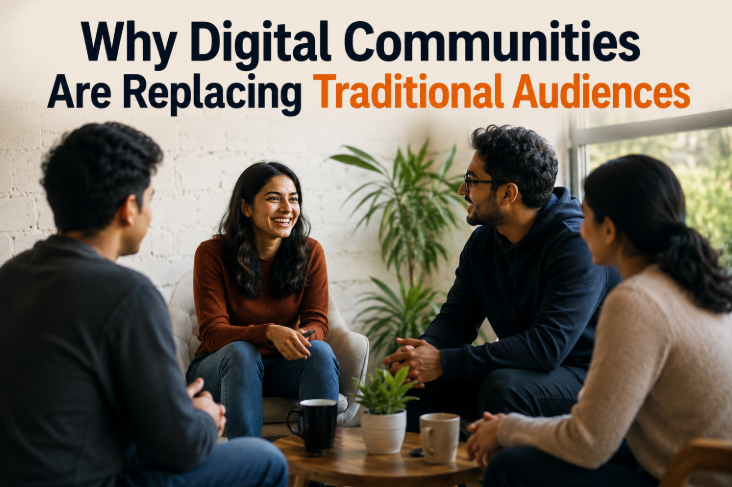
A community, on the other hand, is a group of people united by shared values, interests, or goals who actively interact with each other, not just with the brand. The relationship is multi-directional. Members contribute, discuss, support one another, and collectively shape the identity of the group.
Key Distinction: An audience follows you. A community belongs with you. One is built on reach. The other is built on relationships.
This distinction matters enormously for marketing. Audiences can be rented through paid ads or built through follower counts. Communities must be earned through genuine value, consistency, and trust over time.
Why Traditional Audiences Are Losing Their Power
The traditional audience model built around TV, radio, print, and even early social media relied on reach and repetition. If you could get your message in front of enough people enough times, some percentage would convert.
Several forces have combined to erode this model significantly.
Declining organic reach on social platforms
Facebook and Instagram have dramatically reduced organic reach for brand pages over the past several years. What once reached 20–30% of your followers now reaches 2–5%. Brands that built audiences purely through follower counts are finding those audiences increasingly inaccessible without paid spend.
Ad fatigue and banner blindness
The average consumer is exposed to thousands of advertisements every day. As a result, people have become extraordinarily skilled at ignoring branded content. Click-through rates on display advertising have dropped to fractions of a percentage point. Traditional broadcast-style marketing is fighting a losing battle for attention.
Rising consumer scepticism
Trust in advertising has reached an all-time low. Consumers are increasingly sceptical of brand-generated content and far more influenced by peer recommendations, community conversations, and authentic user-generated content. This is precisely why digital communities are replacing traditional audiences communities generate the kind of peer-to-peer trust that brands simply cannot manufacture.
The 7 Powerful Reasons Digital Communities Are Taking Over
Reason 1: Communities Create Two-Way Relationships
Unlike audiences, communities allow brands to have genuine conversations with their customers. Members can ask questions, share feedback, report problems, and celebrate wins — and the brand can respond in real time. This two-way dynamic builds trust and loyalty at a speed and depth that broadcast marketing cannot achieve.
Reason 2: Community Members Become Brand Advocates
When someone feels genuinely connected to a brand community, they naturally become an advocate. They recommend the brand to friends and family, defend it in public conversations, and share content without being asked. This word-of-mouth amplification is exponentially more credible than any paid advertisement.
Reason 3: Digital Communities Provide Invaluable Market Research
A thriving community is a real-time focus group. Brands can observe conversations, identify pain points, spot emerging trends, and gather product feedback directly from their most engaged customers all without spending a rupee on formal research.
Reason 4: Communities Dramatically Reduce Customer Churn
When a customer belongs to a community, switching to a competitor becomes emotionally costly not just financially. They would be leaving behind relationships, shared experiences, and a sense of belonging. Community membership is one of the most effective retention strategies available to brands in 2026.
Reason 5: Organic Content Generation at Scale
Community members create content. They post reviews, share experiences, make recommendations, and generate discussions all of which provide the brand with a continuous stream of authentic, user-generated content. This content is both free and far more trusted by other consumers than brand-produced material.
Reason 6: Communities Insulate Brands From Algorithm Changes
One of the most dangerous vulnerabilities in traditional audience-building is algorithm dependency. When platforms change their algorithms as they do constantly brands can lose access to their audience overnight. A strong community, especially one built across owned channels like email lists and WhatsApp groups, is far more resilient to these changes.
Reason 7: Community Drives Higher Customer Lifetime Value
Research consistently shows that customers who are active members of a brand community spend more, buy more frequently, and remain loyal for significantly longer than non-community customers. The emotional investment in the community translates directly into commercial value for the brand.
What Makes a Digital Community Thrive
Not every brand that creates a Facebook Group or Discord server successfully builds a community. The difference between a thriving community and a ghost town comes down to a few critical factors.
Shared purpose and identity
The most powerful communities are built around something bigger than a product. Members need to feel that they share a common identity, set of values, or goal. The brand is the facilitator of that connection, not the centre of it.
Consistent value delivery
Communities die when brands stop showing up. Members must receive consistent value whether that is exclusive content, early access, expert advice, peer support, or entertainment. The moment a community stops delivering value, engagement drops and members drift away.
Active moderation and facilitation
Healthy communities require active management. This means welcoming new members, sparking conversations, celebrating contributions, enforcing community guidelines, and ensuring the space remains safe, positive, and relevant.
Important Reminder: Building a community is a long-term investment, not a quick-win campaign. The brands that commit to it consistently over months and years are the ones that reap transformational results.
Platforms Where Digital Communities Are Growing Fastest
Different platforms serve different community types. Here is where the most significant community growth is happening in 2026.
• WhatsApp Communities: Ideal for local businesses, service providers, and brands with a loyal customer base. High open rates and intimate, personal feel.
• Facebook Groups: Still the largest community platform globally. Best for interest-based communities and brands with an older demographic.
• Discord Servers: Rapidly growing beyond gaming into lifestyle, creator, and brand communities. Strong with younger, tech-savvy audiences.
• Instagram Broadcast Channels: One-to-many communication with high engagement. Good for creators and brands wanting to maintain close contact with followers.
• LinkedIn Groups: Best for B2B brands, professional services, and thought leadership communities.
• Telegram Channels and Groups: High privacy, minimal algorithm interference. Excellent for communities that value direct, unfiltered communication.
How Brands Are Successfully Building Communities in 2026
The brands winning the community game in 2026 share several common approaches.
They start with a clear reason for the community to exist not just to promote products, but to bring people together around a shared interest or challenge. They invest in community management as a dedicated function, not an afterthought. They create exclusive value that members cannot get anywhere else. And they treat their most active community members as VIPs, giving them recognition, early access, and genuine influence over brand decisions.
Importantly, the brands building the strongest communities are the ones that listen more than they broadcast. They use community insights to shape product development, content strategy, and customer experience creating a virtuous cycle where the community feels heard and the brand continuously improves.
How to Start Building Your Own Digital Community
If you are ready to move beyond audiences and start building a genuine digital community, here is a practical starting framework.
Define your community’s purpose — What brings these people together beyond your brand?
Choose the right platform — Where does your target audience already spend time?
Start small and focused — A small, highly engaged community is more valuable than a large, inactive one
Seed the community with founding members — Invite your most loyal customers first
Create a content and conversation calendar — Plan what you will post and discuss each week
Establish community guidelines — Set clear expectations for behaviour and participation
Show up consistently — Respond to every comment and question, especially in the early stages
Recognise and reward active members — Public acknowledgement drives ongoing participation
Gather feedback regularly — Ask members what they want more of and act on their answers
Measuring the Success of Your Digital Community
Unlike follower counts or reach metrics, community success is measured differently. The metrics that matter most are indicators of engagement, connection, and commercial impact.
Key community metrics to track:
• Active member rate — What percentage of members are actively participating each month?
• Engagement rate — Likes, comments, shares, and reactions per post
• New member growth rate — How quickly is the community growing organically?
• Content contribution rate — How many members are posting, not just consuming?
• Customer retention rate — Are community members churning at a lower rate than non-members?
• Referral rate — How many new customers are coming through community member recommendations?
• Revenue from community members — Are community members spending more than average customers?
Track these metrics monthly and use them to identify what is working and where the community needs more attention or investment.
Final Thoughts
Digital communities are replacing traditional audiences because they offer something that broadcast marketing fundamentally cannot: belonging. And in a world where consumers are overwhelmed with content, bombarded with advertisements, and skeptical of brand messaging, belonging is extraordinarily powerful.
The brands that understand this shift and invest in building genuine communities will not just survive the changes in digital marketing they will thrive because of them. Their customers will become their advocates. Their community will become their competitive moat. And their marketing costs will decrease as organic word-of-mouth replaces paid acquisition.
The question is not whether to build a digital community. The question is how quickly you can start.
At Upswing Digital, we help brands make this transition strategically — from defining community purpose to choosing the right platform, creating content that sparks engagement, and measuring what truly matters.
Leave a Reply