

How to Create a Smart Content Strategy
Content Strategy is not about publishing more — it is about publishing with purpose. Most businesses today are creating content. Very few are creating content that actually drives results. The gap between the two is almost never a question of talent or budget. It is a question of strategy.
Without a clear Content Strategy, even the best content gets lost. It attracts the wrong audience, targets the wrong keywords, goes out on the wrong channels, and gets measured by the wrong metrics. The result is a content operation that feels busy but delivers little in return. In 2026, where AI-generated content floods every platform and buyer attention is harder to earn than ever, a vague approach to content is a direct path to wasted effort.
A strong Content Strategychanges all of that. It gives every piece of content a clear job to do, a specific audience to serve, and a measurable outcome to drive. This guide walks you through exactly how to build one — step by step — and what it looks like when your Content Strategy starts driving real, compounding business results.
What Is a Content Strategy and What Makes It ‘Results-Driven’?
A Content Strategy is the documented framework that defines why you create content, who it is for, what it covers, where it is published, and how you measure whether it is working. It is the thinking that sits behind all content marketing execution — the plan that makes every piece of content intentional rather than reactive.
What makes a Content Strategy results-driven specifically is alignment. Every element of the strategy — the audience, the topics, the formats, the channels, the publishing cadence, the KPIs — maps directly back to a defined business goal. The content is the foundation of both SEO and owned media effectiveness, and a documented Content Growth Strategy is what ensures that foundation is built with intention rather than guesswork.
The brands that consistently grow through content are not necessarily the ones with the largest teams or the biggest production budgets. They are the ones with the clearest Content Strategy and the discipline to execute it consistently over time.
How to Build a Content Strategy That Delivers 7 Real Business Results
1. Know Exactly Who Your Content Strategy Is Built For
The first and most important decision in any Content Strategy is audience definition. Not a broad demographic — a specific, research-backed picture of the real person your content is meant to serve. Their role, their daily challenges, their goals, the questions they are actively searching for answers to, and the language they use to describe their problems.
Build audience personas from real data: customer interviews, CRM insights, sales call recordings, and social listening. Each persona should clarify the stage of the buyer journey they occupy and the type of content they need at that stage. A Content Framework built on genuine audience understanding produces content that feels personal and relevant — and content that feels personal converts at a significantly higher rate than content built on assumptions.
The audience research is the single most impactful step in building a Content Framework that connects content output to revenue outcomes. Without it, even high-quality content consistently misses the mark.
2. Set Business Goals That Your Content Strategy Is Responsible For
A Content Strategy without defined business goals is just a publishing schedule. Before any content is created, define specifically what you need content to achieve and make sure those outcomes are ones the business actually cares about.
Use SMART goals to anchor your Content Strategy: Specific, Measurable, Achievable, Relevant, and Time-bound. Goals should connect directly to business outcomes such as organic traffic growth, qualified lead generation, sales pipeline contribution, or customer retention rates, not to vanity metrics like impressions or follower counts.
Every goal in your Content Strategy should answer two questions: What business result will this content drive? And how will we know when it has done that? These questions force strategic clarity and make it far easier to prioritise content topics, formats, and channels that actually matter.
3. Build Your Content Strategy Around Topic Pillars and Search Intent
The structural backbone of a high-performing Content Strategy in 2026 is topic authority. Rather than creating isolated pieces of content around individual keywords, the most effective approach is to build interconnected topic clusters: a comprehensive pillar page covering a broad subject, surrounded by a network of more specific supporting content that links back to it.
This structure signals genuine topical expertise to both Google and AI-powered answer engines, which are increasingly the primary discovery surfaces for buyers researching solutions. To aligning your Content Strategy with search intent — understanding whether a reader is in an informational, commercial, or transactional mindset — is what separates content that ranks from content that sits unseen.
• Informational content — builds awareness and earns organic discovery at the top of the funnel
• Commercial content — nurtures consideration by comparing options and addressing objections
• Transactional content — supports purchase decisions at the bottom of the funnel
A well-structured Content Strategy maps content to each of these intent types, ensuring your brand is present and helpful at every stage of the buyer journey.
4. Choose the Right Formats and Channels for Your Content Strategy
One of the fastest ways to undermine a Content Strategy is trying to be everywhere at once. Spreading content across every platform with insufficient focus almost always produces mediocre results across all of them. The smarter approach is to identify where your specific audience is most active and most receptive, and then commit to doing those channels exceptionally well.
In 2026, short-form video dominates for awareness and social reach, while long-form written content remains the strongest driver of organic search traffic and lead nurturing. The most effective Content Strategy uses multiple formats assigned to specific roles in the customer journey — rather than repurposing the same content identically across every channel.
Map your content formats to buyer journey stages and assign each channel a specific strategic role within your Content Strategy. This clarity prevents wasted effort and ensures every piece of content is created with its destination and purpose already defined.
5. Build a Content Calendar That Makes Your Content Strategy Executable
The most sophisticated Content Strategy in the world delivers nothing without consistent execution. A content calendar is what bridges the gap between strategic planning and daily publishing reality. It translates your audience insights, goals, and channel decisions into a concrete, shared schedule that keeps the whole team aligned.
Plan your Content Framework execution in 90-day cycles. Define the themes for each cycle, map out individual content pieces, assign ownership, set publication dates, and include a distribution plan for each asset. This sprint-based approach gives your Content Strategy enough structure to maintain consistency and enough flexibility to respond to market moments and real-time opportunities.
The brands that publish on a consistent, planned schedule build domain authority and audience trust significantly faster than those that publish reactively. Consistency is not just a discipline it is a direct competitive advantage in your Content Framework.
6. Distribute Your Content Strategy Intentionally — Creation Is Only Half the Work
One of the most expensive mistakes in any Content Strategy is treating distribution as an afterthought. Creating great content and failing to get it in front of the right people is the equivalent of building a brilliant product and putting it in a warehouse with no signage. Distribution deserves the same strategic attention as creation.
Your Content Strategy should define a distribution plan for every piece of content before it is created. This includes which owned channels will carry it (website, email list, social profiles), which earned channels you will pursue (backlinks, press, influencer shares), and whether any paid amplification is warranted to accelerate reach to a targeted audience.
Repurposing is also a critical element of an efficient Content Framework. A single well-researched long-form article can be broken down into social posts, email newsletter content, short-form video scripts, and infographic assets — extending the reach of one investment across multiple channels and audience segments without starting from scratch each time.
7. Measure What Matters and Let Data Drive Your Content Strategy Forward
The final and most decisive element of a results-driven Content Strategy is measurement. Not tracking everything — tracking the right things. The metrics that matter are the ones connected directly to the business goals defined at the start of your Content Strategy, not the ones that are simply easy to report.
Use Google Search Console and Google Analytics 4 to track organic traffic growth, content engagement, and conversion paths. Connect this data to your CRM to understand which content pieces are contributing to qualified leads and closed revenue. Review performance at the end of every 90-day cycle and use the findings to sharpen the next sprint of your Content Strategy.
The most effective content teams treat their Content Strategy as a living system. They double down on what is working, cut what is not, update older content to keep it competitive, and continuously refine their approach based on real audience behaviour rather than internal assumptions. Over time, this compounding cycle of create, measure, and improve is what separates brands that grow through content from brands that simply publish.
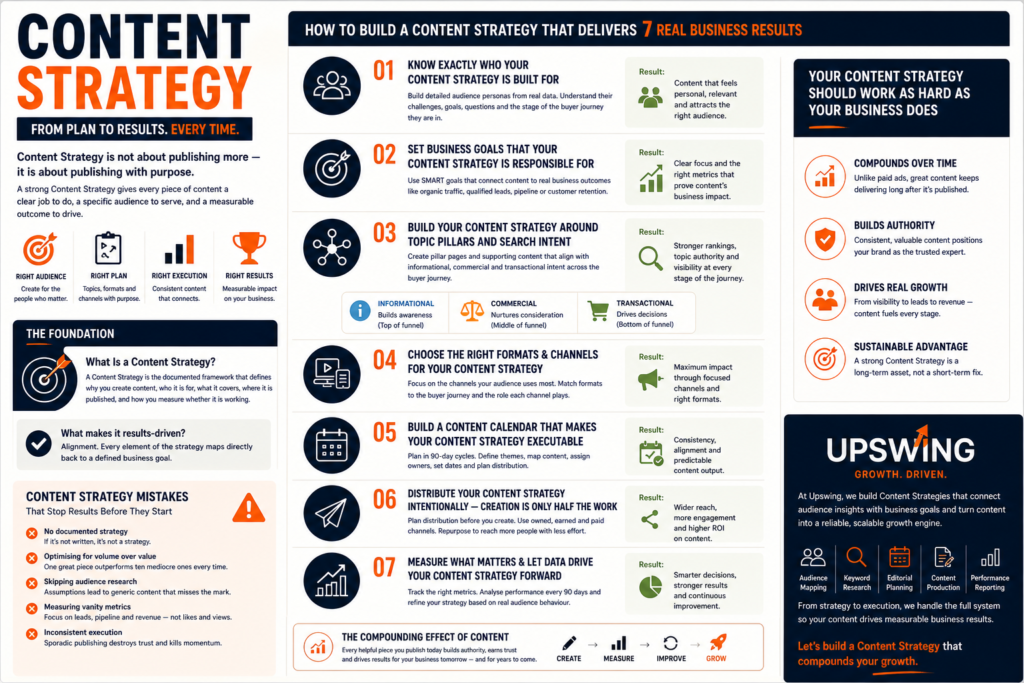
Content Strategy Mistakes That Stop Results Before They Start
These are the errors that most commonly prevent a Content Strategy from delivering the results it should — and most of them are entirely avoidable:
• No documented strategy: A Content Strategy that exists only in someone’s head is not a strategy — it is a preference. Write it down, share it across the team, and treat it as a living document that is reviewed and updated regularly.
• Optimising for volume over value: In 2026, one deeply researched, genuinely useful piece of content outperforms ten thin, generic posts every time. Your Content Strategy should prioritise quality and depth.
• Skipping audience research: Building a Content Strategy on assumptions rather than real audience data is one of the most costly mistakes a marketing team can make. The content will feel generic, miss search intent, and fail to convert.
• Measuring vanity metrics: If your Content Strategy is evaluated by page views and social likes rather than leads, pipeline contribution, and revenue impact, you are optimising for the wrong outcomes entirely.
• Inconsistent execution: A Content Strategy only compounds if it is executed consistently over time. Sporadic publishing destroys trust with both your audience and search algorithms.
Your Content Strategy Should Work as Hard as Your Business Does
At Upswing, we believe a great Content Strategy is one of the highest-leverage investments a business can make. Unlike paid advertising, which stops the moment you stop spending, a well-built Content Strategy compounds. Every piece of content you publish adds to your authority, improves your search visibility, and nurtures your audience — building a brand asset that keeps delivering long after the initial effort.
The businesses we work with are not just looking for content. They are looking for growth. And growth through content requires a Content Strategy that is grounded in real audience understanding, aligned with clear business goals, executed with consistency, and measured with rigour. That is the standard we hold every Content Strategy we build to at Upswing.
Whether you are starting a Content Strategy from scratch or auditing an existing one that is not delivering results, Upswing brings the research, the framework, and the execution capability to turn your content into a reliable, scalable growth engine. From audience mapping and keyword research to editorial planning, content production, and performance reporting — we handle the full system.
Leave a Reply