

The Decision Fatigue Effect: How Too Many Choices Hurt Conversions
Giving customers more choices sounds like good marketing.
After all, more options should mean more opportunities to find something they love, right?
Not always.
In today’s digital world, consumers are constantly making decisions. Which video should they watch? Which product should they buy? Which subscription should they choose? Which brand should they trust?
By the time they reach your website or landing page, they may already be mentally exhausted from making dozens of decisions throughout the day.
Now add 20 product options, five pricing plans, multiple offers, countless filters, and several calls to action.
Instead of making the customer feel empowered, you may have made the decision feel harder.
This is where the decision fatigue effect becomes important.
Decision fatigue explains why the mental effort of making too many choices can eventually lead consumers to delay decisions, choose the easiest option, or avoid making a decision altogether. For businesses, this can quietly become a conversion problem.
In this guide, we explore the psychology behind decision fatigue and 7 powerful reasons why too many choices can hurt conversions — and what brands can do to make the customer journey simpler.
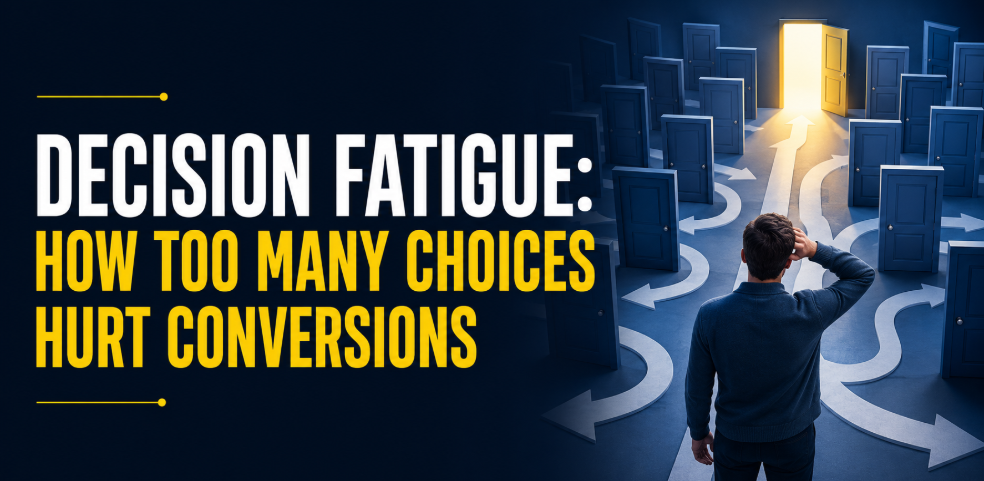
The Psychology Behind Decision Fatigue
Every decision requires mental effort.
Whether you’re choosing a product, comparing prices, selecting a service, or deciding which button to click, your brain is constantly processing information and evaluating alternatives.
The problem is that this mental energy is limited.
As people make more decisions, they can become increasingly tired of evaluating options. When faced with another choice, the brain naturally looks for shortcuts.
This is why consumers often gravitate toward:
- Familiar brands
- Popular products
- Recommended options
- Simple choices
- Default selections
- Options that require the least effort
Decision fatigue doesn’t necessarily mean that customers don’t want to buy.
Sometimes, they simply don’t want to think that hard about buying.
Key Signs of Decision Fatigue in Customer Behaviour:
- Customers spend too long comparing products without purchasing
- Visitors abandon pricing pages without selecting a plan
- Shoppers add products to their carts but don’t complete checkout
- Users repeatedly switch between options
- Customers choose the default or most familiar option
- Visitors leave websites that feel too complicated
- Potential buyers postpone decisions and never return
The key insight is simple:
The more difficult you make the decision, the easier it becomes for the customer to decide to do nothing.
1. Too Many Choices Create Decision Paralysis
Why More Options Can Make Customers Less Likely to Act
One of the biggest problems with too many choices is decision paralysis.
Imagine walking into a restaurant with 200 items on the menu.
At first, the variety feels exciting.
But after reading through dozens of pages, comparing ingredients, and wondering which dish is actually the best, you may start feeling overwhelmed.
Eventually, you might choose something familiar.
Or you might simply give up trying to decide.
The same thing happens online.
When customers are presented with too many similar products, services, or offers, the decision can become mentally exhausting.
How Choice Overload Affects Conversions
- Customers spend more time evaluating options
- Uncertainty increases
- Purchase decisions are delayed
- Customers may default to familiar brands
- Visitors may abandon the website altogether
The Choice Overload Principle:
Customers don’t necessarily need more options. They need better guidance.
A successful digital experience doesn’t just give customers choices. It helps them confidently understand which choice is right for them.
2. More Options Increase Cognitive Load
How Information Overload Makes Buying Harder
Every product page, pricing table, and landing page asks customers to process information.
What does this product do?
Is it better than the other option?
Which features do I need?
Am I paying too much?
What happens if I choose the wrong plan?
The more questions customers have to answer, the greater the cognitive load.
A website that gives customers 15 options may seem comprehensive from the business’s perspective.
But from the customer’s perspective, it may feel like work.
How Cognitive Load Can Hurt Conversions
- Complex pages take longer to understand
- Customers struggle to identify the most important information
- Too many features create confusion
- Multiple calls to action compete for attention
- Customers may postpone decisions
The Cognitive Load Advantage:
The easier your brand makes it to understand a decision, the easier it becomes for the customer to take action. This is why clear messaging, simple layouts, and well-organised information are so important for conversion-focused marketing.
3. Too Many Pricing Plans Create Uncertainty
Why Complex Pricing Can Push Customers Away
Pricing pages are one of the most common places where decision fatigue appears.
Businesses often create multiple plans to serve different customer segments.
But when customers see five or six plans that look almost identical, they may struggle to understand the differences.
Which plan is right for me?
Do I need these features?
What if I choose the wrong one?
Is the expensive option actually worth it?
Instead of moving toward a purchase, the customer starts analysing.
How to Make Pricing Decisions Easier
- Keep pricing tiers simple
- Clearly explain who each plan is for
- Highlight the recommended option
- Make differences between plans easy to understand
- Avoid unnecessary features that complicate comparisons
The Pricing Clarity Principle:
Customers should be able to understand your pricing structure without needing a spreadsheet.
A “Most Popular” or “Recommended” option can also act as a useful decision shortcut, helping customers quickly identify where to start.
The goal isn’t to remove choice.
It is to make the choice easier to understand.
4. Familiar Options Become the Default Choice
Why Consumers Choose What Feels Safe
When people are overwhelmed by choices, they often rely on mental shortcuts.
This is where familiarity becomes powerful.
If a customer recognises a brand, has seen it repeatedly, or has heard positive things about it, choosing that brand can feel easier than evaluating an unfamiliar alternative.
This is one reason why consistent brand exposure matters.
When decision fatigue sets in, customers may ask themselves:
“Which option do I already know?”
How Familiarity Influences Decisions
- Recognisable brands require less mental evaluation
- Familiar products feel less risky
- Customers are more likely to choose brands they have encountered before
- Repeated exposure creates mental availability
- Familiarity can shorten the consideration process
The Familiarity Shortcut:
When consumers don’t have the time or energy to evaluate every option, they often choose what feels familiar and safe.
This is why brands should not focus only on attracting attention.
They should also focus on becoming recognisable before the moment of purchase.
5. Recommendations Reduce the Mental Effort of Choosing
Why Customers Appreciate Being Guided
Customers don’t always want to make every decision themselves.
Sometimes, they want someone to help them decide.
This is why recommendations can be so effective.
Think about the labels you see online:
Best Seller
Most Popular
Recommended For You
Editor’s Choice
Best for Beginners
These labels don’t remove choice.
They simply provide direction.
How Recommendations Help Customers
- They reduce comparison time
- They create a clear starting point
- They reduce uncertainty
- They help customers understand which option suits them
- They make large product ranges feel more manageable
The Guided Choice Advantage:
The best customer experience doesn’t overwhelm people with possibilities.
It helps them confidently move toward the right possibility.
Brands can use product recommendations, quizzes, comparison tools, and personalised suggestions to make this process even easier.
6. Personalization Turns Too Many Choices Into Relevant Choices
Why Relevance Is Better Than More Options
Imagine entering an online store with 10,000 products.
Now imagine the website immediately shows you the 20 products most relevant to your interests.
The number of products hasn’t changed.
But your experience has.
This is the power of personalization.
Personalized marketing helps reduce decision fatigue by filtering out irrelevant options and presenting customers with choices that are more likely to matter to them.
How Personalization Reduces Choice Overload
- Product recommendations based on browsing behaviour
- Personalized email suggestions
- Customer-specific offers
- Location-based recommendations
- AI-powered product discovery
- Personalized content experiences
The Relevance Principle:
Customers don’t necessarily want fewer choices.
They want fewer irrelevant choices.
The more relevant your experience feels, the less effort customers need to spend searching for what they actually want.
7. Simplifying the Customer Journey Improves Conversion Potential
Why Every Extra Decision Can Create Friction
Decision fatigue doesn’t only happen when customers choose a product.
It can happen throughout the entire customer journey.
Imagine a website that asks customers to:
Choose a category.
Choose a subcategory.
Choose a product.
Compare five versions.
Select a package.
Choose an add-on.
Create an account.
Select a delivery option.
Enter payment details.
Every step introduces another decision.
Individually, these choices may seem harmless.
Together, they can create significant friction.
How to Simplify the Customer Journey
- Reduce unnecessary steps
- Use clear navigation
- Provide smart defaults
- Highlight recommended options
- Keep calls to action focused
- Simplify checkout
- Use progress indicators when necessary
- Make important information easy to find
The Friction Reduction Principle:
Every unnecessary decision creates another opportunity for hesitation.
The best conversion experiences make the next step feel obvious.
How to Reduce Decision Fatigue and Improve Conversions
Understanding decision fatigue is only useful if businesses can turn that knowledge into action.
Here is how to create a simpler decision-making experience.
Step 1 — Audit Your Choices
Look at your products, services, pricing plans, and offers.
Ask:
Are all these choices genuinely necessary?
If several options are almost identical, consider simplifying them.
Step 2 — Identify Your Recommended Option
Help customers understand where to start.
Use labels such as “Most Popular,” “Recommended,” or “Best for Growing Businesses.”
Step 3 — Make Comparisons Easy
If customers need to compare products, show the differences clearly.
Don’t force them to remember information from five separate pages.
Step 4 — Use Personalization
Show customers the options most relevant to their interests instead of making them search through everything.
Step 5 — Simplify Calls to Action
Don’t ask customers to do five things at once.
Give them one clear next step.
Step 6 — Reduce Checkout Friction
Make the final stage of the customer journey as simple as possible.
Remove unnecessary fields and steps wherever possible.
Step 7 — Test and Optimize
Use analytics, heatmaps, customer feedback, and conversion data to identify where users hesitate or abandon the journey.
Sometimes, the biggest conversion improvement doesn’t come from adding something.
It comes from removing something.
How Digital Marketing Agencies Help Reduce Decision Fatigue
A professional digital marketing agency understands that generating traffic is only one part of the conversion process.
The real challenge is what happens after the customer arrives.
Agencies can help businesses identify and remove decision-making friction through:
Search Engine Optimization (SEO)
Helping users find relevant pages that directly match their search intent instead of forcing them to navigate through irrelevant content.
Conversion Rate Optimization (CRO)
Identifying areas where customers hesitate, abandon pages, or struggle to complete actions.
User Experience Design
Creating simple, intuitive digital experiences that make navigation and decision-making easier.
Content Marketing
Providing educational content that answers customer questions and reduces uncertainty before the purchase.
Personalization
Using customer data and behaviour to present more relevant recommendations and experiences.
Paid Advertising
Directing users to focused landing pages with clear messages rather than overwhelming them with unnecessary information.
Together, these strategies can create a customer journey that feels simpler, clearer, and easier to navigate.
Common Mistakes Businesses Make
Many businesses unintentionally create decision fatigue by:
- Offering too many similar products
- Creating complicated pricing structures
- Using multiple competing calls to action
- Overloading landing pages with information
- Making website navigation confusing
- Giving every option equal importance
- Failing to highlight recommended products
- Making customers compare options manually
- Adding unnecessary checkout steps
- Assuming more choice always means a better experience
Avoiding these mistakes can make the customer journey significantly easier.
And sometimes, making the journey easier is exactly what a business needs to improve conversions.
The Future of Conversion Optimization
The future of digital marketing isn’t necessarily about giving customers more.
It’s about giving them more relevant experiences.
Artificial intelligence, personalization, recommendation engines, and smarter user experiences are making it possible for brands to help customers navigate increasingly complex choices.
But the fundamental principle remains unchanged.
People want freedom of choice.
They simply don’t want to feel overwhelmed by it.
The brands that succeed will be the ones that understand the difference.
They won’t ask:
“How many options can we give our customers?”
They’ll ask:
“How can we help our customers find the right option faster?”
Technology will continue to evolve.
Consumer behaviour will continue to change.
But the need for simplicity will remain.
Final Thoughts
The decision fatigue effect is a powerful reminder that more choices don’t always create better customer experiences.
Sometimes, they create confusion.
Customers don’t want to spend hours comparing similar products, decoding complicated pricing plans, or figuring out what they are supposed to do next.
They want clarity.
They want confidence.
And they want the decision to feel easy.
At Upswing Digital, we believe that effective digital marketing is not just about attracting customers—it’s about creating experiences that make it easier for them to take action. Businesses that understand this can create digital experiences that guide customers instead of overwhelming them.
Simplify the choices. Highlight what’s important. Recommend what makes sense. Remove unnecessary friction. And make the next step obvious.
Because conversion optimization isn’t always about convincing customers to buy. Sometimes, it’s simply about making it easier for them to decide.
With the right strategy from Upswing Digital, brands can reduce decision fatigue, create smoother customer journeys, and turn more visitors into confident customers.
The fewer unnecessary decisions you ask your customers to make, the easier you make it for them to say yes.
Google My Business for Local SEO: How to Optimise Your Profile
If you are looking to improve your local SEO and attract more customers, optimising your Google My B
How to Set Up Google Ads Campaign That Convert
Google Ads is one of the most powerful tools in digital marketing, but without the right setup, your
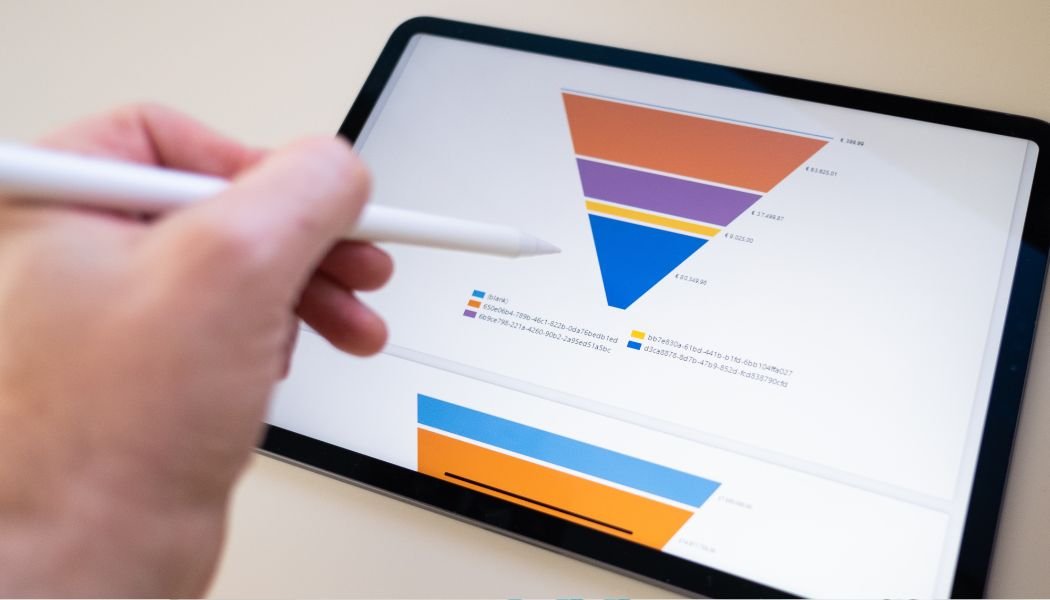
From Clicks to Customers: Building a High-Converting Marketing Funnel
In today’s competitive digital landscape, generating website traffic is only half the battle.
Leave a Reply