People can instantly tell when they’re being sold to, even when it’s subtle. It shows up in the tone, the urgency, and the constant push to take action. Over time, this creates resistance. People scroll faster, skip content, and disconnect from anything that feels too promotional. That’s why many brands struggle to hold attention today, even with consistent posting.
Authority works differently. Brands that focus on sharing value instead of constantly selling build trust naturally. People don’t feel targeted — they feel connected. And that connection is what keeps a brand relevant, trusted, and remembered.
1. Understand What Authority Really Means Today
Authority is no longer about sounding perfect or overly professional. In fact, content that feels too polished often creates distance instead of connection. What works now is clarity, honesty, and consistency in communication. When someone comes across your content and feels like it actually makes sense or helps them understand something better, trust starts forming instantly. Over time, that trust builds into something stronger, and that’s where build authority without selling starts becoming real instead of just a concept.
2. Focus on Being Useful Instead of Impressive
A lot of content tries to sound smart rather than be helpful, but people don’t remember complexity—they remember clarity. When your content solves a small problem, answers a question, or gives a simple insight someone can use immediately, it stays with them. Shifting your mindset from trying to impress to trying to help completely changes how people perceive you. This is where brand authority building begins, through consistent value rather than big claims.
3. Share the Process, Not Just the Outcome
Most content online focuses only on results, showing the final polished version of success. But what people connect with is the journey behind it. Talking about what didn’t work, what had to be changed, and what you learned along the way makes your content feel real. It removes the pressure of perfection and replaces it with relatability. This kind of openness builds deeper trust and supports build authority without selling in a much more natural way.
4. Communicate Like a Human, Not a Brand
One of the biggest mistakes in content is sounding too scripted or corporate. People don’t connect with perfect language—they connect with real conversations. When your content feels like something a person would actually say, it becomes easier to understand and more engaging to read. Over time, this creates familiarity, and that familiarity plays a huge role in build authority without selling because people start recognizing and trusting your voice.
5. Give Value Without Holding Back
There’s always a hesitation that sharing too much will reduce your value, but the opposite is true. When you consistently share insights, break down ideas, and make things easier for others to understand, people begin to see you as someone who genuinely knows their space. Instead of questioning your expertise, they start trusting it. This is how build authority without selling works in practice—by giving without immediate expectation.
6. Stay Consistent Even When Growth Feels Slow
Authority doesn’t come from one post or one viral moment. It builds over time through consistency. Even when it feels like your content isn’t getting enough attention, people are still watching and forming impressions. They begin to recognize your ideas, your tone, and your perspective. Over time, that recognition turns into trust, and that trust is what makes build authority without selling sustainable.
7. Let Results Speak Without Over-Promotion
You don’t need to constantly say you’re the best to be seen as valuable. In fact, repeating it too often reduces credibility. Instead, showing small wins, real examples, and honest outcomes allows people to understand your value on their own. This kind of subtle approach feels more genuine and builds stronger trust. That’s how brand authority building happens quietly but effectively.
8. Build a Clear Point of View
Authority becomes stronger when you’re not just sharing information, but also sharing your perspective. When you consistently express what you believe works, what doesn’t, and what people often misunderstand, your content becomes more memorable. People begin to associate certain ideas with you. This clarity of thought is a key part of build authority without selling, because it makes your voice stand out without needing to be loud.
Conclusion
Building authority today isn’t about pushing people to trust you or constantly proving your value. It’s about showing up in a way that feels honest, clear, and genuinely helpful. When brands focus more on connection than conversion, people start paying attention naturally.
Over time, audiences stop seeing the content as just another post and begin to see the brand as trustworthy and worth following. That’s the real power of building authority without selling — it turns attention into trust, and trust into long-term growth.
At Upswing Digital, building meaningful brand authority is at the core of creating lasting audience relationships. Upswing Digital believes that brands grow stronger when they focus on trust, value, and genuine connection instead of constant selling.
Every brand dreams of the moment a piece of content takes off — the shares multiply, notifications flood in, and the brand name is on everyone’s lips. But virality isn’t pure luck. It’s the result of precise, intentional decisions made before a single word is written or a frame is recorded.
In this blog, we break down the science and strategy behind viral contents — and show you how Upswing helps brands engineer that breakthrough moment.
1. Emotion Is the Engine
Viral contents almost always triggers a strong emotional reaction. Research consistently shows that contents evoking high-arousal emotions — awe, amusement, anger, inspiration, or surprise — is far more likely to be shared than contents that leaves people feeling neutral.
Contents don’t go viral because it’s seen. It goes viral because it’s felt.
Think about the most shared posts you’ve encountered. They probably made you laugh out loud, gasp, cry, or feel deeply inspired. That emotional charge is what compels someone to hit ‘share’ without a second thought.
The emotions that drive the most sharing include:
• Awe — contents that expand the viewer’s perspective or shows something extraordinary
• Amusement — humor that feels authentic, not forced or corporate
• Inspiration — stories of transformation, resilience, or achievement
• Surprise — unexpected twists, stats, or revelations that defy expectations
• Nostalgia — contents that reconnects people with cherished memories
2. Value That Stands Alone
Viral contents offers something genuinely useful, entertaining, or enlightening. It needs to be so good that people want others to see it — not because they were prompted, but because sharing it makes them look knowledgeable, funny, or caring.
There are three core types of value that drive virality:
Practical Value
How-to guides, life hacks, and actionable tips that genuinely solve problems. When someone learns something useful, they naturally want to pass it on.
Entertainment Value
Engaging storytelling, humor, or creative visuals that captivate audiences. People share what makes them look like they have great taste.
Social Currency
Contents that makes the sharer look good — smart, funny, compassionate, or in-the-know. This is one of the most underrated drivers of sharing behaviour.
3. Identity and Tribal Belonging
Viral contents often taps into a person’s sense of identity — who they are, what they believe, and who they belong to. When contents resonate with someone’s values, community, or worldview, sharing it becomes a statement of self.
“This is so me.” “My team needs to see this.” “Every parent can relate.” — These are all identity-driven sharing triggers.
Brands that understand their audience’s identity deeply — their aspirations, frustrations, and tribal affiliations — can craft contents that feels personally made for each viewer, even at scale.
4. Simplicity and Clarity
Complexity kills virality. The most shared contents are easy to understand, quick to consume, and immediately obvious in its value. If someone needs to think too hard, they’ll scroll past.
Key principles for viral-ready clarity:
• Headlines that promise a specific, compelling outcome
• Visuals that communicate the core idea in seconds
• Short-form formats — Reels, TikToks, Twitter threads — that respect the audience’s time
• A single, focused message rather than multiple competing ideas
The goal is zero friction between encountering the content and understanding its value.
5. Timing and Cultural Relevance
Even the best contents can fall flat if it arrives too early, too late, or out of context. Viral moments are often born at the intersection of a great idea and perfect timing.
Timing factors that amplify reach:
• Trending topics, hashtags, and conversations already in motion
• Cultural moments — holidays, sports events, award shows, breaking news
• Platform-specific peak hours when your target audience is most active
• Seasonal trends that align with your brand’s message
Brands that can move fast — ideating, creating, and publishing within hours of a trend — consistently capture disproportionate attention.
6. Shareability Is Designed, Not Accidental
The most viral contents are built with sharing in mind from the very first draft. This means thinking about why someone would share it, who they’d share it with, and what it says about them when they do.
Design-for-sharing checklist:
• Do the contents have a strong, shareable hook in the first 3 seconds?
• Is it mobile-optimized? (Over 90% of shares happen on mobile)
• Does it include a clear call-to-action — tag a friend, share this, save it?
• Are captions optimized for both algorithmic discovery and human appeal?
• Is the format native to the platform it’s published on?
7. Social Proof and the Network Effect
People share what other people are already sharing. The early momentum of a post — likes, comments, initial shares — signals to algorithms and audiences alike that this content is worth paying attention to.
This is why the first 60 minutes of a post’s life are often the most critical. Engaging your core community immediately after publishing can trigger the algorithmic boost that propels contents into broader feeds.
• Encourage your team, partners, and loyal followers to engage early
• Use email newsletters to drive initial traffic to high-priority posts
• Leverage influencer partnerships to seed content in new audiences
• Re-share and repurpose contents across multiple channels to extend its reach
Conclusion
At Upswing, we believe virality isn’t a lottery ticket — it’s an outcome you architect.
Our approach to is rooted in a deep understanding of what makes people share — and what makes algorithms amplify. Here’s how we help brands engineer content that travels:
Audience Intelligence Before Ideation
Before we write a single word, we dig into your audience’s psychology — their emotional triggers, their identity markers, the conversations they’re already having. This isn’t guesswork. It’s data-driven empathy.
Platform-Native Content Creation
A Reel is not a TikTok is not a LinkedIn post. We create contents tailored to each platform’s unique language, format, and algorithm — ensuring maximum native reach wherever your audience lives.
Speed Without Sacrificing Quality
Trend windows are narrow. Upswing’s agile contents are built to move fast — from a cultural moment emerging to a polished, on-brand post published — without cutting corners on creativity or quality.
Systematic Testing and Optimization
We don’t just create and hope. We test hooks, formats, posting times, and CTAs systematically, feeding real performance data back into every future decision. Your strategy gets smarter with every post.
Owned + Earned Distribution Strategy
Going viral requires more than great contents — it requires a distribution engine. Upswing builds integrated distribution strategies that combine owned channels (email, website, social profiles), earned channels (press, influencers, communities), and paid amplification to give every contents the best possible launchpad.
Final Thoughts
Viral contents are rarely an accident. It’s the product of emotional intelligence, creative clarity, cultural timing, and a deep understanding of the people you’re creating for. The brands that consistently produce contents that spreads aren’t lucky — they’re strategic.
At Upswing, we bring together the art of storytelling and the science of distribution to help brands create contents that doesn’t just get seen — it gets shared, saved, and talked about.
Ready to build a content strategy that travels? Let’s create something worth sharing.
Introduction: The Battle for Attention Has Never Been Fiercer
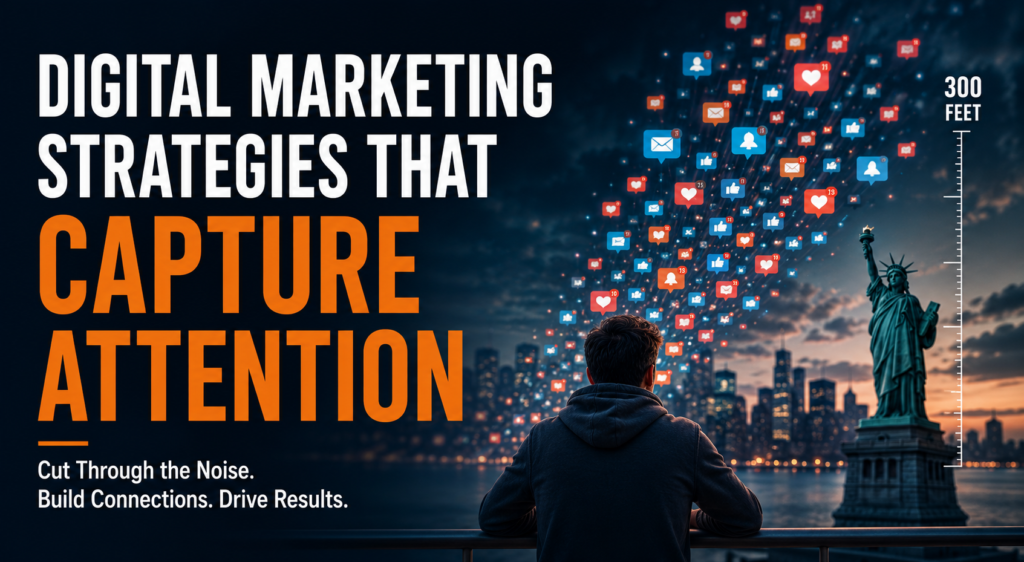
Here’s a reality check: the average person scrolls through 300 feet of content every day. That’s the height of the Statue of Liberty—twice.
Your potential customers are drowning in notifications, ads, emails, and social posts. They’re skimming, not reading. Swiping, not stopping.
So how do you make them pause? How do you earn their attention in a world designed to steal it?
That’s exactly what we’re going to cover. This guide breaks down digital marketing strategies that actually work—the ones that cut through noise, create genuine connections, and turn casual scrollers into loyal customers.
No fluff. No outdated tactics. Just practical approaches you can implement this week.
Why Capturing Attention Online Is Harder Than Ever
Let’s start with what you’re up against.
The average human attention span has dropped to around 8 seconds. For context, a goldfish clocks in at 9. We’re not just competing with other brands anymore—we’re competing with everything else demanding space in someone’s brain.
The Three Enemies of Online Attention
1. Content Overload
Over 7 million blog posts are published every single day. Add in social media posts, videos, podcasts, and emails, and the sheer volume is overwhelming.
2. Platform Algorithms
Social media platforms prioritize content that keeps users engaged longer. If your content doesn’t spark immediate interest, it gets buried.
3. Shrinking Patience
People want answers fast. If your website takes more than 3 seconds to load, 53% of mobile users will leave.
Understanding these challenges is step one. Now let’s talk solutions.
Strategy 1: Lead With Value, Not Sales Pitches
Here’s a mistake I see constantly: businesses leading with what they sell instead of what they solve.
Nobody wakes up wanting to buy a “revolutionary SaaS platform” or a “cutting-edge solution.” They wake up with problems. Your job is to position your brand as the answer.
How to Apply This
● Create content that teaches first. Answer questions your audience is already asking. Use tools like AnswerThePublic or Google’s “People Also Ask” to find these.
● Give away your best ideas. Sounds counterintuitive, but generosity builds trust.
When you help someone for free, they remember you when they’re ready to buy.
● Solve one specific problem per piece of content. Don’t try to cover everything. Depth beats breadth.
Example: A fitness brand could write “How to Build a Home Workout Routine in 20 Minutes” instead of “Why Our Fitness App Is Amazing.” One attracts. The other repels.
Strategy 2: Master the Hook
You have roughly 3 seconds to convince someone to keep reading, watching, or listening. That’s your hook—and it’s everything.
Elements of a Great Hook
● Pattern interrupt. Say something unexpected. Challenge a common belief. Start with a surprising statistic.
● Specificity. Vague promises don’t work. “Boost your sales” is forgettable. “How one email added $47,000 in revenue” is not.
● Curiosity gap. Give enough information to intrigue, but not enough to satisfy. Make them need to know more.
Hook Examples That Work
Weak Hook
Strong Hook
Learn about marketing tips
The marketing tactic that tripled our traffic in 60 days
Social media is important
Why posting more is actually hurting your reach
Grow your business online
We went from 0 to 10,000 followers without spending a dime
The strong hooks create questions in your mind. That tension is what drives engagement.
Strategy 3: Embrace Video Marketing (Seriously)
If you’re not using video content, you’re leaving massive opportunities on the table.
Here’s what the data shows:
● Video content gets 1200% more shares than text and images combined
● 84% of consumers say they’ve been convinced to buy after watching a brand’s video
● YouTube is the second-largest search engine in the world
Video Formats That Capture Attention
Short-form video (15–60 seconds)
Perfect for TikTok, Instagram Reels, and YouTube Shorts. Focus on quick tips, behind-the-scenes glimpses, or entertaining content related to your niche.
Educational long-form video (5–15 minutes)
Great for YouTube. Dive deep into topics. Establish expertise. These videos build serious trust over time.
Live video
Webinars, Q&As, product demos. Live content feels authentic and creates urgency—people don’t want to miss out.
Getting Started With Video
You don’t need fancy equipment. A smartphone, decent lighting, and a clear message are enough to begin. Perfectionism kills more content than poor production ever will.
Strategy 4: Build an Email List (And Actually Use It)
Social media reach is rented. Algorithms change. Platforms rise and fall.
Your email list is owned. It’s direct access to people who raised their hands and said, “Yes, I want to hear from you.”
Why Email Still Dominates
● Email marketing returns an average of $36 for every $1 spent
● You control the relationship—no algorithm sitting between you and your audience
● Emails feel personal in a way that social posts don’t
How to Grow Your List
Offer something valuable in exchange. This is your lead magnet—a free guide, checklist, template, or mini-course that solves a specific problem.
Make signup easy. Place forms in multiple locations: homepage, blog posts, exit-intent popups, and landing pages.
Segment from the start. Ask one simple question during signup to learn what subscribers care about most. Then tailor your content accordingly.
Email Engagement Tips
● Write subject lines like headlines. Make them impossible to ignore.
● Keep emails scannable. Short paragraphs, bullet points, one clear call to action.
● Send consistently. Whether it’s weekly or monthly, set an expectation and stick to it.
Strategy 5: Leverage Social Proof Everywhere
Humans are wired to look at what others are doing before making decisions. This is social proof, and it’s one of the most powerful psychological triggers in marketing.
Types of Social Proof
● Customer reviews and testimonials. Feature them prominently on your website, landing pages, and product pages.
● Case studies. Show the transformation. What was life like before your product? What changed after?
● User-generated content. When customers share photos or videos using your product, amplify it. It’s more believable than anything you could create.
● Numbers. “Trusted by 50,000+ businesses” or “4.8 stars from 2,000 reviews” creates instant credibility.
Where to Use Social Proof
Don’t limit it to a single testimonials page nobody visits. Sprinkle it throughout:
● Homepage above the fold
● Checkout pages (reduces cart abandonment)
● Email sequences
● Social media bios and posts
● Sales pages and landing pages
Strategy 6: Optimize for Search Intent (Not Just Keywords)
SEO has evolved. It’s not enough to stuff keywords into your content and hope for the best. Google now prioritizes content that truly answers what people are searching for.
Understanding Search Intent
Every search falls into one of four categories:
Intent Type
What They Want
Example Search
Informational
Learn something
“How does content marketing work”
Navigational
Find a specific site
“HubSpot login”
Commercial
Compare options
“Best email marketing tools 2025”
Your content should match the intent behind the keyword you’re targeting. An informational searcher doesn’t want a sales page. A transactional searcher doesn’t want a 3,000-word guide.
SEO Best Practices for Attention
● Optimize title tags and meta descriptions. These are your first impression in search results. Make them compelling.
● Use headers strategically. Structure your content so both readers and search engines can easily navigate it.
● Answer questions directly. This increases your chances of appearing in featured snippets—the coveted “position zero.”
● Focus on user experience. Fast loading, mobile-friendly design, and easy navigation all influence rankings.
Strategy 7: Create Interactive and Personalized Experiences
Static content is everywhere. Interactive content stands out because it requires participation.
Interactive Content Ideas
● Quizzes. “What’s Your Marketing Personality?” or “Which Product Is Right for You?” These generate engagement and collect valuable data.
● Calculators. ROI calculators, savings estimators, or custom quote tools. They provide immediate, personalized value.
● Polls and surveys. Ask your audience what they think. People love sharing opinions.
● Interactive infographics. Let users explore data at their own pace.
The Power of Personalization
When content feels tailored to the individual, attention increases dramatically.
● Use dynamic website content that changes based on visitor behavior or demographics.
● Send personalized email campaigns based on past purchases or browsing history.
● Implement retargeting ads that remind people of products they viewed.
For small businesses with limited budgets, content marketing combined with email marketing offers the best return. Creating valuable blog posts or videos attracts organic traffic over time, while email marketing nurtures those visitors into customers without ongoing ad spend.
How long does it take to see results from digital marketing?
It depends on the strategy. Paid advertising can generate traffic immediately. SEO and content marketing typically take 3–6 months to gain momentum. Email marketing shows results within weeks once you have an engaged list. Patience and consistency are essential.
Should I focus on one platform or be everywhere?
Start with one or two platforms where your target audience is most active. Master those before expanding. Spreading too thin leads to mediocre results everywhere. Depth beats breadth, especially when you’re building an audience.
How important is mobile optimization for digital marketing?
Critical. Over 60% of web traffic comes from mobile devices. If your website isn’t mobile-friendly, you’re losing the majority of potential customers before they even engage with your content.
What’s the biggest mistake brands make when trying to capture attention online?
Talking about themselves too much. The brands that win focus obsessively on their audience’s problems, desires, and questions—not on their own features and achievements.
Conclusion: Attention Is Earned, Not Demanded
The brands that capture attention online aren’t the loudest. They’re the most helpful, the most human, and the most consistent.
Every strategy in this guide comes back to one principle: put your audience first.
Lead with value. Hook them fast. Show up reliably. Make their experience personal.
Start with one strategy today. Master it. Then add another.
At Upswing, we believe that in a world where everyone is fighting for attention, the brands that earn it through genuine value will always win. That’s why Upswing focuses on creating strategies that build real engagement, not just impressions.
Your next step: Pick the strategy that resonates most with where you are right now, and commit to implementing it this week. Progress beats perfection.
Internal Linking Suggestions
● Link to related posts on content marketing tips, SEO fundamentals, or email marketing guides
● Connect to case studies showcasing successful digital campaigns
● Reference product or service pages where relevant strategies align with your offerings
External Authority Sources to Reference
● Google Search Central documentation for SEO best practices
● HubSpot State of Marketing Report for statistics
● Nielsen research on consumer behavior and attention● Pew Research Center for digital usage trends
Ambient marketing ideas are no longer just creative experiments, they are powerful tools that help brands break through the noise and create unforgettable experiences. In a world where consumers are constantly bombarded with ads, traditional marketing often gets ignored. Ambient marketing, however, surprises people in their everyday environments and makes them stop, notice, and engage.
Think about the last time you saw something unexpected in public — a creative billboard, a street installation, or a clever brand placement. Chances are, you remembered it and maybe even shared it online. That’s exactly what makes ambient marketing ideas so effective — they are designed to spark curiosity and go viral naturally.
In 2026, brands are moving beyond digital screens and focusing on real-world experiences that connect emotionally with audiences. Whether you’re a marketer, business owner, or creative strategist, this guide covers the 7 best ambient marketing ideas that can drive massive brand awareness.
• 70% — of consumers remember brands that use creative outdoor advertising • 60% — of viral campaigns include an offline or experiential element • 85% — of people are more likely to engage with interactive brand experiences • 3X — higher recall rate compared to traditional ads
What Makes Ambient Marketing So Powerful?
Before jumping into ideas, it’s important to understand why ambient marketing works so well. Every successful campaign is built on three core principles:
• Surprise: Catching people off guard in unexpected places • Engagement: Encouraging interaction and participation • Shareability: Making the experience worth sharing online
Master these three, and your campaign has strong viral potential.
7 Best Ambient Marketing Ideas That Go Viral in 2026
1. Street-Level Interactive Installations
One of the most effective ambient marketing ideas is transforming public spaces into interactive experiences. This could be anything from creative benches to augmented reality street art.
For example, brands install motion-sensitive displays or creative props that people can touch, sit on, or play with. These installations naturally attract attention and encourage people to take photos and share them.
Pro Tip: Add a subtle brand message — not a hard sell — to keep it authentic and engaging.
2. Guerrilla Marketing in High-Traffic Areas
Guerrilla marketing focuses on bold, unconventional tactics placed in crowded locations like malls, metros, or city centers.
This type of ambient marketing idea works because it disrupts routine. People don’t expect advertising in these formats, which makes it more memorable.
Pro Tip: Timing matters — launch during peak hours for maximum visibility.
3. Creative Use of Everyday Objects
Turning everyday objects into marketing tools is one of the smartest ambient marketing ideas.
Think of branded coffee cups, escalators, or even pedestrian crossings transformed into creative visuals. These subtle yet clever executions blend into daily life while still grabbing attention.
Pro Tip: Keep the design simple but visually striking for better recall.
4. Experiential Pop-Up Campaigns
Pop-ups are temporary experiences designed to immerse people in your brand. These can be mini-events, themed installations, or interactive zones.
This ambient marketing idea works especially well for product launches or seasonal campaigns because it creates urgency and exclusivity.
Pro Tip: Combine offline experience with social media hashtags to boost reach.
5. Ambient Projections and Digital Displays
Projection mapping and digital displays are modern ambient marketing ideas that bring buildings and spaces to life.
Brands can project visuals onto walls, roads, or landmarks, creating a visually stunning experience that attracts crowds instantly.
Pro Tip: Use storytelling in your visuals to create emotional impact.
6. Transit Advertising with a Twist
Buses, taxis, and trains are traditional ad spaces — but with creativity, they become powerful ambient marketing tools.
Wrap vehicles in 3D designs or interactive elements that make people look twice. This increases both offline visibility and online sharing.
Pro Tip: Design for movement — your message should be clear even at a glance.
7. Socially Driven Ambient Campaigns
The best ambient marketing ideas today are designed for social media amplification.
Create installations or experiences that encourage user-generated content. When people share your campaign, your reach multiplies organically.
Pro Tip: Make your campaign “Instagrammable” — visuals matter more than ever.
Common Mistakes in Ambient Marketing
Even great ideas can fail if executed poorly. Here are common mistakes to avoid:
• Over-branding the experience — it should feel natural, not forced • Ignoring audience context — relevance is key • Lack of shareability — if people don’t share it, reach is limited • Poor location choice — placement determines success • No follow-up strategy — connect offline impact with online channels
Ambient Marketing Is About Experience, Not Just Visibility
Ambient marketing ideas are not just about being seen — they are about being remembered. The brands that succeed are the ones that create experiences people talk about, share, and emotionally connect with.
In 2026, the future of marketing lies in blending physical and digital worlds. Campaigns that combine creativity, interaction, and shareability will always outperform traditional ads.
If you want your brand to stand out, don’t just advertise — create moments.
Final Thoughts & Conclusion
Ambient marketing ideas are not just creative tactics — they are strategic brand-building tools that bridge the gap between real-world experiences and digital amplification. In an era where attention spans are shrinking and ad fatigue is rising, brands that dare to be different are the ones that win.
The real power of ambient marketing lies in its ability to surprise, engage, and spread organically. At Upswing, it’s not about spending more — it’s about thinking smarter. A single well-executed idea in the right place can outperform large-scale traditional campaigns when it connects emotionally and encourages sharing.
However, success doesn’t come from creativity alone. The most effective ambient marketing ideas are backed by clear audience understanding, strong placement strategy, and a seamless integration with digital channels. When offline experiences are designed with online amplification in mind, that’s when true virality happens.
Looking ahead, the future of marketing will increasingly blend physical experiences with AI, social media, and immersive technologies. Brands that experiment with ambient marketing today are not just creating campaigns — they are building memorable brand moments that stay with consumers long after the interaction.
If you want to stand out in 2026 and beyond, the takeaway is simple: Don’t just advertise — create experiences people can’t ignore
Social media content is evolving faster than ever. What worked a few years ago no longer guarantees results today. Among the biggest shifts is how carousel posts are now outperforming static creatives across platforms like Instagram and LinkedIn.
While static posts still have their place, carousel content is gaining more reach, higher engagement, and better retention. For brands and creators, understanding this shift is essential to stay competitive.
So, why exactly are carousel posts outperforming static creatives? The answer lies in how users interact with content today.
1. Carousels Increase User Interaction Time
One of the biggest advantages of carousel posts is that they encourage users to spend more time on a single piece of content. Instead of just viewing and scrolling past, users swipe through multiple slides.
This extended interaction signals to the platform that the content is engaging. As a result, the algorithm pushes it to more users, increasing reach and visibility.
2. They Deliver More Value in a Single Post
Static creatives are limited to one message, but carousels allow you to share multiple ideas within the same post. This makes them ideal for storytelling, education, and step-by-step content.
When users find value in multiple slides, they are more likely to save and share the post, which further boosts performance.
3. Carousels Improve Content Retention
People tend to remember content better when it is presented in a structured and progressive way. Carousel posts guide users through information one step at a time, making it easier to understand and retain.
This is especially effective for educational content, tips, and insights that require explanation.
4. Multiple Chances to Capture Attention
With static posts, you only have one chance to grab attention. If the first impression fails, the user scrolls away.
Carousels offer multiple opportunities. Even if the first slide does not fully capture interest, the next slides can still engage the viewer. This increases the chances of keeping users hooked.
5. Better Algorithm Support
Social media platforms prioritize content that keeps users engaged. Since carousel posts encourage swiping, saving, and sharing, they naturally perform better in terms of engagement metrics.
Some platforms even re-show carousel posts to users who did not interact the first time, giving them a second chance to perform.
6. Ideal for Storytelling and Branding
Carousels allow brands to tell a story rather than just deliver a message. This makes content more relatable and emotionally engaging.
From showcasing a journey to explaining a process, storytelling through carousels helps brands connect with their audience on a deeper level.
7. Higher Save and Share Rates
Content that provides value tends to get saved and shared. Carousel posts, especially those that offer tips or insights, encourage users to revisit and share with others.
Higher saves and shares signal strong engagement, which further improves reach and visibility.
8. Versatility Across Content Types
Carousel posts can be used for various purposes, including education, promotions, storytelling, and brand awareness. This versatility makes them a powerful tool for content strategy.
Instead of creating multiple posts, brands can deliver comprehensive content in a single carousel.
Conclusion
Carousel posts are outperforming static creatives because they align with how users consume content today. They encourage interaction, deliver more value, and keep users engaged for longer periods.
While static creatives are still useful for quick messaging, carousel posts offer a deeper and more effective way to connect with your audience.
At Upswing, we help brands create content strategies that maximize engagement and performance across platforms. At Upswing, we believe that in today’s digital landscape, the content that performs best is the one that keeps people engaged, not just impressed.
Generating leads is one of the biggest challenges for small businesses. With limited budgets, growing competition, and constantly changing digital trends, attracting the right audience can feel overwhelming. However, lead generation does not always require complex systems or expensive campaigns.
The key is to focus on simple, consistent, and effective strategies that bring results over time. When done correctly, even small efforts can create a steady flow of quality leads.
Here are simple lead generation strategies that small businesses can use to grow without overcomplicating their marketing.
1. Optimize Your Website for Lead Generation
Your website is often the first interaction potential customers have with your business, so it should be designed to capture leads effectively. A clear value proposition, easy navigation, and visible call-to-actions help guide visitors toward taking action. When your website communicates your offer clearly and makes it easy to contact you, lead generation becomes more consistent.
2. Focus on Local SEO to Attract Nearby Customers
For small businesses, local visibility is crucial. Optimizing your Google Business Profile, using location-based keywords, and encouraging customer reviews can help your business appear in local search results. When people search for services near them, a strong local presence increases the chances of generating qualified leads.
3. Use Social Media to Build Relationships
Social media is not just about posting content but about engaging with your audience. By responding to comments, sharing valuable insights, and interacting regularly, small businesses can build trust with potential customers. This trust eventually turns into leads, as people are more likely to buy from brands they feel connected to.
4. Offer Valuable Content to Attract Interest
Providing useful content is one of the simplest ways to generate leads. Whether it is blog posts, short videos, or helpful tips, content that solves problems attracts the right audience. When users find value in your content, they are more likely to reach out or follow your business for more information.
5. Use Simple Lead Magnets to Capture Contacts
Offering something valuable in exchange for contact information can significantly increase lead generation. This could be a free consultation, a downloadable guide, or a special discount. When the offer is relevant and useful, people are more willing to share their details.
6. Leverage Email Marketing for Consistent Follow-Up
Collecting leads is only the first step; nurturing them is equally important. Email marketing allows small businesses to stay connected with potential customers by sharing updates, offers, and useful information. Consistent communication builds trust and keeps your brand top of mind.
7. Encourage Word-of-Mouth and Referrals
Happy customers can become your best source of leads. Encouraging referrals and creating a positive customer experience helps generate organic growth. When people recommend your business to others, it brings in leads that already have a level of trust.
8. Use Paid Ads Strategically, Not Excessively
Paid advertising can support lead generation, but it should be used wisely. Instead of spending heavily, small businesses can focus on targeted campaigns that reach the right audience. Even a small budget can generate good results when combined with strong messaging and clear objectives.
Conclusion
Lead generation for small businesses does not need to be complicated. By focusing on simple strategies such as optimizing your website, building relationships, creating valuable content, and nurturing leads, you can create a steady and reliable flow of potential customers.
At Upswing, we believe that effective lead generation is built on clarity, not complexity. Our approach focuses on creating practical systems that small businesses can maintain and scale without unnecessary pressure. From improving your online presence to building structured follow-up processes, Upswing helps turn everyday marketing activities into consistent lead generation opportunities.
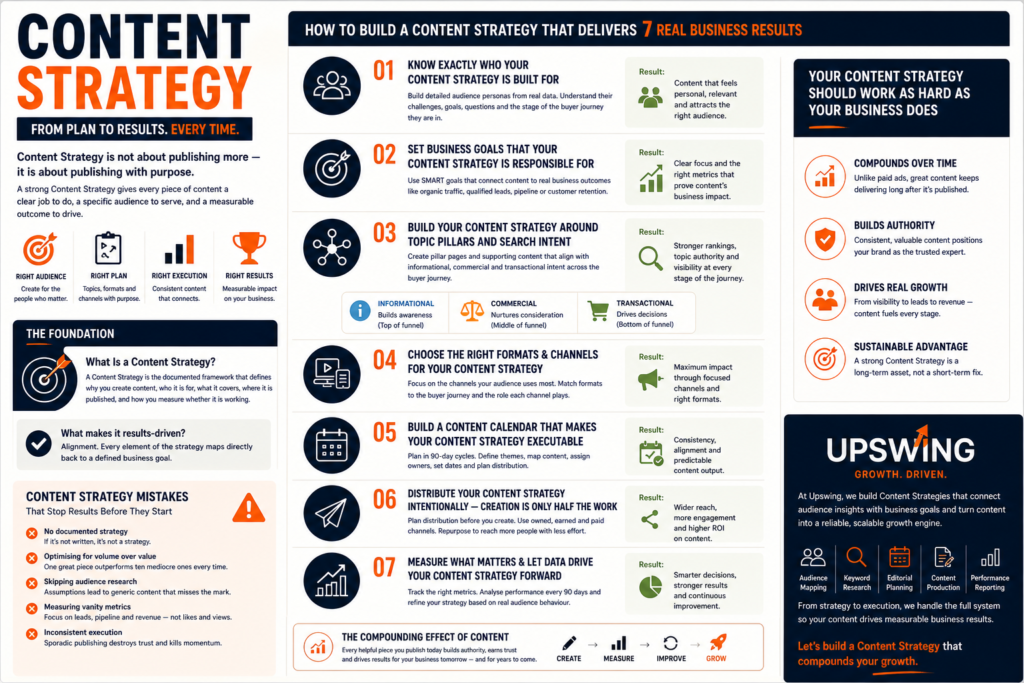
Content Strategy is not about publishing more — it is about publishing with purpose. Most businesses today are creating content. Very few are creating content that actually drives results. The gap between the two is almost never a question of talent or budget. It is a question of strategy.
Without a clear Content Strategy, even the best content gets lost. It attracts the wrong audience, targets the wrong keywords, goes out on the wrong channels, and gets measured by the wrong metrics. The result is a content operation that feels busy but delivers little in return. In 2026, where AI-generated content floods every platform and buyer attention is harder to earn than ever, a vague approach to content is a direct path to wasted effort.
A strong Content Strategychanges all of that. It gives every piece of content a clear job to do, a specific audience to serve, and a measurable outcome to drive. This guide walks you through exactly how to build one — step by step — and what it looks like when your Content Strategy starts driving real, compounding business results.
What Is a Content Strategy and What Makes It ‘Results-Driven’?
A Content Strategy is the documented framework that defines why you create content, who it is for, what it covers, where it is published, and how you measure whether it is working. It is the thinking that sits behind all content marketing execution — the plan that makes every piece of content intentional rather than reactive.
What makes a Content Strategy results-driven specifically is alignment. Every element of the strategy — the audience, the topics, the formats, the channels, the publishing cadence, the KPIs — maps directly back to a defined business goal. The content is the foundation of both SEO and owned media effectiveness, and a documented Content Growth Strategy is what ensures that foundation is built with intention rather than guesswork.
The brands that consistently grow through content are not necessarily the ones with the largest teams or the biggest production budgets. They are the ones with the clearest Content Strategy and the discipline to execute it consistently over time.
How to Build a Content Strategy That Delivers 7 Real Business Results
1. Know Exactly Who Your Content Strategy Is Built For
The first and most important decision in any Content Strategy is audience definition. Not a broad demographic — a specific, research-backed picture of the real person your content is meant to serve. Their role, their daily challenges, their goals, the questions they are actively searching for answers to, and the language they use to describe their problems.
Build audience personas from real data: customer interviews, CRM insights, sales call recordings, and social listening. Each persona should clarify the stage of the buyer journey they occupy and the type of content they need at that stage. A Content Framework built on genuine audience understanding produces content that feels personal and relevant — and content that feels personal converts at a significantly higher rate than content built on assumptions.
The audience research is the single most impactful step in building a Content Framework that connects content output to revenue outcomes. Without it, even high-quality content consistently misses the mark.
2. Set Business Goals That Your Content Strategy Is Responsible For
A Content Strategy without defined business goals is just a publishing schedule. Before any content is created, define specifically what you need content to achieve and make sure those outcomes are ones the business actually cares about.
Use SMART goals to anchor your Content Strategy: Specific, Measurable, Achievable, Relevant, and Time-bound. Goals should connect directly to business outcomes such as organic traffic growth, qualified lead generation, sales pipeline contribution, or customer retention rates, not to vanity metrics like impressions or follower counts.
Every goal in your Content Strategy should answer two questions: What business result will this content drive? And how will we know when it has done that? These questions force strategic clarity and make it far easier to prioritise content topics, formats, and channels that actually matter.
3. Build Your Content Strategy Around Topic Pillars and Search Intent
The structural backbone of a high-performing Content Strategy in 2026 is topic authority. Rather than creating isolated pieces of content around individual keywords, the most effective approach is to build interconnected topic clusters: a comprehensive pillar page covering a broad subject, surrounded by a network of more specific supporting content that links back to it.
This structure signals genuine topical expertise to both Google and AI-powered answer engines, which are increasingly the primary discovery surfaces for buyers researching solutions. To aligning your Content Strategy with search intent — understanding whether a reader is in an informational, commercial, or transactional mindset — is what separates content that ranks from content that sits unseen.
• Informational content — builds awareness and earns organic discovery at the top of the funnel
• Commercial content — nurtures consideration by comparing options and addressing objections
• Transactional content — supports purchase decisions at the bottom of the funnel
A well-structured Content Strategy maps content to each of these intent types, ensuring your brand is present and helpful at every stage of the buyer journey.
4. Choose the Right Formats and Channels for Your Content Strategy
One of the fastest ways to undermine a Content Strategy is trying to be everywhere at once. Spreading content across every platform with insufficient focus almost always produces mediocre results across all of them. The smarter approach is to identify where your specific audience is most active and most receptive, and then commit to doing those channels exceptionally well.
In 2026, short-form video dominates for awareness and social reach, while long-form written content remains the strongest driver of organic search traffic and lead nurturing. The most effective Content Strategy uses multiple formats assigned to specific roles in the customer journey — rather than repurposing the same content identically across every channel.
Map your content formats to buyer journey stages and assign each channel a specific strategic role within your Content Strategy. This clarity prevents wasted effort and ensures every piece of content is created with its destination and purpose already defined.
5. Build a Content Calendar That Makes Your Content Strategy Executable
The most sophisticated Content Strategy in the world delivers nothing without consistent execution. A content calendar is what bridges the gap between strategic planning and daily publishing reality. It translates your audience insights, goals, and channel decisions into a concrete, shared schedule that keeps the whole team aligned.
Plan your Content Framework execution in 90-day cycles. Define the themes for each cycle, map out individual content pieces, assign ownership, set publication dates, and include a distribution plan for each asset. This sprint-based approach gives your Content Strategy enough structure to maintain consistency and enough flexibility to respond to market moments and real-time opportunities.
The brands that publish on a consistent, planned schedule build domain authority and audience trust significantly faster than those that publish reactively. Consistency is not just a discipline it is a direct competitive advantage in your Content Framework.
6. Distribute Your Content Strategy Intentionally — Creation Is Only Half the Work
One of the most expensive mistakes in any Content Strategy is treating distribution as an afterthought. Creating great content and failing to get it in front of the right people is the equivalent of building a brilliant product and putting it in a warehouse with no signage. Distribution deserves the same strategic attention as creation.
Your Content Strategy should define a distribution plan for every piece of content before it is created. This includes which owned channels will carry it (website, email list, social profiles), which earned channels you will pursue (backlinks, press, influencer shares), and whether any paid amplification is warranted to accelerate reach to a targeted audience.
Repurposing is also a critical element of an efficient Content Framework. A single well-researched long-form article can be broken down into social posts, email newsletter content, short-form video scripts, and infographic assets — extending the reach of one investment across multiple channels and audience segments without starting from scratch each time.
7. Measure What Matters and Let Data Drive Your Content Strategy Forward
The final and most decisive element of a results-driven Content Strategy is measurement. Not tracking everything — tracking the right things. The metrics that matter are the ones connected directly to the business goals defined at the start of your Content Strategy, not the ones that are simply easy to report.
Use Google Search Console and Google Analytics 4 to track organic traffic growth, content engagement, and conversion paths. Connect this data to your CRM to understand which content pieces are contributing to qualified leads and closed revenue. Review performance at the end of every 90-day cycle and use the findings to sharpen the next sprint of your Content Strategy.
The most effective content teams treat their Content Strategy as a living system. They double down on what is working, cut what is not, update older content to keep it competitive, and continuously refine their approach based on real audience behaviour rather than internal assumptions. Over time, this compounding cycle of create, measure, and improve is what separates brands that grow through content from brands that simply publish.
Content Strategy Mistakes That Stop Results Before They Start
These are the errors that most commonly prevent a Content Strategy from delivering the results it should — and most of them are entirely avoidable:
• No documented strategy: A Content Strategy that exists only in someone’s head is not a strategy — it is a preference. Write it down, share it across the team, and treat it as a living document that is reviewed and updated regularly.
• Optimising for volume over value: In 2026, one deeply researched, genuinely useful piece of content outperforms ten thin, generic posts every time. Your Content Strategy should prioritise quality and depth.
• Skipping audience research: Building a Content Strategy on assumptions rather than real audience data is one of the most costly mistakes a marketing team can make. The content will feel generic, miss search intent, and fail to convert.
• Measuring vanity metrics: If your Content Strategy is evaluated by page views and social likes rather than leads, pipeline contribution, and revenue impact, you are optimising for the wrong outcomes entirely.
• Inconsistent execution: A Content Strategy only compounds if it is executed consistently over time. Sporadic publishing destroys trust with both your audience and search algorithms.
Your Content Strategy Should Work as Hard as Your Business Does
At Upswing, we believe a great Content Strategy is one of the highest-leverage investments a business can make. Unlike paid advertising, which stops the moment you stop spending, a well-built Content Strategy compounds. Every piece of content you publish adds to your authority, improves your search visibility, and nurtures your audience — building a brand asset that keeps delivering long after the initial effort.
The businesses we work with are not just looking for content. They are looking for growth. And growth through content requires a Content Strategy that is grounded in real audience understanding, aligned with clear business goals, executed with consistency, and measured with rigour. That is the standard we hold every Content Strategy we build to at Upswing.
Whether you are starting a Content Strategy from scratch or auditing an existing one that is not delivering results, Upswing brings the research, the framework, and the execution capability to turn your content into a reliable, scalable growth engine. From audience mapping and keyword research to editorial planning, content production, and performance reporting — we handle the full system.