

Why Customers Ignore Online Ads
Why customers ignore online ads is one of the most important questions any marketer can ask in 2026. Brands are spending more on digital advertising than ever before — and yet click-through rates are falling, ad blocker usage is rising, and consumers are becoming harder and harder to reach through traditional paid placements.
The uncomfortable truth is that most online ads are not being ignored because people hate advertising. They are being ignored because most ads are irrelevant, interruptive, repetitive, or simply untrustworthy.
Understanding why customers ignore online ads is the first step toward fixing the problem. In this blog, we break down the 8 most significant reasons and more importantly, what smart brands are doing differently to cut through the noise and connect with their audiences in ways that actually work.
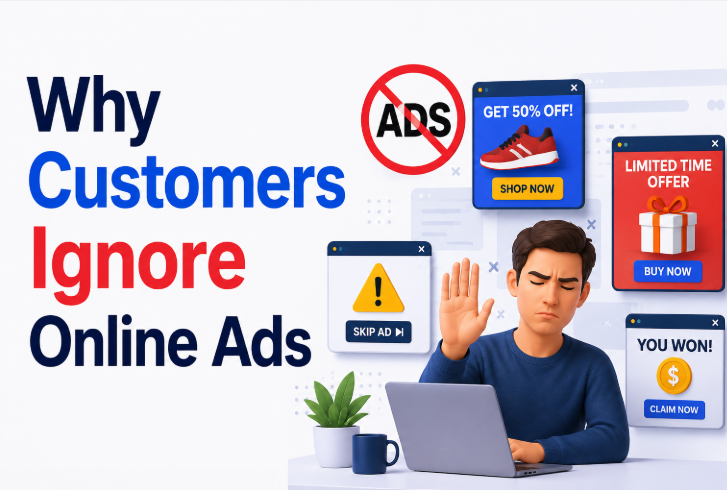
The Scale of the Problem: How Bad Is Ad Blindness?
Before exploring why customers ignore online ads, it helps to understand just how widespread the problem really is.
The average click-through rate for display ads across the internet sits at around 0.1% — meaning 999 out of every 1,000 people who see a banner ad do not click on it. Studies from the Nielsen Norman Group have shown that users have become so conditioned to ignore banner-shaped areas of a webpage that their eyes actively avoid those zones a phenomenon known as banner blindness.
Ad blocker usage has grown significantly year on year. Research suggests that over 40% of internet users now use some form of ad blocking software, with that number significantly higher among younger demographics. And even users who do not block ads have developed sophisticated psychological filters that allow them to tune out advertising content almost automatically.
Key Insight: The problem is not that people cannot see your ads. The problem is that they have trained themselves not to. Understanding why is the most valuable thing a marketer can do.
Reason 1: Ads Feel Irrelevant to the Viewer
The single biggest reason why customers ignore online ads is irrelevance. When an ad does not speak to the viewer’s current needs, interests, or situation, it registers as noise and the brain dismisses it instantly.
This happens constantly. Someone who just bought a new laptop is shown laptop ads for weeks. A 55-year-old professional is shown content aimed at teenagers. A business owner looking for marketing services is shown ads for consumer products that have nothing to do with their world.
Relevance is not just about demographic targeting. It is about reaching the right person at the right moment in their buying journey with a message that matches exactly where they are. When brands fail to do this, customers ignore online ads without a second thought.
How to fix relevance problems:
• Segment your audiences based on behaviour and intent, not just demographics
• Use retargeting to serve ads that reflect what a user has already shown interest in
• Align ad messaging to specific stages of the customer journey awareness, consideration, and decision
• Test different messages for different audience segments and let performance data guide decisions
Reason 2: Consumers Experience Ad Fatigue
Ad fatigue occurs when a consumer sees the same ad or the same type of ad so many times that they become completely desensitised to it. Even a well-crafted, relevant ad will eventually be ignored if it is shown to the same person too frequently.
The problem is particularly acute in digital advertising, where automation and retargeting can result in a single user seeing the same creative dozens of times across multiple platforms in a short period. Rather than building brand recognition, this level of repetition creates irritation —and irritation is one of the fastest routes to being ignored and then actively avoided.
This is one of the most practical and preventable reasons why customers ignore online ads, yet many brands continue to run the same creatives for months without refreshing them.
How to combat ad fatigue:
• Set frequency caps on your ad campaigns limit how many times one person sees the same ad
• Rotate multiple creative variations so audiences see different versions of your message
• Refresh ad creative at least every 4–6 weeks, even if performance appears stable
• Monitor frequency metrics closely rising frequency with falling CTR is the clearest signal of fatigue
Reason 3: Ads Are Too Interruptive
Nobody opens a website or a social media app to watch advertisements. They come for content, connection, entertainment, or information. When an ad interrupts that experience particularly aggressively, with auto-play video, pop-overs, or forced pre-roll the immediate psychological response is resistance.
This is why customers ignore online ads that feel like interruptions: they represent a violation of the user’s intent. The more disruptive the format, the stronger the negative association with the brand which means interruptive advertising can actively damage the brand it is trying to promote.
Research consistently shows that consumers are far more receptive to ads that feel native to the content environment ads that blend into the feed, match the platform’s content style, or offer genuine value rather than demanding attention.
Important Shift: The most effective ads in 2026 do not interrupt the experience they add to it. Think native content, useful sponsored posts, and creator-led integrations that feel like a natural part of the feed.
Reason 4: Trust in Advertising Has Collapsed
Decades of exaggerated claims, misleading promotions, and outright dishonest advertising have left consumers deeply sceptical of anything that looks like a paid placement. This erosion of trust is a fundamental reason why customers ignore online ads and it cannot be solved with better targeting or smarter creative alone.
When a consumer sees an ad claim, their default response in 2026 is scepticism. They ask: Is this too good to be true? Is this brand actually trustworthy? What do other customers say about this? Before acting on almost any ad, the modern consumer will seek external validation through reviews, community discussions, social media comments, or recommendations from people they trust.
Brands that acknowledge this reality and build trust signals into their advertising real reviews, transparent claims, honest comparisons are significantly more likely to cut through than those still relying on empty superlatives.
Trust signals that make ads more believable:
• Real customer testimonials and star ratings within ad creative
• Specific, verifiable claims rather than vague superlatives
• User-generated content incorporated into paid placements
• Transparent pricing and clear terms no hidden catches
• Social proof numbers that are genuine and specific
Reason 5: Banner Blindness Is Hardwired
Banner blindness is not a choice it is a deeply ingrained cognitive response. The human brain is extraordinarily efficient at pattern recognition, and after years of exposure to online advertising, most internet users have developed an automatic visual filter that bypasses anything that looks like an ad.
Eye-tracking studies have demonstrated this phenomenon repeatedly. Users instinctively avoid looking at areas of a webpage where ads are typically placed even when those areas contain content they might actually find relevant. The pattern recognition is faster than conscious thought.
This is one of the most difficult reasons why customers ignore online ads to overcome, precisely because it operates below the level of conscious decision-making. Traditional banner formats, in particular, have become virtually invisible to experienced internet users.
Formats less susceptible to banner blindness:
• Native advertising that matches the look and feel of editorial content
• In-feed social media ads that blend naturally with organic posts
• Sponsored content that delivers genuine value rather than a direct sales message
• Interactive ad formats that require engagement rather than passive viewing
• Video content that earns attention through storytelling rather than demanding it through interruption
Reason 6: Ads Lack Personalisation
In an era when every major digital platform delivers highly personalised experiences Netflix recommending your next show, Spotify curating your daily mix, Amazon suggesting products based on your browsing history a generic, one-size-fits-all advertisement feels jarringly out of place.
Consumers have been conditioned to expect personalisation. When they receive an ad that is clearly not tailored to them wrong product category, wrong life stage, wrong tone, wrong platform it immediately signals that the brand either does not know them or does not care enough to try. Either way, the ad is ignored.
This is why customers ignore online ads that feel generic: in 2026, generic feels disrespectful of the consumer’s time and attention.
Data Point: Personalised ads deliver significantly higher engagement and conversion rates than generic ones. The investment in better data and segmentation pays for itself many times over in improved campaign performance.
Reason 7: Poor Creative Quality
Not every ad is ignored because of a structural problem. Sometimes the creative is simply not good enough to earn attention in the first place.
Poor creative quality is a significant reason why customers ignore online ads. A blurry image, a stock photo that looks identical to thousands of other ads, a headline that says nothing distinctive, a call to action that is confusing or generic these are all reasons for a consumer’s eye to move straight past without pausing.
In a content environment of extraordinary richness and variety, the standard for creative quality is higher than it has ever been. Consumers are constantly exposed to world-class content from their favourite creators, publishers, and brands. Any ad that falls significantly below that standard will be ignored as a matter of course.
What strong ad creative looks like in 2026:
• A clear, specific headline that speaks directly to a real problem or desire
• Visual design that stops the scroll within the first half-second
• A single, focused message rather than trying to communicate everything at once
• Creative that feels native to the platform it appears on
• An honest, specific call to action that tells the viewer exactly what to do next
Reason 8: Ad Blocker Adoption Is Growing Fast
For a growing segment of internet users, the question of why customers ignore online ads is moot because they have taken active steps to ensure they never see ads at all. Ad blocker adoption has grown significantly and consistently, with younger audiences particularly likely to have blocking software installed across their devices.
Ad blockers do not just block banner ads many now block pre-roll video, sponsored search results, and social media paid placements. For brands relying entirely on paid advertising to reach their audience, this represents a fundamental challenge that cannot be solved by improving the ads themselves.
The rise of ad blockers is perhaps the clearest signal the market has sent: consumers will actively work to avoid advertising that does not respect their attention. The brands that take this signal seriously are the ones investing in marketing approaches that earn attention rather than purchasing it.
What Smart Brands Do Instead
Understanding why customers ignore online ads is only useful if it leads to a better approach. Here is what the brands seeing the strongest marketing results in 2026 are doing differently.
They invest in content that earns attention
Rather than fighting for attention through interruption, smart brands create content that consumers actively seek out helpful blog posts, entertaining short-form videos, educational guides, and insightful social media content that delivers real value before asking for anything in return.
They build community instead of just audiences
Brands that have built genuine communities around shared values and interests find that their marketing reach extends organically through member advocacy. Community members share, recommend, and defend the brand without being paid to do so because they genuinely believe in it.
They use paid ads smarter, not louder
The answer to ad blindness is not more ads it is better ads. Smart brands use tight audience segmentation, frequent creative refreshes, native formats, and continuous A/B testing to ensure their paid placements stay relevant, fresh, and genuinely useful to the people who see them.
They leverage social proof and user-generated content
Real customer reviews, user-generated content, and micro influencer partnerships deliver the authenticity that polished brand advertising cannot. When potential customers see real people with real experiences endorsing a product or service, the instinctive scepticism that makes them ignore online ads is significantly reduced.
They prioritise experience over exposure
Rather than optimising purely for reach and impressions, smart brands in 2026 optimise for the quality of every interaction. A smaller number of highly relevant, well-timed, genuinely useful ad exposures will always outperform a large volume of ignored impressions.
Final Thoughts
Why customers ignore online ads is ultimately a story about respect. Consumers ignore ads that waste their time, insult their intelligence, or treat them as passive targets rather than intelligent people with real needs and limited patience.
The brands that take this seriously that build their marketing around genuine relevance, real trust, authentic creativity, and meaningful value are the ones that cut through. Not because they found a way to make people watch ads, but because they found ways to make people genuinely want to engage with their brand.
In 2026, the most powerful marketing does not look like advertising at all. It looks like content people want to read, communities people want to join, and stories people want to share.
At Upswing Digital, we help brands make exactly this shift from spray-and-pray advertising to strategic, audience-first marketing that earns attention and builds lasting relationships with customers.
Leave a Reply