

Why Brands Need a Content Strategy, Not Just Content
Content strategy is one of the most talked about yet least understood concepts in digital marketing. Most brands know they need to create content. Far fewer have a genuine strategy behind what they create, why they create it, and how it connects to their business goals.
The result is an enormous amount of content being produced every day that delivers very little return — because it has no strategic direction guiding it.
In this guide, we explore what a content strategy actually is, why producing content without one is an expensive mistake, and 7 powerful reasons why a clear content strategy consistently outperforms content alone.
What Is a Content Strategy — and What Is It Not?
A content strategy is a documented plan that defines what content a brand will create, why it will create it, who it is created for, where it will be published, and how its performance will be measured.
It is not a content calendar. A content calendar is a scheduling tool — it tells you when content will be published. A content strategy is the framework that decides what goes in that calendar and why.
It is not a list of content ideas. Ideas are the raw material of content. A strategy is the architecture that determines which ideas to pursue, in which format, for which audience, and toward which specific goal.
A genuine content strategy answers one fundamental question: how will this content serve our audience and advance our business goals? Without that answer, content is just noise.
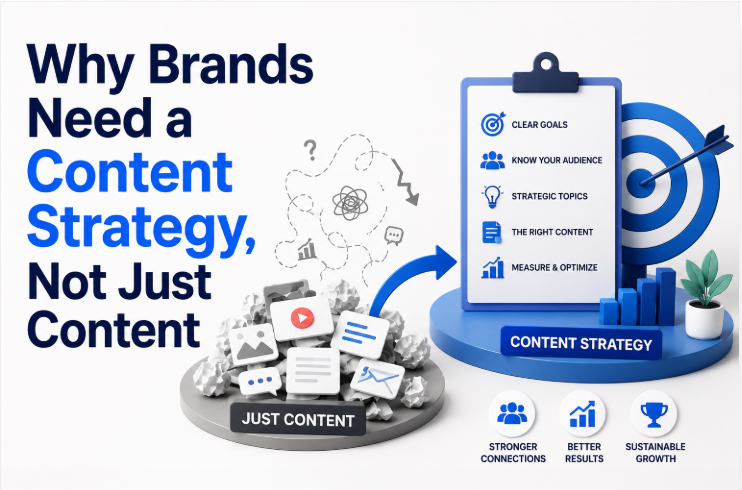
Core Components of a Content Strategy:
• Defined target audience with specific characteristics, needs, and pain points
• Clear business goals that the content is designed to support
• Content pillars — the core themes the brand will consistently cover
• Channel and format plan — where content will appear and in what form
• A measurement framework — the metrics that define content success
• A workflow — how content will be created, approved, and published consistently
Why Content Without a Strategy Almost Always Fails
The evidence of content without a strategy is everywhere. Brands that post inconsistently, cover topics randomly, generate engagement without generating leads, and invest significant time in content creation without seeing any meaningful business return.
This is not a creativity problem. Most brands have no shortage of content ideas. It is a direction problem — content being produced without a clear understanding of who it is for, what it is supposed to achieve, or how it fits into a larger plan.
Signs Your Brand Has Content Without a Content Strategy
• Content topics are chosen based on what feels relevant this week rather than what serves the audience’s deepest needs
• There is no consistent brand voice or visual identity across different pieces of content
• The team cannot articulate which content is performing well and why
• Content generates likes and views but rarely generates enquiries, leads, or sales
• There is no system for content creation — it depends entirely on whoever has time that week
• Content covers every topic under the sun without ever building genuine authority on anything
1. A Content Strategy Connects Every Piece of Content to a Business Goal
The Most Fundamental Advantage of a Content Strategy
The single most important thing a content strategy does is establish a direct line between content and business outcomes. Without this connection, content is an expense. With it, content becomes an investment — one with a measurable return.
A content strategy defines the specific business goals that content is designed to serve — whether that is generating organic search traffic, building brand awareness, nurturing leads through the sales funnel, or converting prospects into customers. And every piece of content created under that strategy is designed with one or more of those goals explicitly in mind.
How Goal-Connected Content Strategy Changes Results
• Every content decision is evaluated against its expected contribution to a defined goal
• Resources are allocated to the content types and channels most likely to deliver on those goals
• Performance is measured against clear objectives rather than vanity metrics
• The team has a shared understanding of what success looks like for each piece of content
The Purpose Test:
A simple but powerful test for any piece of content: which specific business goal does this serve? If the honest answer is none — the content needs to be reconsidered before resources are invested in creating it.
2. A Content Strategy Builds Topical Authority Over Time
How Content Strategy Creates Expertise That Ranks and Converts
One of the most powerful long-term benefits of a well-built content strategy is the topical authority it creates over time. Topical authority is the perception — by both search engines and human audiences — that a brand has deep, comprehensive expertise on a specific subject.
Topical authority is not built by publishing a single great piece of content. It is built by consistently covering a topic in depth over an extended period — creating a network of interconnected content that collectively demonstrates genuine mastery of the subject.
How a Content Strategy Builds Topical Authority
• Defining 3 to 5 content pillars — the core topics the brand will own — and committing to them consistently
• Creating a mix of pillar content and supporting cluster content that covers every dimension of each topic
• Interlinking related content to signal the depth and breadth of coverage to search engines
• Publishing new content within the defined pillars consistently rather than jumping between unrelated topics
• Updating and expanding existing content regularly to maintain its relevance and authority
The SEO Dimension:
Search engines in 2026 reward topical authority significantly. A brand with a content strategy that builds systematic depth on a defined set of topics will consistently outrank competitors who publish broadly without strategic focus — regardless of budget differences.
3. A Content Strategy Ensures Consistency Across Every Channel
Why Consistency Is the Difference Between a Brand and a Publisher
One of the most common problems facing brands without a content strategy is inconsistency. Different team members create content in different tones. Different platforms get treated as unrelated channels rather than parts of a unified brand experience. The result is a fragmented brand identity that confuses audiences and erodes trust.
A content strategy solves this by establishing the brand’s voice, tone, visual identity, and messaging framework as non-negotiable foundations that every piece of content is built upon — regardless of who creates it, which platform it appears on, or what format it takes.
What Consistency Through Content Strategy Looks Like
• A defined brand voice guide that governs how the brand writes and speaks across all channels
• Content pillars that ensure every piece of content reinforces the same core brand themes
• Visual guidelines that create immediate brand recognition across different platforms and formats
• A consistent publishing schedule that trains both algorithms and audiences to expect regular content
• Messaging frameworks that ensure the brand’s core value proposition is expressed consistently
The Consistency Compound:
Every consistent piece of content reinforces every piece that came before it. Over time, this consistency creates a brand identity that is immediately recognisable — and that recognition translates directly into trust, recall, and preference when a consumer is ready to make a purchase decision.
4. A Content Strategy Makes Every Piece of Content Work Harder
How Content Strategy Maximises the Value of Every Content Investment
Without a content strategy, most content is used once and forgotten. A blog post is published, shared on social media, and then buried under the next week’s content. A video is uploaded and never referenced again. A podcast episode airs and is not connected to anything else the brand is producing.
A content strategy changes this by building systematic content repurposing into the plan. Every core piece of content is designed from the start to be adapted, reformatted, and distributed across multiple channels — multiplying the reach and lifespan of every content investment.
How Content Strategy Drives Repurposing
• A long-form blog post becomes a LinkedIn article, an email newsletter, a social media carousel, and a short-form video script
• A podcast episode becomes a blog post transcript, a series of social media quotes, and an email campaign
• A customer case study becomes a written testimonial, a video interview, a social proof graphic, and a sales enablement asset
• A research report becomes an infographic, a webinar, a blog series, and a downloadable lead magnet
The Repurposing ROI:
Brands with a content strategy that includes systematic repurposing get significantly more value from every piece of content they create. The same core investment generates content across multiple channels, reaches different audience segments, and continues generating return long after the original publication date.
5. A Content Strategy Turns Content Into a Sales Asset
How a Content Strategy Connects Content to Revenue
Content without a strategy is often disconnected from the sales process. It generates awareness and engagement, but there is no clear path from that awareness to a sale — no content designed to nurture consideration, no content that addresses purchase objections, no content that guides the prospect toward a conversion.
A content strategy maps content to every stage of the buyer’s journey — ensuring that the brand has relevant, valuable content for prospects at every point from first discovery to final decision.
Content Strategy Mapped to the Buyer’s Journey
• Awareness stage — educational blog posts, social media content, and short-form video that introduce the brand to new audiences
• Consideration stage — comparison guides, case studies, expert insights, and detailed how-to content that help prospects evaluate their options
• Decision stage — testimonials, pricing clarity, FAQ content, and strong calls to action that remove final objections and guide conversion
• Retention stage — onboarding content, tips and tutorials, and community content that increases customer lifetime value
The Sales Funnel Advantage:
Brands with a content strategy that covers every stage of the buyer’s journey consistently convert more prospects into customers — because they have the right content ready for every moment in the decision process, rather than hoping that awareness-level content will somehow translate directly into sales.
6. A Content Strategy Enables Smarter Resource Allocation
How Content Strategy Eliminates Wasted Marketing Investment
Content production is expensive. It requires time, creative talent, design resources, distribution effort, and — if paid promotion is involved — significant budget. Without a content strategy to guide these investments, a significant proportion of them will be wasted on content that does not perform, on channels that do not reach the target audience, and on formats that do not suit the brand’s goals.
A content strategy ensures that every resource invested in content creation is directed toward the content types, topics, formats, and channels most likely to deliver meaningful results for the specific business.
How Content Strategy Improves Resource Efficiency
• Channel selection is based on evidence of where the target audience actually spends time — not assumption
• Content formats are chosen based on what performs best for the brand’s specific audience and goals
• Topics are prioritised based on their strategic value — search volume, audience relevance, and business alignment
• Production effort is concentrated on content with the highest expected return rather than spread evenly across all possibilities
• Performance data from existing content informs future investment decisions — creating a continuously improving system
The Efficiency Advantage:
Brands with a content strategy consistently achieve better results with the same or lower content budgets than those without — because their investment is directed with precision rather than spread randomly across every possible content opportunity.
7. A Content Strategy Creates Compounding Long-Term Growth
The Most Powerful Long-Term Benefit of a Content Strategy
The most transformative benefit of a well-executed content strategy is the compounding growth it creates over time. Unlike paid advertising — which delivers results only while the budget is active — strategic content builds assets that continue generating value indefinitely.
A blog post optimised for a valuable search keyword can continue generating organic traffic for years. An email list built through consistent content can be activated repeatedly without additional acquisition cost. A brand reputation built through systematic, high-quality content becomes a moat that competitors find very difficult to cross.
How Content Strategy Creates Compounding Returns
• SEO content builds search rankings over time — each new piece adding to the brand’s overall organic visibility
• Email subscribers accumulated through valuable content can be marketed to repeatedly at virtually zero cost
• Brand authority built through consistent expertise positions the brand as the default choice in its niche
• Content assets created today continue generating leads and enquiries months and years after publication
• The audience built through strategic content becomes a distribution channel in itself — amplifying every new piece of content organically
The Compounding Principle:
Content without a strategy generates linear results at best — each piece of content producing a small, independent return before fading. Content with a strategy generates compounding results — each piece building on the last, the whole becoming significantly more valuable than the sum of its parts.
How to Build a Content Strategy for Your Brand
Building a genuine content strategy does not require a complex process. It requires clarity, discipline, and a commitment to connecting content to outcomes. Here is a practical framework to get started:
Step 1 — Define Your Business Goals for Content
What do you want your content to achieve in the next 6 to 12 months? More organic search traffic? More leads from social media? Greater brand awareness in a specific market? Define 2 to 3 clear, measurable goals that your content strategy will be built around.
Step 2 — Know Your Audience in Depth
Who is your content for? What are their specific problems, interests, and goals? What questions are they searching for answers to? What content do they currently consume and trust? The more precisely you understand your audience, the more effectively your content strategy will serve them.
Step 3 — Define Your Content Pillars
Choose 3 to 5 core topics that your brand will consistently own through content. These pillars should sit at the intersection of your audience’s genuine interests and your brand’s area of expertise. Everything you create should connect to one of these pillars.
Step 4 — Choose Your Channels and Formats
Based on your audience research and your goals, select the channels and content formats that will be most effective. Do not try to be everywhere. Focus your content strategy on the platforms where your audience is most active and where your content will have the greatest impact.
Step 5 — Build a Measurement Framework
Define the specific metrics that will tell you whether your content strategy is working. These should be connected directly to your business goals — not just engagement metrics like likes and followers. Track organic traffic, lead generation, email subscribers, and conversion rates from content channels.
Final Thoughts
Content strategy is not a luxury reserved for large brands with dedicated marketing teams. It is the essential foundation that makes content work—for brands of every size, in every industry, and at every stage of growth.
Without a content strategy, content is expensive, unpredictable, and exhausting—a treadmill that requires constant effort without building lasting momentum. With a well-defined strategy, content becomes a compounding asset that builds authority, attracts the right audience, nurtures relationships, and drives sustainable business growth.
At Upswing Digital, we believe that every piece of content should have a clear purpose and contribute to measurable business outcomes. By combining audience insights, creativity, and strategic planning, Upswing Digital helps brands transform content from a routine marketing activity into a powerful growth engine.
The question is not whether your brand needs a content strategy. The question is how much longer it can afford to produce content without one.
Define your goals. Know your audience. Build your content pillars. Create with purpose. Measure what matters. Because when every piece of content is backed by strategy, it becomes more than just content—it becomes a genuine business asset.
The Decision Fatigue Effect: How Too Many Choices Hurt Conversions
Giving customers more choices sounds like good marketing. After all, more options should mean more o

How to Get Clients from Instagram in Dubai
Instagram is a platform that gives businesses in Dubai incredible power when it comes to attracting
The Importance of Consistent Branding Across Digital Platforms
Today’s consumers interact with brands across multiple digital touchpoints every single day. A cus
Leave a Reply