

Why Strategic Marketing Beats Random Posting
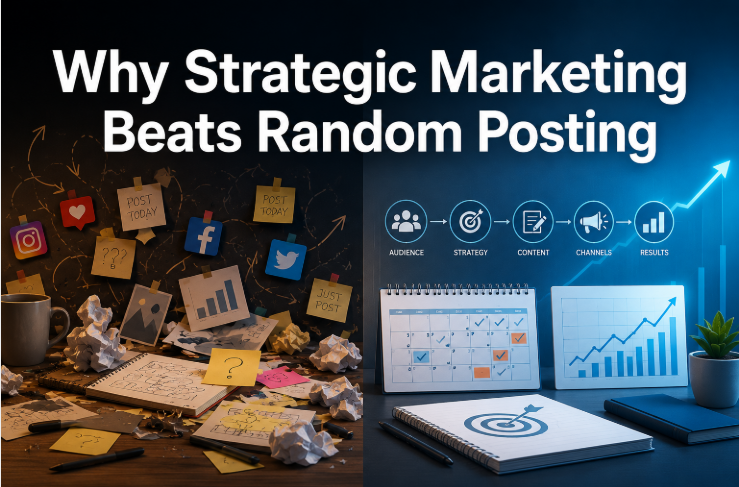
Strategic marketing is the difference between a brand that grows and a brand that just stays busy.
Many businesses pour time, money, and creative energy into posting on social media, sending emails, and running ads — without a clear strategy connecting any of it. The result is a lot of activity and very little progress.
In this guide, we break down exactly what strategic marketing is, why random posting consistently fails, and 7 powerful reasons why a well-built marketing strategy outperforms guesswork in every single measurable way.
What Is Strategic Marketing?
Strategic marketing is a planned, goal-driven approach to marketing that aligns every action — every post, every email, every campaign, every piece of content — with a defined business objective.
It begins with a clear understanding of who the target audience is, what they need, and how the brand can serve them better than anyone else. From there, it builds a consistent, measurable system for reaching that audience, delivering value, and converting interest into revenue.
Strategic marketing is not about doing more. It is about doing the right things, in the right order, for the right reasons — and measuring the results at every step.
Core Elements of Strategic Marketing:
• A defined target audience with specific characteristics and needs
• Clear, measurable marketing goals tied to business outcomes
• A consistent brand voice, identity, and messaging framework
• A content and channel plan built around the audience’s behaviour
• A measurement system that tracks what works and informs future decisions
What Is Random Posting — and Why Do Businesses Fall Into It?
Random posting is exactly what it sounds like — publishing content without a coherent plan, a defined audience, or a clear objective. It is posting when someone has time, sharing whatever feels relevant in the moment, and hoping that something eventually connects.
Most businesses fall into random posting not out of laziness — but out of pressure. They feel they need to be active on social media, they have limited time and resources, and without a strategy to guide them, activity becomes the default goal rather than results.
Signs Your Brand Is Stuck in Random Posting
• You post when you remember to — not on a consistent schedule
• Your content has no consistent theme, tone, or visual style
• You have no idea which posts are actually driving enquiries or sales
• Your follower count fluctuates but your leads do not increase
• Every week feels like starting from scratch with no momentum building
• Your team spends hours creating content that generates minimal engagement
1. Strategic Marketing Gives Every Action a Purpose
The Most Fundamental Advantage of Strategic Marketing
The single most important difference between strategic marketing and random posting is this: every action in a strategic marketing plan has a defined purpose that connects directly to a business goal.
A post is not just a post — it is a piece of content designed to build awareness with a specific audience segment. An email is not just an email — it is a touchpoint designed to move a prospect one step closer to a purchase decision.
How Purpose-Driven Marketing Creates Better Results
• Every piece of content has a measurable goal — awareness, engagement, or conversion
• Resources are allocated to actions that drive outcomes, not just activity
• Teams have clarity about what they are trying to achieve and why
• Performance can be evaluated against clear objectives rather than vague impressions
The Strategic Question Every Brand Should Ask:
Before publishing anything, ask: what specific outcome is this content designed to produce? If the honest answer is ‘I am not sure’, the content needs rethinking before it goes out.
2. Strategic Marketing Builds a Consistent Brand Identity
Why Consistency Is the Foundation of Brand Recognition
Brand recognition is built through repetition. When audiences encounter a brand consistently — the same visual style, the same tone of voice, the same values expressed across every touchpoint — they begin to recognise it, remember it, and trust it.
Random posting destroys this consistency. When content changes tone from post to post, switches visual styles week to week, and covers unrelated topics without a connecting thread, the brand becomes forgettable — regardless of how much content it produces.
What Consistent Strategic Marketing Looks Like
• A defined brand colour palette, typography, and visual style applied to every post
• A consistent tone of voice — whether professional, conversational, or inspirational
• Content pillars that define the themes the brand consistently covers
• A unified message across all platforms and channels
• A brand personality that audiences recognise and connect with over time
The Recognition Compound Effect:
Every consistent touchpoint builds on the last. Over months and years, strategic marketing creates a brand that audiences recognise instantly — and that instant recognition is worth more than any individual campaign.
3. Strategic Marketing Reaches the Right Audience
Precision Targeting vs Scattergun Posting
One of the most damaging myths in marketing is that more reach is always better. In reality, reaching 10,000 people who have no interest in your product is worth far less than reaching 500 people who are actively looking for exactly what you offer.
Strategic marketing begins with a deep understanding of the target audience — their demographics, behaviours, pain points, aspirations, and the platforms they use. This understanding drives every decision about where to show up, what to say, and how to say it.
How Strategic Marketing Improves Audience Targeting
• Audience research defines exactly who the content is created for
• Platform selection is based on where the target audience actually spends time
• Content themes are chosen based on what the audience genuinely cares about
• Paid advertising uses precise targeting parameters to reach defined segments
• Messaging is crafted in the language and tone the audience naturally uses
The Targeting Payoff:
When marketing reaches the right people with the right message, conversion rates improve dramatically. Strategic marketing does not just generate more traffic — it generates better traffic that is far more likely to become leads and customers.
4. Strategic Marketing Makes Budget Work Harder
Eliminating Wasted Spend With Strategic Marketing
Random posting is not just ineffective — it is expensive. The time spent creating content that does not serve a clear purpose, the ad budget spent on campaigns without a coherent targeting strategy, the resources invested in platforms where the audience does not exist — all of this adds up to significant waste.
Strategic marketing eliminates this waste by ensuring that every rupee spent is directed toward an action that has been deliberately chosen because of its expected contribution to a business goal.
How Strategic Marketing Maximises Marketing ROI
• Budget is allocated based on what channels and formats deliver the best results for the specific audience
• Content creation effort is focused on formats that consistently generate engagement and conversions
• Paid advertising targets only the segments most likely to convert — reducing cost per acquisition
• Regular performance reviews identify what is working and reallocate budget accordingly
• Long-term content assets like blog posts and videos continue delivering value without ongoing spend
The ROI Difference:
A business spending the same amount on strategic marketing versus random posting will consistently see higher returns — not because it spends more, but because every pound or rupee is directed with intention and measured for impact.
5. Strategic Marketing Builds Long-Term Momentum
How Strategic Marketing Compounds Over Time
One of the most powerful advantages of strategic marketing is the compound effect it creates over time. Unlike random posting — which starts from scratch with every new piece of content — strategic marketing builds a foundation of content, audience relationships, and brand authority that gets stronger with every passing month.
An SEO-optimised blog post published today can still be generating organic traffic and leads three years from now. A consistently engaged email list becomes more valuable with every new subscriber added. A strong brand reputation built through consistent content becomes a competitive moat that is nearly impossible for competitors to replicate quickly.
Long-Term Assets That Strategic Marketing Builds
• A growing library of SEO content that generates compounding organic search traffic
• An engaged email list that provides a direct, algorithm-free channel to the audience
• A recognisable brand that earns trust and word-of-mouth referrals over time
• A social media presence built on genuine community rather than follower counts
• A data set of performance insights that makes every future campaign smarter
The Momentum Principle:
Strategic marketing creates momentum that makes each subsequent effort more effective. Random posting resets to zero with every post. The gap between these two approaches widens with every passing month.
6. Strategic Marketing Enables Smarter Decisions With Data
From Guesswork to Data-Driven Strategic Marketing
Random posting generates data — but without a strategic framework to interpret it, that data is meaningless. Which posts performed well? Compared to what goal? On which metric? For which audience segment? Without a strategy, there are no clear answers to any of these questions.
Strategic marketing creates a measurement framework that transforms raw data into actionable insight. Every campaign has defined KPIs. Every piece of content has a performance benchmark. Every channel has a role in the overall funnel — and the data from each is used to continuously improve the whole.
What Data-Driven Strategic Marketing Looks Like
• Clear KPIs defined for every campaign before it launches — not assessed after the fact
• Regular performance reviews that compare actual results against strategic goals
• A/B testing of messaging, visuals, and formats to identify what resonates most
• Audience analytics used to refine targeting and content direction over time
• Attribution tracking that shows which marketing activities are actually driving revenue
The Data Advantage:
Brands with a strategic marketing approach get smarter with every campaign. They accumulate a growing body of audience insight that makes each subsequent effort more targeted, more relevant, and more effective. Random posters repeat the same guesses indefinitely.
7. Strategic Marketing Creates a System That Scales
Building a Marketing Engine That Grows With Your Business
Perhaps the most overlooked advantage of strategic marketing is scalability. A well-built marketing strategy is not just a plan for today — it is a system that can grow as the business grows, adapt as the market changes, and be executed by a team without relying on one person’s creative instincts in any given moment.
Random posting cannot scale. It depends entirely on whoever happens to be managing social media that week, the ideas they have at that moment, and the time available to execute them. When that person is unavailable, the marketing stops.
What a Scalable Strategic Marketing System Includes
• A documented content strategy that any team member can follow and execute
• A content calendar that plans activity weeks or months in advance
• Brand guidelines that ensure consistency regardless of who creates the content
• Repeatable campaign templates that can be adapted and reused efficiently
• Clear workflows for content creation, approval, and distribution
Scaling the Strategic Marketing Advantage:
As a business grows, a strategic marketing system grows with it — adding channels, increasing content volume, and expanding audience reach without losing the consistency and intentionality that make it effective. Random posting just gets more chaotic.
How to Move From Random Posting to Strategic Marketing
If your current marketing feels more like random posting than strategic marketing, here is a practical roadmap to make the shift:
Step 1 — Define Your Marketing Goals
What do you actually want your marketing to achieve? More leads? More website traffic? More brand awareness in a specific market? Define 2 to 3 clear, measurable goals that your marketing should deliver within the next 6 to 12 months.
Step 2 — Know Your Audience Deeply
Build a clear picture of your ideal customer — who they are, where they spend time online, what problems they have, what content they consume. Every strategic marketing decision flows from this understanding.
Step 3 — Choose the Right Channels
Do not try to be everywhere. Identify the 2 to 3 platforms where your target audience is most active and most reachable. Build depth on those platforms before expanding.
Step 4 — Build a Content Plan Around Your Goals
Create a content calendar that maps specific content types to specific goals — awareness content, engagement content, and conversion content — published on a consistent schedule that the algorithm and your audience can both rely on.
Step 5 — Measure, Learn, and Improve
Set up tracking for the metrics that matter to your goals. Review performance monthly. Double down on what works. Adjust or eliminate what does not. Strategic marketing is a living system — not a document that gets filed away.
Final Thoughts
Strategic marketing beats random posting every time — not because it requires more effort, but because it directs effort toward outcomes that actually matter.
The businesses that grow consistently are not necessarily the ones posting the most. They are the ones posting with the clearest purpose, the deepest audience understanding, and the most disciplined commitment to measuring and improving their results.
Every post, every email, every campaign is an opportunity — but only if it is part of a strategy that knows what that opportunity is supposed to produce.
At Upswing Digital, we believe that meaningful growth comes from purposeful marketing, not random activity. By combining audience insights, data-driven decisions, and clear objectives, Upswing Digital helps brands create marketing strategies that deliver measurable results.
Stop posting randomly. Start marketing strategically. The results will compound in ways that no amount of random activity ever could.
SEO Content Writing Services That Help Businesses Rank Higher
SEO Content Writing Services competitive digital landscape, simply having a website is not enough to

Top GEO Strategies to Increase Brand Mentions in AI Search
Artificial intelligence is reshaping the way people search for information online. Instead of clicki
The Best Lead Generation Strategies for Small Businesses
When we start a small business, the venture feels thrilling, yet one issue hits: the struggle starts
Leave a Reply