

7 Powerful Ways FOMO Influences Online Purchases (And How Brands Use It)
FOMO — the Fear of Missing Out — is one of the most powerful psychological forces shaping consumer behaviour online today.
It drives impulse purchases, accelerates decision-making, and turns hesitant browsers into committed buyers. And the brands that understand how FOMO influences online purchases are using it deliberately, strategically, and with remarkable results.
In this guide, we explore the psychology behind FOMO, how it shapes buying behaviour, and 7 powerful ways brands are using it to drive more sales — along with how to apply these tactics ethically in your own marketing.
What Is FOMO and Why Does It Influence Online Purchases?
FOMO — Fear of Missing Out — is the anxious feeling that others are experiencing something rewarding or valuable that you are not part of. In a consumer context, it is the feeling that a great deal, a popular product, or an exclusive experience will be gone before you can take advantage of it.
FOMO influences online purchases because the internet has made social comparison instantaneous and constant. Consumers can see — in real time — what others are buying, what they are enjoying, and what they might be missing.
This constant visibility creates a psychological pressure that traditional offline shopping never generated. And brands that understand this pressure can design experiences that harness it to drive action.
FOMO by the Numbers:
• Over 60% of millennials report making reactive purchases because of FOMO
• Nearly 70% of social media users experience FOMO regularly
• FOMO-driven purchases are made faster and with less deliberation than standard purchases
• Scarcity and urgency messaging consistently increases conversion rates across industries
The Psychology of FOMO in Consumer Behaviour
Why FOMO Is Such a Powerful Purchase Driver
FOMO taps into two of the most deeply wired human psychological drives: loss aversion and social belonging.
Loss aversion — the tendency to feel the pain of losing something more acutely than the pleasure of gaining something equivalent — means that the prospect of missing a deal feels worse than the prospect of getting it feels good. This asymmetry makes FOMO an exceptionally powerful motivator.
Social belonging — the need to feel included, accepted, and part of a group — means that seeing others enjoy something you do not have creates genuine psychological discomfort. Online, this discomfort is constantly amplified by social media.
How FOMO Overrides Rational Decision-Making
• It compresses the decision timeline — reducing deliberation and increasing impulse
• It shifts focus from price to availability — making scarcity more important than cost
• It activates emotional rather than logical thinking — bypassing careful evaluation
• It creates a sense of urgency that feels externally imposed rather than brand-generated
1. Limited-Time Offers and Countdown Timers
How Time Scarcity Drives FOMO in Online Purchases
Limited-time offers are one of the most direct and effective ways that FOMO influences online purchases. By attaching a deadline to a deal, brands transform a casual browsing decision into an urgent, time-sensitive choice.
Countdown timers make this urgency visual and undeniable. Every second that ticks away is a reminder that the opportunity is disappearing — and the brain responds with heightened attention and accelerated decision-making.
How to Use Limited-Time Offers Effectively
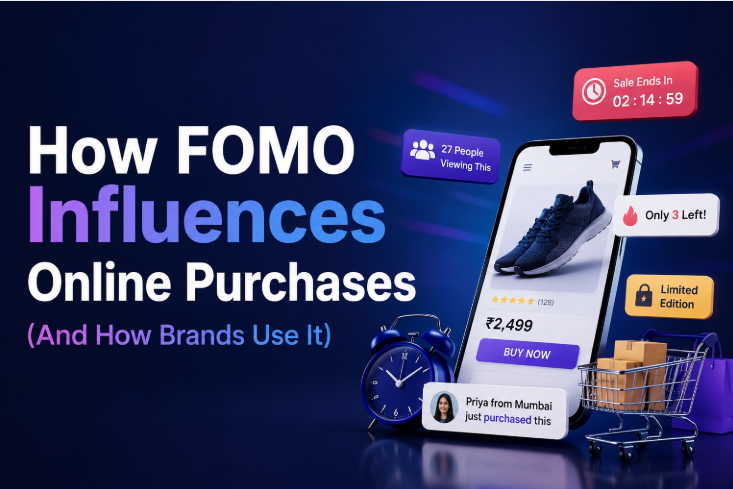
• Display a visible countdown timer on product pages, landing pages, and in emails
• Make the deadline specific and real — vague urgency is less effective than a precise end time
• Use language that reinforces the time constraint — ‘Ends tonight’, ‘Only 3 hours left’
• Send reminder emails and notifications as the deadline approaches
• Honour the deadline — extending offers repeatedly destroys credibility and trust
Platform Application:
Instagram Stories and WhatsApp Status updates are ideal for time-limited offers because they disappear after 24 hours — creating a natural, built-in urgency that the platform itself reinforces.
2. Low Stock and Scarcity Signals
How Product Scarcity Triggers FOMO and Accelerates Purchases
Scarcity is one of the oldest and most reliable psychological triggers in marketing. When something is rare or running out, we want it more — regardless of whether we actually needed it moments before.
Online retailers use scarcity signals to communicate that a product’s availability is limited — triggering the fear that if the consumer does not act now, they will lose the opportunity entirely.
Effective Scarcity Signals for Online Purchases
• Low stock indicators — ‘Only 4 left in stock’ displayed on product pages
• Sold out labels on similar products — showing that demand exceeds supply
• Limited edition product launches with a fixed, finite quantity
• Waitlists and pre-order queues that signal high demand and limited access
• Real-time inventory counters that update as stock decreases
The Credibility Rule:
Scarcity signals only work when they are genuine. False scarcity — claiming limited stock when inventory is actually abundant — damages trust severely when discovered. Use scarcity messaging only when it accurately reflects reality.
3. Social Proof and Real-Time Activity Notifications
How Seeing Others Buy Triggers FOMO in Online Shopping
Social proof is the psychological phenomenon where people look to the behaviour of others to guide their own decisions. Online, this manifests as reviews, ratings, testimonials — and increasingly, real-time notifications showing what other shoppers are doing right now.
Notifications like “23 people are viewing this product” or “Priya from Mumbai just purchased this” are powerful FOMO triggers. They signal that others have already made the decision — creating social pressure to follow.
Social Proof Formats That Amplify FOMO
• Live visitor counts on product pages showing real-time demand
• Recent purchase notifications displayed on e-commerce sites
• Review counts and star ratings that signal widespread adoption
• User-generated content showing real customers enjoying the product
• Social media share counts demonstrating the content’s popularity
Why This Works:
When we see that others have already made a decision, the perceived risk of making the same decision decreases dramatically. Combined with FOMO, social proof creates a powerful double trigger — the fear of missing out amplified by the evidence that others are already benefiting.
4. Exclusive Access and Members-Only Offers
How Exclusivity Creates the Most Powerful Form of FOMO
Exclusivity takes FOMO to its most potent level. While time-based and scarcity-based FOMO says the opportunity is running out, exclusivity-based FOMO says the opportunity was never available to everyone in the first place.
Being part of an exclusive group — early access members, VIP customers, loyalty programme subscribers — creates a sense of privilege and belonging that most people find deeply motivating.
Exclusivity Tactics That Drive Online Purchases
• Early access launches for email subscribers before public sale
• VIP or loyalty tiers with access to products and deals unavailable to the general public
• Invite-only communities or membership programmes
• Pre-launch waitlists that create anticipation and a sense of earned access
• Members-only pricing that makes non-members feel they are missing a significant benefit
Building the Exclusivity Ladder:
The most effective exclusivity strategies create a progression — free subscribers get early access, paid members get exclusive products, premium members get personalised experiences. Each tier creates FOMO for the tier above it, continuously driving upgrades and deeper engagement.
5. Flash Sales and Unannounced Drops
How Surprise Urgency Supercharges FOMO
Flash sales and product drops combine time scarcity, product scarcity, and surprise into a single, high-intensity FOMO event. Unlike planned sales, flash sales and drops are often unannounced or announced with minimal notice — creating an immediate, urgent response.
The unpredictability is a feature, not a bug. Consumers who have missed previous drops become hyper-attentive to brand communications, never wanting to miss the next one. This trains audiences to stay engaged and act quickly.
How to Run a High-Impact Flash Sale or Product Drop
• Announce with minimal notice — 2 to 6 hours creates maximum urgency
• Use all available channels simultaneously — email, WhatsApp, Instagram Stories, push notifications
• Keep the sale window genuinely short — no extensions
• Make the offer meaningfully compelling — deep discounts or genuinely exclusive products
• Follow up with those who missed out — building anticipation for the next drop
The Anticipation Build:
Some brands combine surprise drops with subtle teaser campaigns — cryptic social media posts, mysterious countdowns — that build anticipation without revealing specifics. This amplifies FOMO before the event even begins.
6. Influencer and Peer-Driven FOMO
How Social Influence Amplifies FOMO in Online Purchases
When someone we admire, follow, or identify with is seen using or enjoying a product, the desire to have that same experience is immediate and powerful. Influencer marketing is, at its core, a FOMO machine — it creates a continuous stream of aspirational content that makes audiences want what the influencer has.
Peer-driven FOMO is even more powerful. While we may dismiss celebrity endorsements, seeing a friend, colleague, or community member enjoying something creates a much more personal and urgent desire to participate.
How Brands Leverage Influencer and Peer FOMO
• Partner with influencers whose audience closely matches your target customer
• Encourage user-generated content that shows real customers enjoying your product
• Create referral programmes that incentivise customers to share with their network
• Feature customer stories and testimonials prominently across all touchpoints
• Build community spaces where customers naturally share their experiences with others
Micro-Influencer Advantage:
Micro-influencers with smaller but highly engaged audiences often generate stronger FOMO than major celebrities. Their recommendations feel more personal and believable — making the resulting FOMO feel more genuine and urgent.
7. How to Use FOMO Ethically in Your Marketing
The Difference Between Ethical FOMO and Manipulative Tactics
FOMO is an extraordinarily powerful marketing tool — and with that power comes responsibility. There is a clear line between ethical FOMO marketing, which communicates genuine scarcity and real urgency, and manipulative tactics, which manufacture false pressure to deceive consumers into buying.
Crossing that line does not just risk regulatory consequences — it destroys the trust that is the foundation of any long-term brand relationship.
Principles of Ethical FOMO Marketing
• Only use scarcity messaging when stock or availability is genuinely limited
• Only use countdown timers for offers with real, fixed end dates
• Never fabricate social proof — real-time notifications should reflect actual activity
• Be transparent about why an offer is limited or exclusive
• Honour every deadline and constraint you communicate to your audience
Why Ethical FOMO Builds Long-Term Brand Strength
Brands that use FOMO ethically build a reputation for exclusive, high-value experiences. Their audience trusts that when they say an offer is limited, it genuinely is — which makes every future FOMO trigger more powerful and more effective.
Brands that manufacture false FOMO may see short-term conversion spikes, but they erode the trust that sustains long-term customer relationships. The short-term gain is never worth the long-term cost.
The Ethical FOMO Framework:
• Is the scarcity or urgency real? If yes, communicate it clearly.
• Does the offer provide genuine value? If yes, the FOMO serves the customer.
• Would you be comfortable if the customer knew exactly how this tactic works? If yes, proceed.
Final Thoughts
FOMO influences online purchases in ways that are deep, consistent, and remarkably predictable. It bypasses deliberate thinking, compresses decision timelines, and transforms hesitant browsers into committed buyers.
The brands that understand this psychology — and apply it honestly and creatively — have a genuine competitive advantage. They create marketing experiences that do not just inform or entertain, but genuinely move people to act.
Whether through limited-time offers, scarcity signals, exclusive access, or influencer partnerships, ethical FOMO marketing is one of the most reliable tools available to any brand looking to increase conversions and drive meaningful growth.
At Upswing Digital, we help brands leverage consumer psychology strategically and responsibly, creating campaigns that drive action while building long-term trust.
Use it well. Use it honestly. And watch what happens when your audience genuinely does not want to miss what you have to offer.
Because the most effective marketing is not about creating pressure — it is about creating value that people genuinely want to be part of. Through data-driven strategy, engaging content, and audience-first campaigns, Upswing Digital helps brands turn attention into action and interest into lasting growth.
Use it well. Use it honestly. And watch what happens when your audience genuinely does not want to miss what you have to offer.

How to Rebrand Without Losing Customer Trust: A Complete Guide for Modern Businesses
Rebranding can give a company new life and help it remain relevant in a market that is constantly ch

6 effective Social Media trends in 2025
The Future of Social Media Is Here Social media is no longer just a place for likes and shares; it&#
Local SEO Basics Every Business Should Know
In today’s digital world, customers no longer search globally first they search locally. Whether i
Leave a Reply