

The Psychology Behind Why People Ignore Marketing Content
If you have ever wondered why people ignore marketing content — even when you have worked hard on it — the answer is not simply bad luck or poor timing.
There is deep psychology at work. The human brain is designed to filter out information it considers irrelevant, repetitive, or untrustworthy. And most marketing content triggers exactly those filters.
In this guide, we explore the 7 most powerful psychological reasons why people ignore marketing content — and what you can do to break through and actually get noticed.
The Psychology Behind Ignoring Marketing Content
The human brain processes an estimated 100,000 words of information every single day. To cope with this overwhelming volume, the brain has developed highly efficient filtering systems that decide — in milliseconds — what deserves attention and what gets discarded.
Marketing content competes in this environment constantly. And the brain is not neutral. It is actively biased against content that feels promotional, irrelevant, or untrustworthy.
Understanding why people ignore marketing content is not just an academic exercise. It is the most practical thing a marketer can do — because once you understand the filter, you can learn to bypass it.
The Brain’s Three Key Filters
• Relevance filter — Is this information useful to me right now?
• Trust filter — Is this source credible and reliable?
• Novelty filter — Is this something new or just more of the same?
Marketing content that fails any one of these three filters gets ignored. Most marketing content fails all three simultaneously.
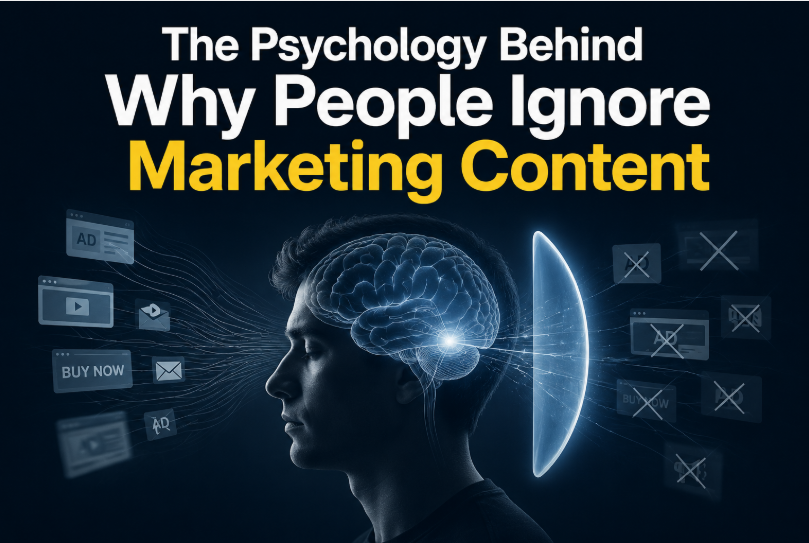
1. Banner Blindness and Ad Fatigue
Why People Ignore Marketing Content They Have Seen Before
Banner blindness is a well-documented psychological phenomenon where internet users unconsciously learn to ignore content that looks like advertising — regardless of whether it actually is advertising.
After years of exposure to display ads, pop-ups, and sponsored posts, the brain has trained itself to skip anything that resembles a marketing message. This happens automatically, below the level of conscious awareness.
The Scale of Ad Fatigue
• The average person is exposed to between 4,000 and 10,000 marketing messages every day
• Most are ignored within milliseconds — before the conscious mind even registers them
• Even genuinely useful content gets ignored if it visually resembles an ad
• Ad blocker usage continues to rise as audiences actively work to filter out marketing
The Fix:
Make your content look and feel less like advertising. Invest in native content formats that blend naturally into the platform. Lead with genuine value — a useful tip, an interesting insight, a relatable story — before any brand message appears.
2. The Content Feels Irrelevant
Relevance Is the Most Powerful Driver of Attention
The most common reason why people ignore marketing content is simple: it does not feel relevant to them. The brain will not invest attention in information it cannot immediately connect to a personal need, interest, or goal.
Most brands make the mistake of creating content about themselves — their products, their achievements, their story. But audiences are fundamentally self-interested. They pay attention to content that is about them and their problems.
Why Irrelevant Marketing Content Gets Ignored
• Generic messaging tries to appeal to everyone and ends up resonating with no one
• Product-focused content ignores the customer’s perspective entirely
• Untargeted distribution puts content in front of the wrong audience
• Lack of audience research means brands guess at what their audience cares about
The Fix:
Build deeply specific audience personas. Understand the exact problems, fears, and goals of the people you are trying to reach. Then create content that speaks directly to those specific concerns — not to a vague, generalised audience.
The Relevance Test
Before publishing any piece of content, ask: would my ideal customer stop scrolling for this? If the honest answer is no — rewrite it until it is.
3. Lack of Trust and Credibility
Why People Ignore Marketing Content From Brands They Don’t Know
Trust is the foundation of all human attention. The brain is hardwired to ignore — and actively avoid — sources it does not recognise or trust. In marketing, this creates a fundamental challenge: how do you earn attention from someone who has no reason to trust you yet?
This is why why people ignore marketing content from unfamiliar brands so consistently — the brain treats unknown sources as potential threats and filters them out automatically.
Trust Signals That Overcome the Credibility Filter
• Social proof — testimonials, case studies, reviews from real customers
• Consistency — showing up regularly over a long period of time
• Expertise — demonstrating genuine knowledge through helpful, accurate content
• Transparency — being honest about what you do, who you are, and what you stand for
• Third-party validation — press mentions, awards, certifications, and endorsements
The Fix:
Build trust before you ask for anything. Invest in content that demonstrates your expertise, showcases real customer results, and shows the human side of your brand. Trust is built through repeated positive interactions over time — not a single impressive ad.
4. Information Overload
The Psychology of Cognitive Overwhelm
The modern internet has created an unprecedented level of information abundance. There is more content published every day than any human being could consume in a lifetime — and the brain responds to this overload by becoming increasingly selective about what it allows in.
When audiences feel cognitively overwhelmed, they do not make more careful choices about what to read. They make fewer choices. They disengage entirely and default to the familiar and the comfortable.
How Information Overload Causes People to Ignore Marketing Content
• Cluttered, text-heavy content feels exhausting before the reader even begins
• Too many messages at once trigger shutdown rather than engagement
• Complex or jargon-heavy content requires too much cognitive effort to process
• Long-form content with no visual breaks loses readers within the first paragraph
The Fix:
Simplify ruthlessly. Break content into short, digestible sections. Use subheadings, bullet points, and visuals to reduce cognitive load. Lead with the most important point — never bury your value at the bottom of a long introduction. Respect your audience’s time and attention by making your content as easy to consume as possible.
5. The Content Is Too Salesy
Why Promotional Marketing Content Gets Tuned Out
There is a deeply ingrained psychological resistance to being sold to. Humans are naturally suspicious of persuasion attempts — a response that psychologists call psychological reactance. When people feel that someone is trying to manipulate their decisions, they instinctively push back.
Marketing content that leads with a sales pitch, uses aggressive calls to action, or frames everything in terms of what the brand wants the audience to do — triggers this resistance immediately.
Signs Your Content Is Too Salesy
• Every post ends with a hard sell or an aggressive call to action
• The content talks about product features rather than customer benefits
• There is no educational, entertaining, or emotional value for the reader
• The tone feels pushy, urgent, or manipulative rather than helpful
• The brand talks about itself more than it talks about the customer
The Fix:
Follow the 80/20 rule. Eighty percent of your content should provide genuine value — education, entertainment, inspiration, or insight — with no sales message attached. The remaining twenty percent can include a promotional element. Audiences who trust you for the value you provide will be far more receptive to your occasional promotional messages.
6. Poor Timing and Wrong Platform
Context Determines Whether Marketing Content Gets Noticed
Even the best content will be ignored if it appears at the wrong time or on the wrong platform. Timing and context are powerful psychological triggers. The brain evaluates the relevance of content not just based on the content itself — but based on where it appears and when.
A LinkedIn post about professional development resonates on a Monday morning. The same content posted on Instagram at 11pm on a Friday is entirely out of context and will be ignored.
Common Timing and Platform Mistakes
• Posting at times when your audience is least active on that platform
• Using a professional tone on platforms designed for casual, entertaining content
• Publishing long-form written content on visual platforms like Instagram
• Running promotional content during periods when audiences are not in buying mode
• Ignoring platform-specific content formats and defaulting to one-size-fits-all content
The Fix:
Research the optimal posting times for your specific audience on each platform. Create platform-native content that matches the format, tone, and expectation of each channel. Test different times and formats systematically, and use performance data to continuously refine your approach.
7. No Emotional Connection
The Most Overlooked Reason Why People Ignore Marketing Content
Human beings are fundamentally emotional decision-makers. Neuroscience research consistently shows that emotions drive decisions — and logic is used afterwards to justify those decisions. Content that fails to trigger an emotional response is content that will be forgotten.
Most marketing content is emotionally flat. It is factually accurate, professionally designed, and strategically positioned — and completely forgettable because it makes the audience feel nothing.
Emotions That Drive Engagement With Marketing Content
• Curiosity — content that makes people want to know more
• Relatability — content that makes people feel seen and understood
• Inspiration — content that makes people believe something better is possible
• Surprise — content that subverts expectations and delivers something unexpected
• Humour — content that makes people smile or laugh and want to share
• Fear of missing out — content that highlights what people stand to lose by not acting
The Fix:
Lead with emotion before logic. Start your content with a story, a provocative question, a surprising statistic, or a relatable observation that triggers an emotional response. Make your audience feel something before you ask them to think about anything. Content that connects emotionally is content that gets remembered — and shared.
How to Create Marketing Content People Cannot Ignore
Understanding why people ignore marketing content is only half the battle. Here is a practical framework for creating content that consistently breaks through:
Step 1 — Start With Deep Audience Understanding
Before writing a single word, know exactly who you are writing for. What keeps them awake at night? What do they aspire to? What language do they use? The more precisely you understand your audience, the more relevant and resonant your content will be.
Step 2 — Lead With Value, Not With the Brand
The first thing your audience should receive from your content is genuine value — a useful insight, a practical tip, an entertaining story, or an emotionally resonant observation. The brand message comes after trust has been established.
Step 3 — Trigger Emotion Before Logic
Open with something that makes your audience feel something — curiosity, surprise, empathy, or excitement. An emotional hook at the beginning dramatically increases the likelihood that the audience will continue engaging with the content.
Step 4 — Make It Effortless to Consume
Short sentences. Short paragraphs. Clear subheadings. Meaningful visuals. Your content should require zero effort to read and understand. Every unnecessary word or visual element is a reason for your audience to stop reading.
Step 5 — Build Trust Consistently Over Time
No single piece of content can build the trust needed to overcome the brain’s marketing filter. Consistent, high-quality content published over months and years is what builds the kind of trust that makes an audience actively seek out your content — rather than ignore it.
Final Thoughts & Conclusion
Why people ignore marketing content is not a mystery — it is a matter of psychology. The brain is doing exactly what it is designed to do: protecting attention, filtering irrelevance, and resisting manipulation.
The brands that break through are not the ones with the biggest budgets or the loudest voices. They are the ones that understand how the human mind works and create content that respects it. At Upswing Digital, we believe meaningful engagement starts with understanding audience behavior, not simply increasing content volume.
Relevant, trustworthy, and emotionally resonant content that appears at the right time and in the right place does not get ignored. It gets remembered, shared, and acted upon. That is the standard every piece of content should be held to.
As digital competition continues to grow, businesses that focus on psychology-driven content strategies will build stronger connections, deeper trust, and long-term loyalty. Through audience-first storytelling and strategic content creation, Upswing Digital helps brands create content that people genuinely want to engage with — not content they scroll past.
Because the goal is not just to be seen.
The goal is to be remembered.

know-how Meta ads supervisor: A novice’s guide to advert Campaigns
Meta advertisements supervisor is an effective tool for groups trying to reach their target audience
The Decision Fatigue Effect: How Too Many Choices Hurt Conversions
Giving customers more choices sounds like good marketing. After all, more options should mean more o
Why Your Leads Aren’t Converting (And What to Do)
Generating leads is important, but converting them is where the real challenge begins. Many business
Leave a Reply