

How Performance Marketing Can Boost Your Business: A Beginner’s Guide to ROI-Driven Ads
Imagine spending your ad budget only on the things that give you value and stop wasting it on elements that will not bring any measurable returns. Not to mention eliminating the guesswork around how much money is being spent on ads and what returns are being generated from them.
Performance marketing covers it all, and it is one of the most relevant ways to spend your marketing budget in 2026.
For those new to the concept, this beginner’s guide is the perfect place to start learning about this space in simple terms.
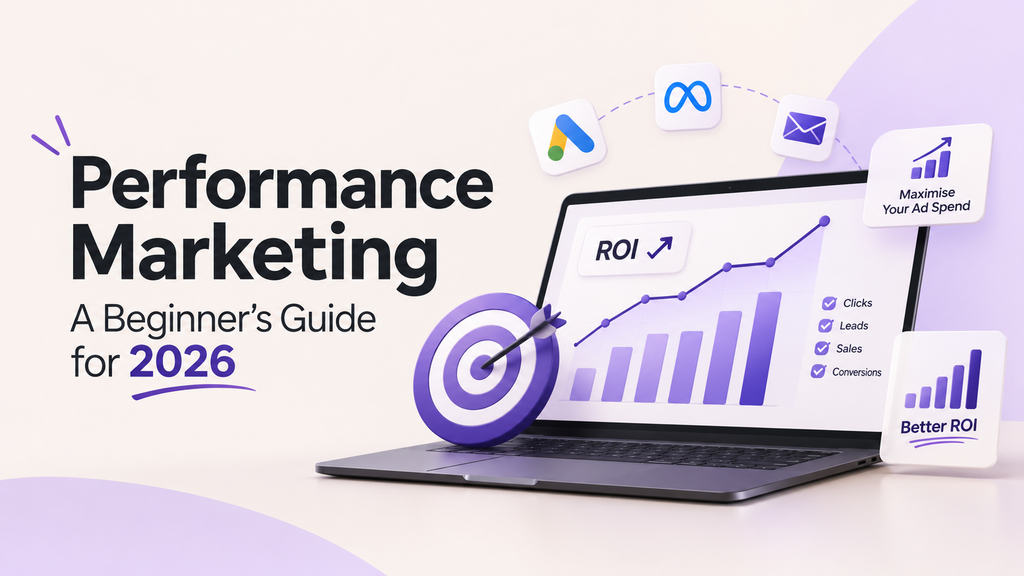
What is performance marketing?
Performance marketing refers to a group of digital marketing activities that require you to pay only when a pre-defined action has occurred. These actions could be anything – clicks, sign-ups, downloads, or purchases.
Compared to traditional forms of advertising, performance marketing is more focused on ensuring every rupee spent on ads is generating value for the brand.
It is especially suited for brands looking to scale their marketing efforts without burning a hole through their pocket.
How is it different from traditional advertising?
Let us dive into the details and understand how traditional advertising differs from performance marketing:
Traditional advertising Performance marketing
Traditional ad formats (TV, newspaper, or even billboards) require you to pay for the ad itself, whereas performance marketing only asks you to pay when a certain action (such as clicks or sign-ups) has occurred. This is one of the most significant differences between the two.
Traditional advertising does not provide any measurable results, whereas performance marketing can help you track almost everything (leads, sales, clicks, etc.) that happens as a result of your campaigns.
Measuring the impact of traditional advertising can be challenging, whereas calculating the ROI of performance marketing is relatively simple.
Overall, performance marketing is a more cost-effective and measurable option for brands looking to advertise their products or services.
Key types of performance marketing
There are multiple types of performance marketing, and the choice between them depends on a variety of factors, including budgets, objectives, target audience, etc. Here are the most popular ones:
Pay-Per-Click advertising:
This is one of the most popular forms of performance marketing and it is mostly used these days with Google or Bing ads. Essentially, you will have to bid for keywords and show your ad as the sponsored message when someone searches for them on the search engine.
Social media ads:
Social media platforms such as Facebook, Instagram, or LinkedIn allow you to run targeted ads and pay for them either through clicks, leads, or sales. For most platforms, you will have to choose between the three, so it is important to set realistic goals before choosing one.
Affiliate marketing:
In this form of performance marketing, you will have to collaborate with publishers and you will only have to pay them when a specific action (clicks, leads, sales, etc.) occurs.
Influencer marketing with tracked results:
This is a variant of affiliate marketing, except that the role of the publisher is played by influencers. You can even track sales that result from their activities to ensure that you get the best value for your money.
Email marketing:
Most businesses use email marketing these days, and you can leverage targeted email campaigns to collect clicks, sales, or even sign-ups.
Important terms every beginner should know
While you start exploring performance marketing, here are the most common terms that you are likely to come across:
ROI (Return on Investment)
This metric shows how much money you are making compared to how much money you are spending on advertising. It is a crucial metric to keep track of for every business that spends money on performance marketing.
CPC (Cost Per Click)
This metric will show you the money you are spending on clicks (ad impressions) as a result of your campaigns, so it is a good idea to keep track of them regularly.
CPL (Cost Per Lead)
Similarly, this metric will show you how much you are spending on leads, so it is best to keep track of it for the same reason.
CPA (Cost Per Acquisition)
If you want to measure your performance in terms of sales, you should look at this metric as it represents the amount of money you spend on ads for every customer that you acquire as a result of your campaigns.
CTR (Click-Through Rate)
This metric will tell you how many people are clicking your ad compared to how many people are seeing it (impressions). A healthy CTR is a must if you want to get value for your ad spend.
Conversion rate:
This metric shows how many people that see your ad click on it and complete the action you want them to (purchase, download, subscribe, etc.).
With that, you should now have a good understanding of some of the most important terms related to performance marketing.
How performance marketing boosts your ROI
Top performance marketing companies adopt a variety of tactics that help them increase the ROI of their clients. Let us explore some of the most common ones:
1.Spending only on the actions that deliver value:
Performance marketing agencies know that to get the best value for the clients’ money, they need to focus on the actions that deliver the best results (leads, sales, or clicks) and avoid the ones that do not contribute to them in any way.
2.Using targeting to connect with the most relevant audience:
Performance marketing allows businesses and agencies to reach out to the most relevant audience based on multiple criteria. And since only people who are genuinely interested in the advertised product or service will see the ad, the likelihood of them clicking on it and (ideally) buying/selling increases exponentially.
3.Testing and optimising more frequently:
Traditional advertising channels rarely allow advertisers to tweak their campaigns quickly. But performance marketing is all about speed and flexibility, so you can see what changes are working and what is not on a daily basis.
4.Having better control over your spend:
Even though traditional advertising channels do not offer much flexibility, performance marketing allows you to set a daily or monthly budget for your ads, so you can control your expenditure better.
How to get started with performance marketing
If you are new to performance marketing and you have decided to try it out for the first time, here are the steps you should take:
1. Set your objective: Do you want to get more leads or are you looking to increase your sales?
2. Decide on your target audience: Who are you going to advertise to, and what are their characteristics?
3. Choose a platform: Should you go for Google Ads or Meta’s advertising platform or another one?
4. Set your budget: Decide how much you are willing to spend on ads every day or month
5. Set up the ads: Create visually appealing and effective ads that have a strong call-to-action (CTA)
6. Track the results: Use Google Analytics or other similar tools to see how your campaigns are performing.
7. Keep optimising: You should keep tweaking your campaigns so that they deliver the best possible results.
Common mistakes to avoid
Most performance marketing agencies make the same mistakes when they start out, so it is best to avoid them no matter what. They are as follows:
1. Trying to target everyone
2. Failing to track leads and sales
3. Giving up too early
4. Failing to optimise the ad content
5. Using a bad landing page
Performance marketing agencies that get good results understand that the more time and effort they put into the campaigns; the better their results will be.
How Upswing Digital can help?
At Upswing Digital, we specialise in developing fully optimised performance marketing campaigns that deliver the best possible ROI for our clients. We will work with you to ensure that every penny spent on performance marketing is being utilised to the full potential, whether it is Google ads or Meta ads.
Our experience in performance marketing will help you achieve your advertising goals, no matter how ambitious they are. Whether you are just getting started or you want to improve your existing performance marketing campaigns, Upswing Digital is the right choice.
Final thoughts
As we come to the end of this beginner’s guide to performance marketing, here are a few final thoughts for you.
As you have seen, performance marketing has transformed the way advertising works these days. From helping businesses get the best value for their money to reaching out to the most relevant people and delivering superior results, performance marketing has it all.
Even though the space is undeniably competitive, agencies that focus on providing the best ROI possible for their clients can expect consistent success.
Social Media Marketing in Kochi: Why Posting Every Day Isn’t Growing Your Business
You post on Instagram and Facebook regularly. The designs look good, the captions are written, and t

Why Choose the Best Digital Marketing Agency in Dubai for Your Business
Today’s competitive business scenario requires having a good online presence as an essential requi

Step-by-Step Guide to Planning a Content Calendar
A well-planned content strategy is essential for building brand authority, driving traffic, and gene
Leave a Reply