

Why AI Will Support Creativity — Not Replace It
Few debates in the modern creative world generate more anxiety than the question of AI and creativity. Will AI replace designers, writers, strategists, and creative directors? Is human creativity becoming redundant in a world where machines can generate images, write copy, and produce music in seconds?
The honest answer — supported by how the most creative brands and teams are actually using AI right now — is a definitive no.
AI is not the enemy of creativity. It is becoming its most powerful enabler. In this guide, we explore the real relationship between AI and creativity, why human creative thinking remains irreplaceable, and 7 powerful reasons why the brands and creators that embrace AI as a creative partner will consistently outperform those who fear it.
Understanding the Real Relationship Between AI and Creativity
The fear that AI will replace human creativity is based on a misunderstanding of what creativity actually is. Creativity is not the production of words, images, or music. It is the generation of meaning — the ability to understand human experience, identify what matters, and express it in a way that resonates with other human beings.
AI can produce outputs. It can generate text, images, audio, and video at extraordinary speed and scale. But it cannot understand meaning in the way humans do. It cannot feel the emotional weight of a brief. It cannot sense when something is culturally off. It cannot make the intuitive leaps that define genuinely original creative work.
The real relationship between AI and creativity is not competition — it is collaboration. AI handles the tasks it is exceptionally good at. Humans provide the judgment, vision, and meaning that AI fundamentally cannot.
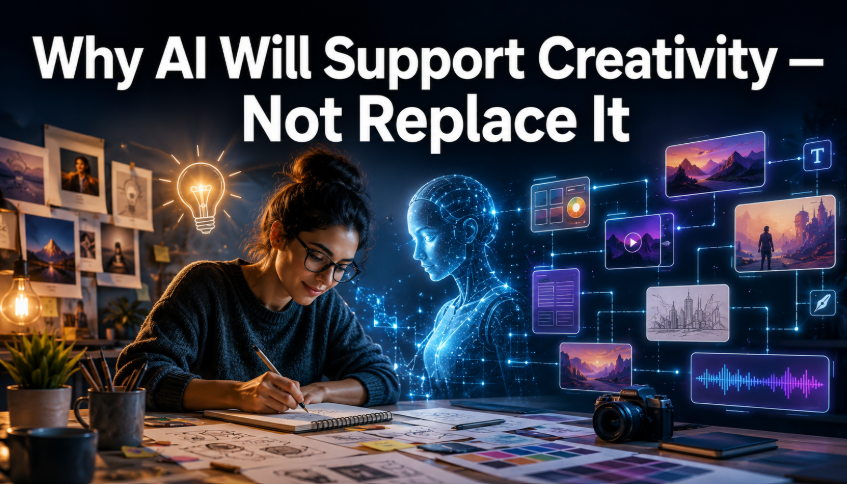
What AI Does Well in Creative Work:
• Generating large volumes of content variations quickly
• Processing and synthesising research and reference material
• Producing first drafts that human creatives can refine and elevate
• Automating repetitive formatting, resizing, and adaptation tasks
• Identifying patterns in audience data that inform creative direction
Why AI Cannot Replace Human Creativity
The Irreplaceable Elements of Human Creative Thinking
No matter how sophisticated AI becomes, there are dimensions of creative thinking that remain exclusively human — and that will continue to define the difference between content that merely exists and content that genuinely moves people.
What Only Human Creativity Can Do
• Understand cultural nuance — the unwritten rules of what resonates in a specific community at a specific moment
• Generate genuine emotional intelligence — the ability to feel what an audience needs to feel and craft an experience that delivers it
• Make intuitive creative leaps — connecting seemingly unrelated ideas in ways that produce something genuinely original
• Take creative risks — the willingness to break conventions in ways that are brave rather than random
• Develop a genuine creative voice — the distinctive perspective that makes a brand or creator recognisable and irreplaceable
• Understand ethical and social context — knowing when content is appropriate, sensitive, or potentially harmful in ways that matter to real people
1. AI Removes Creative Blocks and Sparks New Ideas
How AI and Creativity Combine to Overcome Creative Stagnation
Every creative professional experiences creative blocks — moments when the ideas simply will not come, when every direction feels stale, and when the blank page becomes an obstacle rather than an opportunity.
AI and creativity work together most powerfully in these moments. AI tools can generate dozens of ideas, directions, angles, and approaches in seconds — not to be used directly, but to act as creative catalysts that spark the human imagination.
How AI Sparks Creative Thinking
• Generating multiple headline or concept variations that give the creative team new directions to explore
• Producing mood board references, style directions, and visual concepts to react to
• Suggesting unexpected angles on familiar briefs that challenge conventional thinking
• Providing rapid research summaries that surface insights a human might have taken days to find
• Creating rough first drafts that the creative can then completely transform with their own voice
The Creative Catalyst Effect:
The best use of AI in the creative process is not to produce the final output — it is to give the human creative something to react to. A mediocre AI-generated idea can spark a brilliant human one. And that dynamic makes AI one of the most valuable creative tools available.
2. AI Handles Repetitive Tasks So Humans Can Focus on Thinking
Freeing Human Creativity From Mechanical Work
A significant proportion of most creative professionals’ time is spent not on creative thinking — but on mechanical, repetitive tasks. Resizing images for different platforms. Reformatting content for different channels. Writing variations of the same message for different audience segments. Transcribing, summarising, and organising research.
AI and creativity become a powerful partnership when AI takes ownership of these mechanical tasks — freeing the human creative to spend more time on the thinking, strategy, and original ideas that actually require a human mind.
Repetitive Creative Tasks AI Can Handle
• Resizing and reformatting visual assets for multiple platforms and specifications
• Writing content variations for A/B testing across different audience segments
• Generating captions, alt text, and metadata for large volumes of content
• Transcribing interviews, meetings, and research conversations
• Repurposing long-form content into short-form summaries, social posts, and email excerpts
The Time Dividend:
When AI absorbs the mechanical workload, creative professionals do not just work faster — they work better. The quality of creative thinking improves dramatically when it is not constantly interrupted by repetitive tasks. This is the most underappreciated benefit of AI and creativity working in partnership.
3. AI and Creativity Together Produce More Personalised Content
How AI Enables Creative Personalisation at Scale
One of the most powerful applications of AI and creativity working together is the ability to produce genuinely personalised content at a scale that was previously impossible for human teams alone.
Personalisation has always been a creative ideal — the right message for the right person at the right moment. But the manual effort required to create truly personalised content at scale made it impractical for most brands. AI changes this equation entirely.
How AI Enables Creative Personalisation
• Dynamic content systems that adapt messaging based on individual user behaviour and preferences
• Email campaigns with personalised subject lines, content sections, and calls to action for different audience segments
• Social media content tailored for different audience demographics, interests, and platforms
• Ad creative variations that match the specific context and interests of different target groups
• Website experiences that adapt in real time based on visitor behaviour and history
The Human Creative’s Role in AI Personalisation:
AI provides the engine for personalisation at scale. But the human creative provides the brand voice, the emotional intelligence, and the strategic judgment that ensures personalised content feels genuine rather than mechanical. Without the human creative layer, AI personalisation quickly becomes impersonal — which defeats the entire purpose.
4. AI Expands What Small Creative Teams Can Produce
How AI Levels the Playing Field for Smaller Brands
One of the most significant impacts of AI and creativity working together is the democratisation of creative production. Tasks that previously required large, expensive specialist teams — video production, graphic design, copywriting, research — can now be executed by small teams with AI assistance at a fraction of the traditional cost and time.
This is transformative for smaller brands and agencies. A team of three people with strong creative vision and the right AI tools can now produce the volume and variety of content that previously required a team of fifteen.
What Small Creative Teams Can Now Produce With AI
• High-quality written content across multiple formats and channels
• Visual assets, social media graphics, and marketing materials
• Video scripts, storyboards, and basic video content
• Research reports, competitor analyses, and audience insights
• Personalised email campaigns and automated marketing sequences
The Caveat:
AI expands production capacity — but it does not replace creative strategy or brand vision. The small teams that use AI most effectively are the ones with the strongest creative foundations. AI amplifies what is already there. It cannot create the creative vision from scratch.
5. AI Accelerates the Feedback and Iteration Process
How AI and Creativity Speed Up Creative Development
Creative work has traditionally been slowed by the feedback and iteration cycle. A concept is developed, presented, critiqued, revised, presented again — with days or weeks passing between each stage. This slow cycle limits how much creative exploration is possible within any given project.
AI and creativity working together dramatically accelerate this cycle. AI can generate multiple creative directions simultaneously — giving stakeholders real options to react to rather than abstract concepts to imagine. Feedback becomes faster because there is something concrete to respond to. Iteration becomes faster because AI can implement changes and generate new variations almost instantly.
How AI Accelerates Creative Iteration
• Generating 10 headline variations in the time it takes to write 2 manually
• Producing multiple visual directions simultaneously for client or stakeholder review
• Implementing feedback changes and generating revised versions within minutes
• Testing multiple creative approaches in parallel rather than sequentially
• Reducing the time from brief to first-draft presentation significantly
The Quality Benefit:
Faster iteration does not just save time — it produces better creative work. When teams can explore more directions and test more ideas in the same timeframe, the probability of finding the genuinely best creative solution increases significantly.
6. AI Helps Creative Professionals Work at the Speed of Ideas
Closing the Gap Between Creative Thinking and Creative Execution
One of the most frustrating experiences in creative work is the gap between having an idea and being able to execute it. The time required to write the first draft, produce the initial design, or build the basic framework often allows the creative momentum of a new idea to dissipate before it can be properly explored.
AI and creativity working together close this gap. When a creative professional has an idea, AI can help them get to a working version quickly — capturing the energy and direction of the idea before it fades. The human then refines, elevates, and transforms that working version into something genuinely excellent.
How AI Helps Capture Creative Momentum
• Generating a rough first draft from a brief or a set of notes in minutes
• Producing an initial visual concept from a text description to react to immediately
• Building a content outline that structures a complex idea quickly
• Creating a rapid prototype of a campaign concept to test before full development
• Translating a strategic insight into multiple creative executions simultaneously
The Creative Flow State:
Experienced creative professionals know that the best creative work often happens in a state of flow — when thinking and producing are happening simultaneously without friction. AI tools, used well, remove the friction that interrupts this state and allows creative thinking to move at its natural speed.
How to Build an AI-Supported Creative Marketing Workflow
The brands and creative teams getting the most from AI and creativity are not using AI randomly — they have built intentional workflows that integrate AI at the specific points where it adds the most value. Here is how to build one:
Step 1 — Map Your Creative Process
Before introducing AI, map your current creative workflow from brief to final output. Identify the stages that consume the most time, the points where creative blocks typically occur, and the tasks that are most repetitive and mechanical.
Step 2 — Identify Where AI Adds the Most Value
AI adds the most value in the early ideation stage, in the production of first drafts and variations, in repetitive adaptation tasks, and in the research and synthesis phase. Identify which of these stages exist in your workflow and introduce AI tools at those specific points first.
Step 3 — Establish Clear Human Review Checkpoints
AI-generated content should always pass through human creative review before it is used. Establish clear checkpoints where the human creative team evaluates, refines, and elevates AI outputs — ensuring that every piece of content that leaves the team carries a genuine human creative stamp.
Step 4 — Train Your Team to Prompt Effectively
The quality of AI output is directly determined by the quality of the input. Invest time in training your creative team to write effective prompts — clear, specific, context-rich instructions that give AI the direction it needs to produce genuinely useful outputs.
Step 5 — Protect and Develop Your Human Creative Voice
As AI takes on more of the production workload, invest the time saved in developing the distinctly human elements of your creative work — the brand voice, the strategic thinking, the cultural insight, and the emotional intelligence that AI cannot replicate. These are your creative team’s most valuable and irreplaceable assets.
Final Thoughts
The question is not whether AI will affect creative work — it already has, profoundly and irreversibly. The question is whether creative professionals and brands will use AI as a tool that amplifies their human creativity, or allow the fear of AI to paralyse them while their competitors adapt.
AI and creativity are not in opposition. They are complementary forces — each making the other more powerful. AI brings speed, scale, and analytical depth. Human creativity brings meaning, judgment, emotional intelligence, and original vision.
The creative professionals who will thrive in this environment are not the ones who resist AI — they are the ones who master it. They learn to direct it with precision, refine its outputs with skill, and use the time it saves to think more deeply, explore more boldly, and create more meaningfully than ever before.
At Upswing Digital, we see AI not as a replacement for creativity, but as a powerful tool that helps brands and creators unlock new possibilities. By combining human insight with intelligent technology, Upswing Digital helps businesses create marketing that is both efficient and genuinely impactful.
The future of creativity is not human versus AI. It is human creativity, amplified by AI — and that combination is more powerful than either could ever be alone. The brands that embrace this partnership today will be the ones shaping the future tomorrow.
Leave a Reply