

How Interactive Content Increases User Engagement
Interactive content is changing the way brands communicate with their audiences. While static content asks people to read and move on, interactive content invites them to participate — and that participation transforms passive visitors into active, engaged users.
In this guide, we explore what interactive content is, why it works, and 7 proven ways to use it to dramatically increase user engagement across your digital channels.
What Is Interactive Content?
Interactive content is any type of digital content that requires active participation from the user rather than passive consumption.
Instead of simply reading an article or watching a video, users engage directly — answering questions, making choices, entering data, or clicking through experiences. This two-way exchange creates a fundamentally different relationship between the brand and the audience.
Common Types of Interactive Content:
• Quizzes and personality tests
• Polls and surveys
• Interactive infographics and maps
• Calculators and ROI tools
• Interactive videos with clickable elements
• Contests, giveaways, and spin-to-win wheels
• Chatbots and conversational landing pages
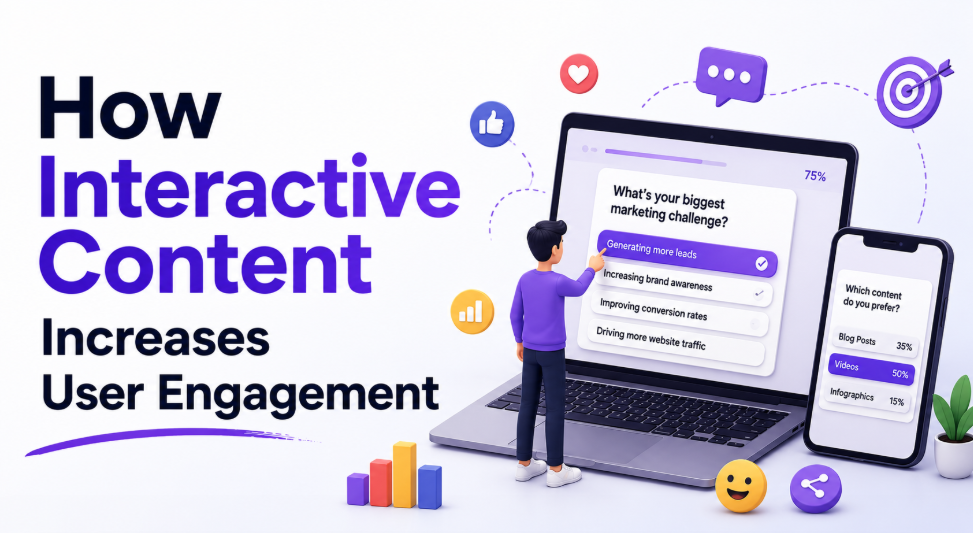
Why Interactive Content Outperforms Static Content
The digital landscape is saturated. Audiences are bombarded with content every single day — and most of it is ignored. Interactive content cuts through the noise by demanding attention in a way that passive content simply cannot.
Key Reasons Interactive Content Drives Higher Engagement
• It requires action — users must participate, not just scroll past
• It feels personalised — results and responses are unique to each user
• It is memorable — people remember experiences they participated in
• It generates data — every interaction tells you more about your audience
• It is inherently shareable — people love to share quiz results, poll outcomes, and contest entries
1. Quizzes and Assessments
The Most Shareable Form of Interactive Content
Quizzes are one of the most effective forms of interactive content available to brands today. They are highly engaging, naturally shareable, and can be designed to serve multiple marketing goals simultaneously.
Whether it is a fun personality quiz or a serious business assessment, quizzes invite users to invest time and attention — and reward them with personalised results that feel genuinely valuable.
How Brands Use Quizzes Effectively
• Product recommendation quizzes that guide users to the right offering
• Knowledge tests that position the brand as an educational authority
• Personality quizzes that connect emotionally with the audience
• Diagnostic assessments that identify a problem the brand can solve
Why Quizzes Increase User Engagement:
Quizzes create a sense of curiosity and anticipation. Users want to see their results — which means they complete the entire experience. This dramatically increases time on site and creates a natural opportunity to capture leads at the end.
2. Polls and Surveys
Interactive Content That Also Generates Insights
Polls and surveys are among the simplest yet most powerful forms of interactive content. They take seconds to complete, but they generate meaningful engagement and provide brands with direct insight into their audience’s opinions and preferences.
On social media platforms like Instagram and LinkedIn, polls consistently outperform static posts in terms of reach and interaction. The algorithm rewards content that generates active responses over passive likes.
How to Use Polls and Surveys Effectively
• Post weekly opinion polls on Instagram Stories to keep your audience engaged
• Use LinkedIn polls to spark professional discussions around industry topics
• Embed short surveys on your website to gather customer feedback
• Use survey responses to inform your content strategy and product development
• Share the results publicly — audiences love to see how their opinions compare
Pro Tip:
Always ask questions your audience genuinely cares about. Polls that feel relevant and timely consistently generate far higher participation than generic questions.
3. Interactive Infographics and Data Visualisations
Making Complex Information Engaging
Static infographics are useful, but interactive infographics take engagement to a completely different level. By allowing users to explore data, click through layers of information, and personalise what they see, interactive infographics turn passive content consumption into an active discovery experience.
Types of Interactive Infographics That Work Well
• Clickable maps that reveal regional data when users hover or tap
• Timeline infographics where users can explore different time periods
• Comparison tools that let users toggle between different data sets
• Step-by-step visual guides where users progress through each stage
Why This Increases User Engagement:
Interactive infographics keep users on the page far longer than static versions. Each click is a micro-engagement that deepens the user’s connection with the content — and with the brand that created it.
4. Calculators and Tools
Interactive Content With High Conversion Value
Calculators are one of the most underused forms of interactive content — and one of the most powerful. A well-designed calculator provides immediate, personalised value to the user while positioning your brand as a trusted, expert resource.
Calculator Ideas for Digital Marketing Brands
• ROI calculator — show potential clients the return on their marketing investment
• Ad budget calculator — help users determine the right spend for their goals
• Website traffic estimator — give users a personalised projection based on their inputs
• Social media growth calculator — show how consistent posting compounds over time
Why Calculators Convert:
Users who interact with a calculator have already invested time and provided personal data. This creates a natural moment for lead capture — offering to send results by email or book a consultation to discuss the findings.
5. Interactive Videos
The Future of Video Content Engagement
Video is already the most consumed content format online. Interactive video takes this further by giving viewers control — allowing them to make choices, click on elements, and shape the direction of the content they watch.
This level of involvement creates a fundamentally different viewing experience. Users are no longer passive spectators — they become active participants in the content journey.
Ways to Use Interactive Video
• Shoppable videos where viewers click directly on featured products
• Choose-your-own-path brand stories that let viewers direct the narrative
• Clickable tutorials where viewers jump to the section most relevant to them
• Live Q&A sessions where audience questions shape the content in real time
Engagement Impact:
Interactive videos consistently generate significantly higher completion rates and click-through rates than standard video content. Viewers who feel in control of their experience stay engaged far longer.
6. Contests and Giveaways
Interactive Content That Builds Audience Fast
Contests and giveaways are among the most effective forms of interactive content for rapidly growing your audience and generating high volumes of engagement in a short time.
When structured correctly, a contest does not just generate entries — it generates shares, tags, user-generated content, and a wave of new followers who are genuinely interested in what your brand offers.
How to Run a High-Engagement Contest
• Make the entry mechanic interactive — tag a friend, answer a question, share a story
• Ensure the prize is genuinely relevant to your niche audience
• Use the contest to collect user-generated content that you can repurpose
• Promote the contest across all channels for maximum reach
• Follow up with all participants after the contest to convert interest into action
Important:
The goal of a contest is not just to gain followers. Structure your contest to attract people who are genuinely interested in your product or service — not just freebie hunters who will never buy.
7. Chatbots and Conversational Content
Interactive Content That Personalises the User Journey
Chatbots and conversational landing pages represent one of the most sophisticated forms of interactive content. Rather than presenting a static page of information, conversational content guides users through a personalised experience based on their specific responses.
This creates a feeling of being heard and understood — which builds trust rapidly and moves users through the buying journey far more effectively than a traditional static page.
How Brands Use Conversational Interactive Content
• Website chatbots that answer questions, qualify leads, and book appointments 24/7
• Conversational landing pages that replace traditional forms with a dialogue-style experience
• WhatsApp automation sequences that deliver personalised content based on user responses
• Messenger bots that guide social media followers toward a specific action
Why Conversational Content Increases Engagement:
People respond more openly to a conversation than to a form. Conversational interactive content reduces friction, feels personal, and consistently delivers higher completion rates and conversion rates than static alternatives.
How to Build an Interactive Content Strategy
Adding interactive content to your marketing is most effective when it is part of a clear, intentional strategy. Here is how to build one:
Step 1 — Define Your Engagement Goals
Are you trying to increase time on site, generate leads, grow your social following, or gather audience insights? Different goals call for different types of interactive content.
Step 2 — Know Your Audience’s Preferences
Not every interactive format suits every audience. A B2B professional audience may respond better to calculators and assessments. A consumer audience may prefer quizzes and contests. Research your audience before choosing your format.
Step 3 — Start Simple and Iterate
You do not need to build a complex interactive experience on day one. Start with a simple Instagram poll or an embedded quiz. Measure the results, learn what your audience responds to, and build from there.
Step 4 — Integrate Interactive Content Into Your Funnel
Interactive content works best when it is connected to the rest of your marketing funnel. A quiz that captures an email address, a calculator that leads to a consultation booking, a survey that segments your audience for personalised follow-up — these integrations are where interactive content delivers its greatest value.
Step 5 — Measure and Optimise
Track the engagement metrics that matter — completion rates, lead capture rates, shares, and time on page. Use this data to continuously improve your interactive content and focus on the formats that deliver the best results for your specific audience.
Final Thoughts
Interactive content is not a trend — it is the direction that effective digital marketing is heading. As audiences become more selective about the content they consume, brands that invite participation will consistently outperform those that simply broadcast. At Upswing, we believe engagement grows when audiences feel involved, not just targeted.
The brands winning online in 2025 are not just creating more content — they are creating better experiences. Interactive content helps brands build stronger relationships, increase engagement, and turn passive visitors into loyal customers. Upswing understands that meaningful digital experiences are what keep audiences coming back for more.
Start with one format. Test it. Learn from it. And build an interactive content strategy that keeps your audience engaged, connected, and coming back for more.
How Micro Influencers Are Changing Social Media Marketing
Micro influencers social media marketing is no longer a trend — it is a proven growth strategy tha
Why Your Business Needs a Brand Story
As people, we love stories. We’ve been hearing them since we were children Think about it – who

How to Get Clients from Instagram in Dubai
Instagram is a platform that gives businesses in Dubai incredible power when it comes to attracting
Leave a Reply