
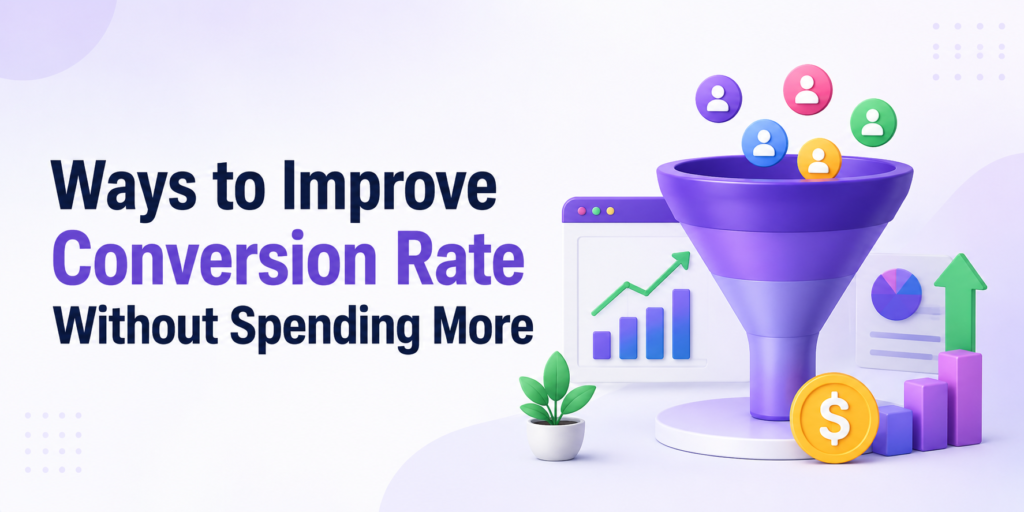
Ways to Improve Conversion Rate Without Spending More
Conversion Rate optimisation is one of the highest-leverage growth strategies available to any business and it costs nothing in additional ad spend. Most marketing conversations focus on driving more traffic: more clicks, more impressions, more reach. But traffic without conversion is just an expense. The real opportunity lies in getting more value from the audience you already have.
Improving your Conversion Rate means convincing a greater share of your existing visitors to take the action you want them to take whether that is making a purchase, filling in a form, booking a call, or signing up for a newsletter. Even a modest improvement in your Conversion Rate can produce a dramatic increase in revenue without any increase in your marketing budget.
In 2026, where paid media costs continue to rise and organic attention is harder to earn, Conversion Rate optimisation has become a core growth discipline rather than a tactical afterthought. This guide covers 8 practical, proven ways to improve your Conversion Rate without spending a single extra rupee on traffic acquisition.
What Is Conversion Rate Optimisation and Why Does It Matter?
Conversion Rate optimisation commonly referred to as CRO is the systematic process of increasing the percentage of visitors who complete a desired action on your website, landing page, or marketing funnel. It is not about guessing what might work. It is about using real user data, behavioural insights, and structured testing to remove friction and make it easier for your audience to say yes.
The case for prioritising Conversion Rate optimisation is straightforward. Consider two scenarios: you double your traffic while maintaining a 2% Conversion Rate, or you keep your traffic steady while improving your Conversion Rate to 4%. Both deliver the same number of conversions but the second approach requires zero additional acquisition spend. When CRO is weak, brands compensate with spend. When CRO is strong, every pound of ad spend becomes a multiplier.
The brands winning in 2026 are not the ones spending the most on traffic. They are the ones removing the most friction before they spend. That is the mindset shift that makes Conversion Rate optimisation such a powerful and underutilised growth lever.
8 Proven Ways to Improve Your Conversion Rate Without Spending More
1. Clarify Your Value Proposition to Instantly Lift Conversion Rate
The single most common reason a Conversion Rate underperforms is a weak or unclear value proposition. Visitors land on your page and cannot immediately understand what you offer, who it is for, and why it is better than every alternative. If that clarity is missing in the first few seconds, they leave and no amount of design polish or traffic volume will fix it.
Your value proposition should be the first thing a visitor reads on your homepage, landing page, or product page. It needs to answer three questions instantly: What do you do? Who is it for? What makes it worth choosing over everything else? When you sharpen this message, your Conversion Rate improves because visitors immediately understand why they are in the right place.
Audit every key page on your website through this lens. If a new visitor cannot state your value proposition back to you after five seconds on the page, your Conversion Rate is suffering because of clarity, not traffic.
2. Reduce Friction in Your Funnel to Remove Conversion Rate Killers
Friction is anything that makes it harder for a visitor to complete the action you want them to take. Long forms, confusing navigation, slow page loads, too many steps in a checkout process, unexpected costs appearing late in the journey all of these are Conversion Rate killers that cost you conversions every single day without requiring any additional traffic to fix.
Look for the points where people stop scrolling, where they abandon forms, and where they exit without converting. Each of these drop-off points is a Conversion Rate opportunity waiting to be fixed.
Start with the highest-traffic, lowest-converting pages first. Remove unnecessary form fields and ask only for what you truly need. Simplify your checkout process to as few steps as possible. Make your calls to action prominent, clear, and single-focused. Every element of friction you remove is a direct improvement to your Conversion Rate without spending a single additional dollar on acquisition.
3. Strengthen Trust Signals to Build the Confidence That Drives Conversion Rate
People do not convert when they are not sure they can trust you. Trust is one of the most important and most overlooked drivers of Conversion Rate, especially for first-time visitors who have never interacted with your brand before. The question every visitor is silently asking is: “Is this safe? Is this real? Will this actually deliver what it promises?”
Trust signals answer those questions before the visitor has to ask them. Customer reviews and testimonials, case studies with real results, recognisable client logos, security badges, clear return or refund policies, money-back guarantees, and transparent pricing all contribute to the confidence that turns a visitor into a customer. Trust signals placed strategically near your call to action have a direct and measurable impact on Conversion Rate across virtually every industry.
Audit your most important conversion pages and ask honestly: how much evidence is there that you can be trusted? If the answer is “not much,” adding trust signals is one of the fastest and most cost-effective Conversion Metrics improvements you can make.
4. Improve Your Call to Action Copy for an Immediate Conversion Rate Boost
Generic calls to action destroy Conversion Rate. “Submit,” “Click here,” “Learn more” — these phrases are bland, forgettable, and give the visitor no compelling reason to act. Strong CTA copy is specific, benefit-oriented, and makes the outcome of clicking feel immediately valuable.
Rewrite your CTAs to communicate what the visitor will gain, not just what they will do. “Get my free audit,” “Start growing my business,” “Book my strategy call” all perform significantly better than their generic equivalents because they make the benefit of action concrete and personal. This single change, which costs nothing, can produce a meaningful lift in Conversion Rate almost immediately.
Also consider the placement and design of your CTA. It should appear above the fold on key pages, repeat at logical intervals in long-form content, and stand out visually from the rest of the page. A CTA that is buried or blends into the background is a Conversion Metrics problem as much as a copy problem.
5. Use A/B Testing to Make Data-Driven Conversion Rate Decisions
One of the most powerful tools for improving Conversion Rate without spending more is A/B testing — the practice of running two versions of a page element simultaneously to see which one converts better. Rather than guessing what will improve your Conversion Rate, testing gives you definitive, data-backed answers.
Start with the elements that have the greatest impact on Conversion Rate: your headline, your primary CTA, your hero image, your value proposition statement, and your form length. Test one element at a time so you know exactly what is driving the change. Use tools like Google Optimize or VWO to set up and run tests without any development resource.
The discipline of continuous testing turns your Conversion Metrics improvement from a one-time project into an ongoing growth system. Every test teaches you something about your audience and that knowledge compounds over time into a significant, sustained competitive advantage.
6. Optimise Page Speed to Stop Losing Conversion Rate to Slow Load Times
Page speed is a direct and measurable Conversion Rate factor. For every additional second a page takes to load, a significant percentage of visitors abandon it before it even renders. In a world where buyer attention is already scarce, a slow website is one of the most avoidable Conversion Rate problems a brand can have.
Use Google PageSpeed Insights to audit every key page in your funnel. Address the highest-impact issues first: compress images and convert them to WebP format, eliminate render-blocking scripts, enable browser caching, and use a Content Delivery Network (CDN) to serve pages faster to visitors regardless of their location. Each of these improvements costs nothing beyond time and directly improves your Conversion Metrics by keeping more visitors on the page long enough to convert.
Mobile page speed deserves particular attention. In 2026, the majority of web traffic arrives on mobile devices, and a poor mobile experience is one of the fastest ways to destroy Conversion Rate for an audience that is increasingly browsing and purchasing on their phones.
7. Leverage Social Proof at Key Decision Points to Elevate Conversion Rate
Social proof is one of the most psychologically powerful Conversion Rate drivers available to any brand. When people are uncertain about whether to take an action, they look to others who have already taken it. Reviews, testimonials, case studies, client logos, usage numbers, and user-generated content all serve as social proof that reduces doubt and accelerates decision-making.
The placement of social proof matters as much as its presence. Position your strongest testimonials directly adjacent to your primary CTA. Include case study results on your service or product pages where visitors are evaluating their options. Display client logos prominently to build credibility. Show review counts and star ratings near price points where purchase hesitation is highest. Strategic social proof placement can produce significant Conversion Rate improvements without any change to your traffic or your offer.
If you do not yet have strong social proof, building it should be an immediate priority. Reach out to your best customers for testimonials and case study participation. The Conversion Metrics impact of authentic, specific customer stories consistently outperforms any amount of brand-generated copy.
8. Personalise the Experience to Match Visitor Intent and Boost Conversion Rate
Personalisation is one of the fastest-growing Conversion Rate strategies in 2026. When a visitor lands on a page that feels like it was built specifically for them, addressing their specific industry, their specific problem, or their specific stage in the buying journey, they are significantly more likely to convert than when they land on a generic page that speaks to everyone and no one at the same time.
Basic personalisation does not require expensive technology. Start by creating dedicated landing pages for different traffic sources, audience segments, or service offerings rather than sending all traffic to a generic homepage. Tailor the headline, the imagery, and the CTA to match the specific intent of each segment.Content and page experiences that align tightly with visitor intent consistently produce higher Conversion Rate outcomes across industries.
As your Conversion Metrics programme matures, invest in dynamic personalisation tools that adapt page content based on visitor behaviour, referral source, or demographic data. The more relevant the experience, the higher the Conversion Rate and the lower the acquisition cost per customer.
Conversion Rate Mistakes That Undermine Your Results
Even brands actively investing in Conversion Rate optimisation make these errors and each one quietly erodes the gains they are working to build:
• Optimising for traffic before fixing Conversion Rate: Sending more traffic to a leaking funnel accelerates the loss. Fix your Conversion Metrics first, then scale your traffic.
• Testing too many things at once: Running multiple simultaneous tests makes it impossible to know what actually moved your Conversion Metrics. Test one element at a time with clear hypotheses.
• Ignoring mobile experience: A Conversion Metrics that looks acceptable on desktop may be catastrophically low on mobile. Always audit and optimise for both.
• Stopping after one win: Conversion Metrics optimisation is not a one-time project. It is an ongoing system of testing, learning, and improving that compounds over time.
• Using generic social proof: Vague testimonials like “Great service!” do almost nothing for Conversion Metrics. Specific, results-oriented proof stories are what actually build the trust that converts.
Conversion Rate Optimisation Is Where Upswing Finds Your Hidden Revenue
At Upswing, we see Conversion Rate optimisation as one of the most underinvested growth levers in most marketing budgets. Businesses pour resources into driving more traffic without first ensuring that the traffic they already have is being converted as effectively as possible. The result is a leaking funnel that gets more expensive to fill every quarter.
A 1% improvement in Conversion Rate can be worth more to a business than doubling its traffic, at a fraction of the cost. That is why we approach Conversion Rate optimisation as a revenue strategy, not a design project. We audit your funnel, identify where visitors are dropping off, build and test hypotheses, and implement the changes that move your Conversion Rate in a direction that matters to your bottom line.
Whether you are running paid campaigns, growing through organic search, or building an audience through content, your Conversion Rate determines how much return you get on every single marketing investment you make. Upswing helps you make that number as high as it can be before you spend another rupee on traffic.
More traffic is not always the answer. A better Conversion Rate almost always is. Let Upswing show you where your revenue is hiding.
Leave a Reply